253 posters, 14 videos, 27 audios, 14 topics, 392 authors, 132 institutions
ePostersLive by SciGen Technologies S.A. All rights reserved.
4th Commonwealth Chemistry Posters
October 4 - 5, 2023 | Online, United Kingdom

P138
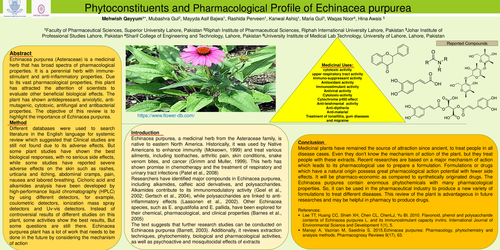
Phytoconstituents and Pharmacological Profile of Echinacea purpurae
Poster Presenter
Authors
Affiliations
Part of Topic
Good health and well-being
Phytoconstituents and Pharmacological Profile of Echinacea purpurea
Abstract:Echinacea purpurea (Asteraceae) is a medicinal herb that has broad spectra of pharmacological properties. It is a perennial herb with immune-stimulant and anti-inflammatory properties. Due to its vast pharmacological properties, this plant has attracted the attention of scientists to evaluate other beneficial biological effects. The plant has shown antidepressant, anxiolytic, anti-mutagenic, cytotoxic, antifungal and antibacterial properties. The objective of this review is to highlight the importance of Echinacea purpurea.
Method:Different databases were used to search literature in the English language for systemic review which suggested that Clinical studies are still not found due to its adverse effects. But some plant studies have shown the best biological responses, with no serious side effects, while some studies have reported severe adverse effects on the skin such as rashes, urticaria and itching, abdominal cramps, pain, nausea and labored breathing. Cichoric acid and alkamides analysis have been developed by high-performance liquid chromatography (HPLC) by using different detectors, for example, coulometric detectors, ionization mass spray detectors and Uv-vis detectors. Instead of controversial results of different studies on this plant, some activities show the best results, But some questions are still there. Echinacea purpurea plant has a lot of work that needs to be done in the future by considering the mechanism of action.
Introduction:Echinacea purpurea, a medicinal herb from the Asteraceae family, is native to eastern North America. Historically, it was used by Native Americans to enhance immunity (Mckeown, 1999) and treat various ailments, including toothaches, arthritic pain, skin conditions, snake venom bites, and cancer (Grimm and Muller, 1999). This herb has shown promise in chemotherapy and the treatment of respiratory and urinary tract infections (Patel et al., 2008)Researchers have identified major compounds in Echinacea purpurea, including alkamides, caffeic acid derivatives, and polysaccharides. Alkamides contribute to its immunomodulatory activity (Goel et al., 2002; Gertsch et al., 2004), while polysaccharides are linked to anti-inflammatory effects (Laasonen et al., 2002). Other Echinacea species, such as E. angustifolia and E. pallida, have been explored for their chemical, pharmacological, and clinical properties (Barnes et al., 2005).The text suggests that further research studies can be conducted on Echinacea purpurea (Barrett, 2003). Additionally, it reviews extraction techniques, phytochemistry, biological and pharmacological activities, as well as psychoactive and mosquitocidal effects of extracts.
Conclusion
Medicinal plants have remained the source of attraction since ancient, to treat people in all disease cases. Even they don’t know the mechanism of action of the plant, but they treat people with these extracts. Recent researches are based on a major mechanism of action which leads to its pharmacological use to prepare a formulation. Formulations or drugs which have a natural origin possess great pharmacological action potential with fewer side effects. It will be pharmaco-economic as compared to synthetically originated drugs. The Echinacea purpurea contain enormous phytochemicals with many pharmacological properties. So, it can be used in the pharmaceutical industry to produce a new variety of formulations to treat different diseases. This review of the plant is advantageous in future researches and may be helpful in pharmacy to produce drugs