253 posters, 14 videos, 27 audios, 14 topics, 392 authors, 132 institutions
ePostersLive by SciGen Technologies S.A. All rights reserved.
4th Commonwealth Chemistry Posters
October 4 - 5, 2023 | Online, United Kingdom

P130
Biophysical methodologies used to assess the aggregation, phosphorylation, and antibody inhibition mechanisms of ALS-associated protein, TDP-43
Poster Presenter
Authors
Affiliations
Part of Topic
Good health and well-being
Biophysical methodologies used to assess the aggregation, phosphorylation, and antibody inhibition mechanisms of ALS-associated protein, TDP-43
Josephine Esposto1, Robert J. Huber3, Sanela Martic1,2
1Department of Forensic Sciences, Trent University, Peterborough, ON
2Department of Environmental and Life Sciences, Trent University, Peterborough, ON
3Department of Biology, Trent University, Peterborough, ON
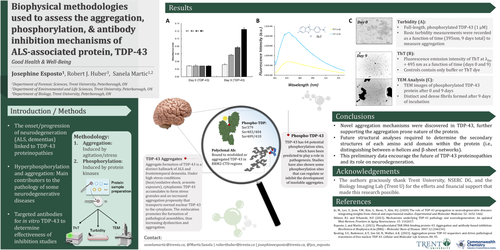
In several neurological diseases, the onset and progression of degeneration has been linked to TDP-43 proteinopathy, specifically protein aggregation and post-translational modifications. Hyperphosphorylation and aggregation of the protein have been shown to contribute to the pathology in vivo, suggesting that the inhibition of these mechanisms could be a viable therapeutic target. Pertinent research has only discovered a superficial understanding of the aggregation mechanisms of TDP-43, thus providing us with a critical knowledge gap in the functionality and structural composition of the protein. Using various biochemical and biophysical techniques to analyze the aggregates formed in vitro, phosphorylated, full-length TDP-43 was shown to aggregate under agitated, temperature-controlled environments that resulted in protein fibrils. The proteins were analyzed via Thioflavin T (ThT) fluorescence assays to monitor β-sheet formation, transmission electron microscopy (TEM) for visualization of the structural morphologies of TDP-43 aggregates, and turbidity measurements. When incubated with antibodies specific to epitopes (RRM2-CTD domain), a significant reduction in the formation of insoluble aggregates was observed at a low antibody. The outcomes of the inhibition were highly dependent on the type of protein and antibodies used when compared to negative controls of anti-SOD and anti-tau antibodies that demonstrated no binding to TDP-43. Further studies are necessary to confirm the exact binding mechanism of the polyclonal antibodies but provides a preliminary pathway for immunotherapies as a viable treatment for TDP-43 proteinopathies.