253 posters, 14 videos, 27 audios, 14 topics, 392 authors, 132 institutions
ePostersLive by SciGen Technologies S.A. All rights reserved.
4th Commonwealth Chemistry Posters
October 4 - 5, 2023 | Online, United Kingdom

P128
Phytochemical screening and gram-negative antibacterial activity of carica papaya leaves extracts
Poster Presenter
Authors
Part of Topic
Good health and well-being
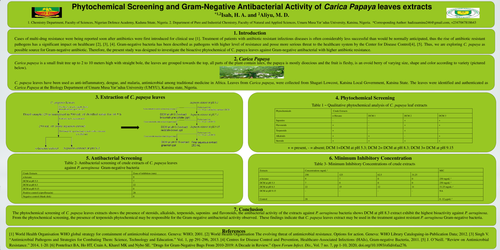
Phytochemical Screening and Gram-Negative Antibacterial Activity of Carica Papaya leaves extracts
*1,2Isah, H. A. and 2Aliyu, M. D.
1. Chemistry Department, Faculty of Sciences, Nigerian Defence Academy, Kaduna Sttate, Nigeria. 2. Department of Pure and Industrial Chemistry, Faculty of Natural and Applied Sciences, Umaru Musa Yar’adua University, Katsina, Nigeria. *Corresponding Author: hadizaaminu246@gmail.com, +2347047818643
1. Introduction
Cases of multi-drug resistance were being reported soon after antibiotics were first introduced for clinical use [1]. Treatment of patients with antibiotic resistant infectious diseases is often considerably less successful than would be normally anticipated, thus the rise of antibiotic resistant pathogens has a significant impact on healthcare [2], [3], [4]. Gram-negative bacteria has been described as pathogens with higher level of resistance and posse more serious threat to the healthcare system by the Center for Disease Control[4], [5]. Thus, we are exploring C. papaya as possible source for Gram-negative antibiotic. Therefore, the present study was designed to investigate the bioactive phytochemical of C. papaya leaves against Gram-negative antibacterial with higher antibiotic resistance.
2. Carica Papaya
Carica papaya is a small fruit tree up to 2 to 10 meters high with straight bole, the leaves are grouped towards the top, all parts of the plant contain latex, the papaya is mostly dioecious and the fruit is fleshy, is an ovoid berry of varying size, shape and color according to variety (pictured below).
C. papaya leaves have been used as anti-inflammatory, dengue, and malaria, antimicrobial among traditional medicine in Africa. Leaves from Carica papaya, were collected from Shagari Lowcost, Katsina Local Government, Katsina State. The leaves were identified and authenticated as Carica Papaya at the Biology Department of Umaru Musa Yar’adua University (UMYU), Katsina state, Nigeria.
7. Conclusion
The phytochemical screening of C. papaya leaves extracts shows the presence of steroids, alkaloids, terpenoids, saponins and flavonoids, the antibacterial activity of the extracts against P. aeruginosa bacteria shows DCM at pH 8.3 extract exhibit the highest bioactivity against P. aeruginosa. From the phytochemical screening, the presence of terpenoids phytochemical may be responsible for the Gram-negative antibacterial activity observed. These findings indicate that C. papaya leaves extract may be used in the treatment against resistant P. aeruginosa Gram-negative bacteria.
References
[1] World Health Organisation WHO global strategy for containment of antimicrobial resistance. Geneva: WHO; 2001. [2] World Health Organisation The evolving threat of antimicrobial resistance. Options for action. Geneva: WHO Library Cataloguing-in-Publication Data; 2012. [3] Singh V. “Antimicrobial Pathogens and Strategies for Combating Them: Science, Technology and Education.” Vol. 1, pp 291-296, 2013. [4] Centres for Disease Control and Prevention, Healthcare-Associated Infections (HAIs), Gram-negative Bacteria, 2011. [5] J. O’Neill. “Review on Antimicrobial Resistance.” 2014, 1-20. [6] Pontefract BA, Ho HT, Crain A, Kharel MK and Nybo SE. “Drugs for Gram-Negative Bugs From 2010-2019: A Decade in Review.” Open Forum Infect. Dis., Vol. 7 no. 7, pp 1-10, 2020, doi.org/10.1093/ofid/ofaa276.