253 posters, 14 videos, 27 audios, 14 topics, 392 authors, 132 institutions
ePostersLive by SciGen Technologies S.A. All rights reserved.
4th Commonwealth Chemistry Posters
October 4 - 5, 2023 | Online, United Kingdom

P126
Synthesis, crystal structure, and in silico docking for colon cancer of aryl sulfonamide Schiff bases
Poster Presenter
Authors
Affiliations
Part of Topic
Good health and well-being
SYNTHESIS, CRYSTAL STRUCTURE AND IN-SILICO ANTICOLON CANCER STUDY OF ARYL SULFONAMIDE SCHIFF BASES
Sherif O. Kolade, Oluwafemi S. Aina, Olayinka T. Asekun , Idiris A. Olasupo, Adeniyi S. Ogunlaja and Oluwole B. Familoni*
Department of Chemistry, University of Lagos, Akoka, Lagos, Nigeria
Introduction
Colon cancer, abnormal proliferation of colon cell, is a major global cause of cancer-related deaths1, highlighting the urgent need for innovative treatments. Schiff bases, with their versatile chemical properties, are promising candidates for developing new anticancer agents. Sulphonamide-derived Schiff bases have garnered attention for their broad spectrum of applications, including corrosion inhibitors2, antimicrobial3, antifungal4, and anticancer agents5.The aforementioned attributes of the sulphonamide Schiff bases are primarily relying on nitrogen, oxygen, and sulfur atoms present in the molecules6. This research project aims to synthesize and analyze aryl sulfonamide Schiff bases, with a focus on their crystal structures and in-silico evaluation for colon cancer treatment.
Abstract
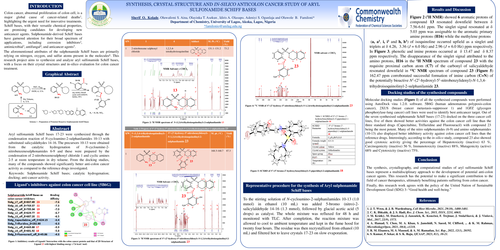
Aryl sulfonamide Schiff bases 17-23 were synthesized through the condensation reaction of N-cycloamino-2-sulphanilamides 10-13 with substituted salicyaldehydes 14-16. The precursors 10-13 were obtained from the catalytic hydrogenation of N-cycloamine-2-nitrobenzenesulphonamides 6-9 and these were prepared by the condensation of 2-nitrobenzenesulphonyl chloride 1 and cyclic amines 2-5 at room temperature in dry toluene. From the docking studies, many of the compounds showed significantly better anti-colon cancer activity as compared to the reference drugs investigated.
Keywords: Sulphonamide Schiff bases; catalytic hydrogenation; docking; anti-cancer activity.
Representative procedure for the synthesis of Aryl sulphonamide Schiff bases
To the stirring solution of N-cycloamino-2-sulphanilamides 10-13 (1.0 mmol) in ethanol (10 mL) was added 5-bromo (nitro)-2-salicylaldehyde 14-16 (1.3 mmol), followed by glacial acetic acid (5 drops) as catalyst. The whole mixture was refluxed for 48 h and monitored with TLC. After completion, the reaction mixture was allowed to cool to ambient temperature and kept in the fume hood for twenty four hours. The residue was then recrystallized from ethanol (10 mL) and filtered hot to leave crystals 17-23 on slow evaporation.
Results and Discussion
Figure 2 (1H NMR) showed 6 aromatic protons of compound 13 resonated downfield between δ 7.56-6.61 ppm. The singlet signal resonated at δ 5.03 ppm was assignable to the aromatic primary amine protons (H16) while the methylene protons (a, a1, i, i1 and h, h1) of isoquinoline occurred upfield as a singlet and triplets at δ 4.26, 3.36 (J = 6.0 Hz) and 2.96 (J = 6.0 Hz) ppm respectively. In Figure 3, phenolic and imine protons occurred at δ 13.47 and δ 8.37 ppm respectively. The disappearance of the singlet signal attributed to the amino protons, H16 in the 1H NMR spectrum of compound 23 with the requisite proximal carbon atom (C7) of the carbonyl of salicyaldehyde resonated downfield in 13C NMR spectrum of compound 23 (Figure 5) 162.47 ppm corroborated successful formation of imine carbon (C=N) of the potentially bioactive N1-(21-hydroxyl-51-nitrobenzylidenyl)-N-1,3,4-trihydroisoquinolinyl-2-sulphanilamide 23.
Docking studies of the synthesised compounds
Molecular docking studies (Figure 1) of all the synthesised compounds were performed using AutoDock vina 1.2.0. software. 5B6G (human adenomatous polyposis-colon cancer), 2XUS (breast cancer metastasis-suppressor 1) and 1GFZ (glycogen phosphorylase-lung cancer) cell lines were used to identify best anticancer target. Out of the seven synthesised sulphonamde Schiff bases (17-23) docked on the three cancer cell lines, five of them showed better activities against the colon cancer cell line than the three standard drugs (Capecitabine, Trifluridine and Fluorouracil) with compound 23 being the most potent. Many of the nitro sulphonamides (6-9) and amino sulphonamides (10-13) also displayed better inhibitory activity against colon cancer cell lines than the reference drugs. Interestingly, according to the in-silico study, compound 23 also showed good cytotoxic activity giving the percentage of Hepatotoxicity (inactive) 63 %, Carcinogenicity (inactive) 56 %, Immunotoxicity (inactive) 88%, Mutagenicity (active) 68% and Cytotoxicity (inactive) 75%.
Conclusion
The synthesis, crystallography, and computational studies of aryl sulfonamide Schiff bases represent a multidisciplinary approach to the development of potential anti-colon cancer agents. This research has the potential to make a significant contribution to the field of cancer therapeutics, ultimately benefiting patients suffering from colon cancer.
Finally, this research work agrees with the policy of the United Nation of Sustainable Development Goal (SDG) 3–“Good health and well-being.”
References
1. J. T. Wren, & J. B. Wardenburg, Cell Host Microbe, 2021, 29(10), 1480-1481.
2. C. K. Bhkahk, & J. S. Hadi, Res. J. Chem. Sci., 2015, ISSN, 2231, 606X.
3. M. Krátký, M. Dzurková, J. Janoušek, K. Konečná, F. Trejtnar, J. Stolaříková, & J. Vinšová, Mol., 2017, 22(9), 1573.
4. A. Hamad, Y. Chen, M. A. Khan, S. Jamshidi, N. Saeed, M. Clifford, ... & K. M. Rahman, MicrobiologyOpen, 2021, 10(4), e1218.
5. R. M. Elsamra, M. S. Masoud, & A. M. Ramadan, Sci. Rep., 2022, 12(1), 20192.
6. S. Kumar, P. Sekar, & S. K. Raju, IJCAAP, 2023, 8(1), 10-21.