253 posters, 14 videos, 27 audios, 14 topics, 392 authors, 132 institutions
ePostersLive by SciGen Technologies S.A. All rights reserved.
4th Commonwealth Chemistry Posters
October 4 - 5, 2023 | Online, United Kingdom

P116
Variations in the Beta- carotene content of Blighia sapida under various processing methods
Poster Presenter
Authors
Affiliations
Part of Topic
Good health and well-being
Variation in the β-Carotene Content of BlighiasapidaUnder Various Processing Methods.
Debbie Ann Phillips and Andrea Goldson-Barnaby
The University of the West Indies, Mona, The Department of Chemistry
Faculty of Science & Technology
Email: debbieann.phillips89@gmail.com
Abstract
Blighia sapida, also known as ackee, is a fruit originating from West Africa and is widely consumed in Jamaica. After harvesting, the edible arilli is separated from the seed and pod. The arilli is then blanched and sautéed with codfish. The impact of various processing methods (uncooked, cooked, uncooked frozen, cooked frozen, and canned) on the beta-carotene content of the arilli was measured using a spectroscopic assay. The findings revealed a strong relationship between processing method and beta-carotene concentration. Canned ackee had the highest beta- carotene content (1.126 ppm). This is likely due to high temperature processing breaking down cellular structures and releasing beta-carotene. Uncooked arilli had the lowest beta-carotene content (0.507 ppm). Temperature was a significant factor impacting beta-carotene concentration suggesting that processing methods play a crucial role in shaping the nutritional composition of Blighia sapida arilli.
Introduction
Beta-carotene, a naturally occurring carotenoid pigment, is well-known for its essential role as a precursor to vitamin A and its potent antioxidant properties (Goindi, et.al, 2016). As a result, it is highly regarded for its significance in human health and nutrition. The determination of beta-carotene content in various food products is of great interest, especially given the diverse methods of food processing and their potential impact on nutrient retention. This research paper explores the beta carotene content in the Blighia sapida fruit utilizing UV spectrophotometry (473 nm) (Putri and Yetti, 2021). The concentration of beta-carotene in ackee samples subjected to different processing methods (uncooked frozen, cooked frozen, cooked, uncooked, and canned) was evaluated. The diverse processing methods applied to food products can significantly influence the retention and availability of beta-carotene. By examining these food processing techniques, we seek to provide valuable insights into how different processing techniques impact the beta-carotene content in ackee. Such insights are critical for both consumers and the food industry, as they inform choices that may help preserve the nutritional value of foods throughout processing. This research contributes to our understanding of beta-carotene extraction and analysis methods while shedding light on the effects of food processing on this vital nutrient. Ultimately, it aids in the development of strategies to maximize the retention of beta-carotene in processed foods, promoting better nutrition and overall health.
Materials and Method
Samples were analyzed in triplicate..
Discussion
This study evaluated the beta-carotene content of ackees produced utilizing various food processing methods. The study presents interesting insights into the effect of these processing techniques on beta-carotene retention. The choice of solvent (acetone with the addition of BHT), is a crucial factor in beta-carotene extraction. BHT, a synthetic antioxidant, is employed to prevent the degradation of carotenoids during the extraction process, thereby ensuring the accuracy and reliability of results.
Beta-Carotene Concentration
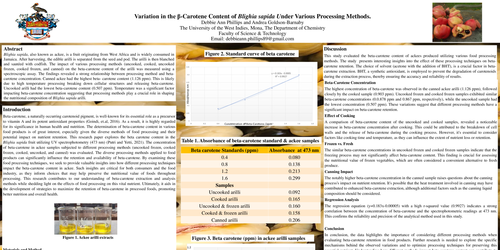
The highest concentration of beta-carotene was observed in the canned ackee arilli (1.126 ppm), followed closely by the cooked sample (0.903 ppm). Uncooked frozen and cooked frozen samples exhibited similar beta-carotene concentrations (0.0.878 ppm and 0.867 ppm, respectively), while the uncooked sample had the lowest concentration (0.507 ppm). These variations suggest that different processing methods have a significant impact on beta-carotene retention.
Effect of Cooking
A comparison of beta-carotene content of the uncooked and cooked samples, revealed a noticeable increase in beta-carotene concentration after cooking. This could be attributed to the breakdown of cell walls and the release of beta-carotene during the cooking process. However, it's essential to consider factors like cooking time and temperature, as they can influence the extent of nutrient loss or retention.
Frozen vs. Fresh
The similar beta-carotene concentrations in uncooked frozen and cooked frozen samples indicate that the freezing process may not significantly affect beta-carotene content. This finding is crucial for assessing the nutritional value of frozen vegetables, which are often considered a convenient alternative to fresh produce.
Canning Impact
The notably higher beta-carotene concentration in the canned sample raises questions about the canning process's impact on nutrient retention. It's possible that the heat treatment involved in canning may have contributed to enhanced beta-carotene extraction, although additional factors such as the canning liquid composition should be considered.
Regression Analysis
The regression equation (y=0.183x-0.00005) with a high r-squared value (0.9927) indicates a strong correlation between the concentration of beta-carotene and the spectrophotometric readings at 473 nm. This confirms the reliability and precision of the analytical method used in this study.
Conclusion
In conclusion, the data highlights the importance of considering different processing methods when evaluating beta-carotene retention in food products. Further research is needed to explore the specific mechanisms behind the observed variations and to optimize processing techniques for preserving this essential nutrient. Understanding how different methods impact beta-carotene content can contribute to improved dietary recommendations and food processing practices, ultimately benefiting public health.
References
Anu; Hopia, I.; Heikki, J.; Kalevi Pihlaja; Tytti, S.; Kujala, M. Antioxidant Activity of Plant Extracts Containing Phenolic Compounds Marja P. Ka Hko Nen.
Analysis of β-Carotene Content in Plants Using Some Methods: A Review of Current Research Ainia Putri; Rina Desni Yetti, Rusdi.
Ahamad, M. N.; Saleemullah, M.; Shah, H. U.; Khalil, I. A.; Saljoqi, A. U. R. In fresh vegetables using high performance. Edu.pk. https://www.aup.edu.pk/sj_pdf/DETERMINATION%20OF%20BETA%20CAROTENE%20CONTENT.pdf
Karnjanawipagul, P.; Nittayanuntawech, W.; Rojsanga, P.; Suntornsuk, L. Analysis of b-carotene in carrot by spectrophotometry. Mahidol.ac.th. https://pharmacy.mahidol.ac.th/journal/_files/2010.08-16.pdf
Putri, A.; Yetti, R. D. Analysis of β-Carotene Content in Plants Using Some Methods: A Review of Current Research. https://doi.org/10.35629/7781-0601480489.