253 posters, 14 videos, 27 audios, 14 topics, 392 authors, 132 institutions
ePostersLive by SciGen Technologies S.A. All rights reserved.
4th Commonwealth Chemistry Posters
October 4 - 5, 2023 | Online, United Kingdom

P109
Exploring Solvent Effect on Chemical Profile and Invitro Anti plasmodial Activity of Root Extracts of an Under Explored African Plant; Triplochiton scleroxylon
Poster Presenter
Authors
Part of Topic
Good health and well-being
Exploring Solvent Effect on Chemical Profile and Invitro Anti- plasmodial Activity of Root Extracts of an Under Explored African Plant; Triplochiton scleroxylon
Yahaya Yakubu1*, Gabi Baba2, Lateefa Mustafa Sulaiman1, Zakariyya Jibril1, Radiatu Jibril1, Firdausi Bello1, Idris Abdullahi3
1 Department of Pure and Applied Chemistry, Faculty of Physical Sciences, Kaduna State University
2 Department of Biochemistry, Faculty of Life Sciences, Kaduna State University
3 Department of Pharmaceuticals and Medicinal Chemistry, Faculty of Pharmaceutical Science, Kaduna State University
*Corresponding author email: bbmobly@yahoo.com
Introduction
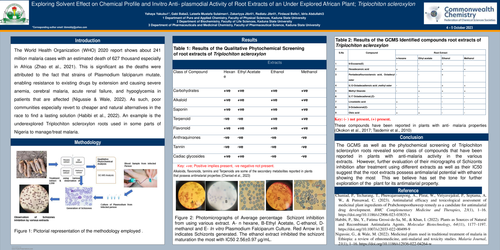
The World Health Organization (WHO) 2020 report shows about 241 million malaria cases with an estimated death of 627 thousand especially in Africa (Zhao et al., 2021). This is significant as the deaths were attributed to the fact that strains of Plasmodium falciparum mutate, enabling resistance to existing drugs by extension and causing severe anemia, cerebral malaria, acute renal failure, and hypoglycemia in patients that are affected (Nigussie & Wale, 2022). As such, poor communities especially revert to cheaper and natural alternatives in the race to find a lasting solution (Habibi et al., 2022). An example is the underexplored Triplochiton scleroxylon roots used in some parts of Nigeria to manage/treat malaria.
Conclussion
The GCMS as well as the phytochemical screening of Triplochiton scleroxylon roots revealed some class of compounds that have been reported in plants with anti-malaria activity in the various extracts. However, further evaluation of their micrographs of Schizonts inhibition after treatment using different extracts as well as their IC50 suggest that the root extracts possess antimalarial potential with ethanol showing the most This we believe has set the tone for further exploration of the plant for its antimalarial property