11 posters, 7 topics, 32 authors, 14 institutions
ePostersLive by SciGen Technologies S.A. All rights reserved.
Clinical Radiology Quality Improvement ePoster Competition 2024
22 NOVEMBER, 2024 | LONDON, UK
62
Quality improvement project to improve the quality of clinical context in chest X-ray requests
Poster Presenter
Authors
Affiliations
Part of Topic
Appropriateness of referral
Quality Improvement Project to Improve the Clinical Context in Chest X-Ray Requests
Authors: Dr Vaishnav Prakash1 & Dr Shemir Sha Salim2
Background:
Chest X-ray (CXR) is the most requested imaging procedure in the UK, with millions performed annually, estimated at around 8.6 million in 2019. Incomplete or poorly detailed CXR requests can hinder the radiologist's ability to provide specific and accurate interpretations, which may lead to less effective patient care. Providing detailed clinical context in the requests ensures more precise and relevant diagnoses from radiologists. This project was done within the Community Rapid Response Team (CRT) at St Woolos Hospital, Newport, which focuses on managing acutely unwell elderly and frail patients in the community to avoid hospital admissions.
Methods:
We raised the team's awareness on the importance of appropriately detailed CXR requests through discussions. The Plan-Do-Study-Act (PDSA) methodology of quality improvement was used for this project. Baseline data was collected for the first 20 CXR requests prior to May 2024 from electronic records. These data were analysed for completeness, clarity, and relevance of clinical information provided.
Intervention:
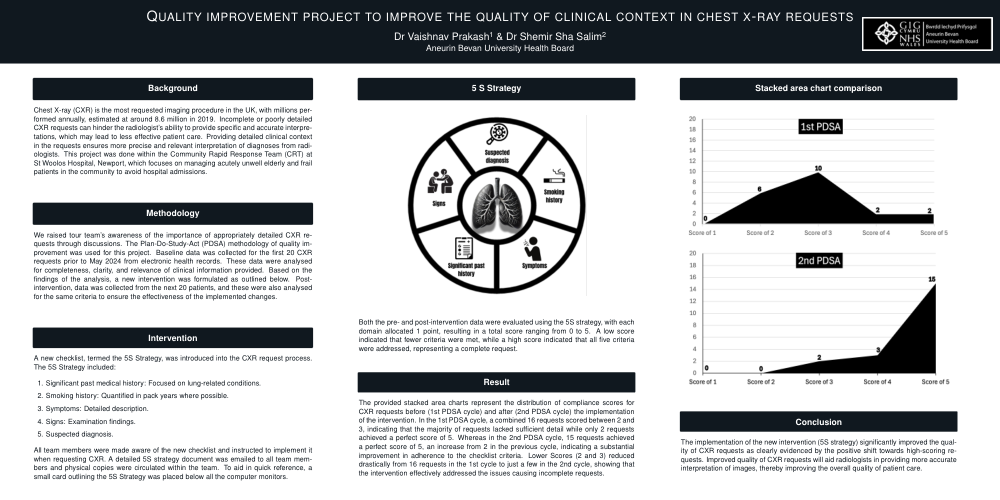
A new checklist, termed the 5S Strategy, was introduced into the CXR request process. The 5S Strategy includes:
- Significant past medical history: Focused on lung-related conditions
- Smoking history: Quantified in pack years where possible
- Symptoms: Detailed description
- Signs: Examination findings
- Suspected diagnosis
All team members were made aware of the new checklist and instructed to implement it when requesting CXR. A detailed 5S strategy document was emailed to all team members and physical laminated copies were circulated within the team. To aid in quick reference, a small card outlining the 5S Strategy was placed below all the computer monitors.
Results:
Data was collected from 20 patients’ post-implementation of the intervention. Both the pre- and post-intervention data were evaluated using the 5S strategy, with each domain allocated 1 point, resulting in a total score ranging from 0 to 5. A low score indicated that fewer criteria were met, while a high score indicated that all five criteria were addressed, representing a complete request.
The provided stacked area charts represent the distribution of compliance scores for CXR requests before (1st PDSA cycle) and after (2nd PDSA cycle) the implementation of the intervention. In the 1st PDSA cycle, a combined 16 requests scored between 2 and 3, indicating that the majority of requests lacked sufficient detail and completeness while only 2 requests achieved a perfect score of 5. Whereas in the 2nd PDSA cycle, 15 requests achieved a perfect score of 5, an increase from 2 requests in the previous cycle, indicating a substantial improvement in adherence to the checklist criteria. Lower Scores (2 and 3) reduced drastically from 16 requests in the 1st cycle to just a few in the 2nd cycle, showing that the intervention effectively addressed the issues causing incomplete requests.
Conclusions:
The implementation of the new intervention significantly improved the quality of CXR requests as clearly evidenced by the positive shift towards high scoring requests. Improved quality of CXR requests will help the Radiologists towards providing more accurate interpretation of image, thereby improving the overall quality of patient care.