Loading...

11 posters, 7 topics, 32 authors, 14 institutions

ePostersLive by SciGen Technologies S.A. All rights reserved.

58

Compliance with NICE guidelines for pulmonary embolism assessment in a stable patient within A&E of a tertiary hospital.
Part of Topic

CT and PET-CT

LEARNING POINTS

-  Pulmonary embolism (PE) remains a critical and potentially life-threatening diagnosis in ED requiring immediate and thorough assessment to prevent adverse outcomes. The National Institute for Health and Care Excellence guidelines (NICE) recommend an algorithmic approach for PE investigations.
- Compliance with this guideline in a stable patient can help with avoiding exposure of stable patients to the hazards associated with ionising radiation of computed tomography pulmonary angiography (CTPA). 
 

INTRODUCTION

Acute pulmonary embolism often presents with variable signs and symptoms is a common clinical diagnosis in ED.  NICE guidelines recommend algorithmic steps to consider when suspecting PE in a haemodynamically stable patient. It lays out a structured clinical evaluation and incorporates Well’s score calculation before ordering CTPA.  Strict adherence to this algorithm ensures patient safety through timely diagnoses and protects stable patients from the risk of harm when being exposed to ionising radiation during PE workup. 

STUDY DESIGN 

To assess the adherence to NICE guidelines for PE assessment in our ED department, the Plan Do Study Act (PDSA) method of quality improvement was used. A retrospective review of patient medical records for 4 weeks was performed. 
§70 patients were identified who had CTPA scans in ED before intervention. 2-level Wells score documentation was reviewed, either in the clerking notes or the CTPA request forms. Finally, a modified Wells score was calculated for each patient, and the diagnostic approach was evaluated.
 

RESULTS

PRE-INTERVENTION

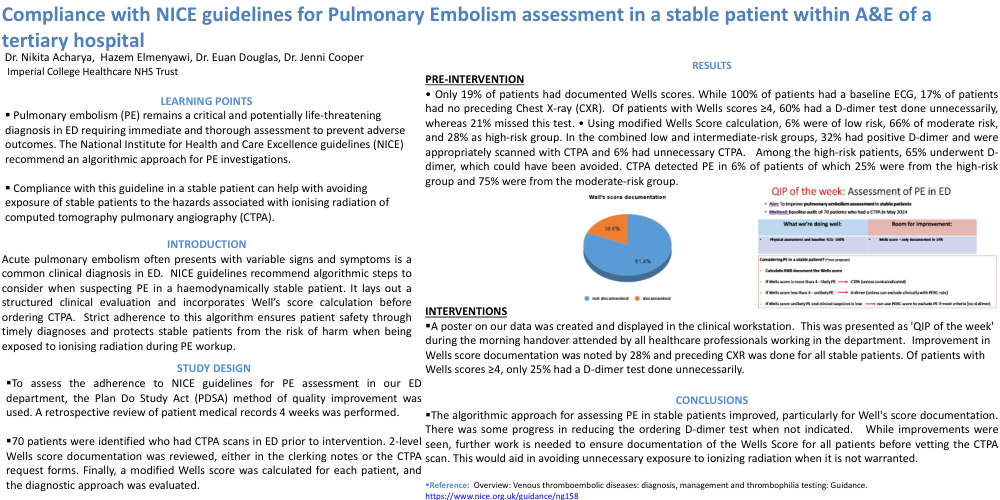
• Only 19% of patients had documented Wells scores. While 100% of patients had a baseline ECG, 17% of patients had no preceding Chest X-ray (CXR).  Of patients with Wells scores ≥4, 60% had a D-dimer test done unnecessarily, whereas 21% missed this test. • Using modified Wells Score calculation, 6% were of low risk, 66% of moderate risk, and 28% as high-risk group. In the combined low and intermediate-risk groups, 32% had positive D-dimer and were appropriately scanned with CTPA and 6% had unnecessary CTPA.   Among the high-risk patients, 65% underwent D-dimer, which could have been avoided. CTPA detected PE in 6% of patients of which 25% were from the high-risk group and 75% were from the moderate-risk group.

INTERVENTIONS

§A poster on our data was created and displayed in the clinical workstation.  This was presented as 'QIP of the week' during the morning handover attended by all healthcare professionals working in the department.  Improvement in Wells score documentation was noted by 28% and preceding CXR was done for all stable patients. Of patients with Wells scores ≥4, only 25% had a D-dimer test done unnecessarily. 
 

CONCLUSIONS

§The algorithmic approach for assessing PE in stable patients improved, particularly for Well's score documentation. There was some progress in reducing the ordering D-dimer test when not indicated.   While improvements were seen, further work is needed to ensure documentation of the Wells Score for all patients before vetting the CTPA scan. This would aid in avoiding unnecessary exposure to ionizing radiation when it is not warranted. 
Copyright © 2015-2026, ePostersLive® SciGen is a registered trademark of SciGen Technologies S.A. Patent pending.

This website and third-party tools we use rely on cookies for the best user experience. By selecting "I agree", you agree to cookie usage as described in our Privacy Policy.