11 posters, 7 topics, 32 authors, 14 institutions
ePostersLive by SciGen Technologies S.A. All rights reserved.
Clinical Radiology Quality Improvement ePoster Competition 2024
22 NOVEMBER, 2024 | LONDON, UK
52
Quality improvement project to reduce CT post-contrast acute kidney injury in the elderly frail population in the community
Poster Presenter
Part of Topic
Contrast
Quality Improvement Project to Reduce Post-Contrast Acute Kidney Injury in the Elderly Frail Population in the community
Authors: Dr Vaishnav Prakash1 & Dr Shemir Sha Salim2
Background:
Post-Contrast Acute Kidney Injury (PC-AKI) is a significant complication following the use of iodinated contrast media in computerised tomography (CT) procedures. The Community Rapid Response Team (CRT) at St Woolos Hospital focuses on managing acutely unwell elderly and frail patients in the community to avoid hospital admissions. This patient population often has reduced renal function, necessitating heightened caution when planning contrast-enhanced imaging. This Quality Improvement Project (QIP) aims to enhance the quality and safety of patient care by reducing the incidence of PC-AKI through more stringent risk assessments and monitoring.
Methods:
We improved the awareness of PC-AKI in the elderly within the team through discussions. The Plan-Do-Study-Act (PDSA) methodology of quality improvement was used for this project. Data was collected for the first 20 patients admitted under CRT since May 2023 from the medical records. This sample was selected to negate the seasonal temperature variations altering the hydration status of elderly patients. Data was based on previous renal disease, review of nephrotoxic medications, hydration protocols for pre- and post-contrast administration and monitoring of renal function to report PC-AKI cases.
Intervention:
A new checklist was introduced into the Comprehensive Geriatric Assessment (CGA) document to identify at-risk patients based on RCR-endorsed Royal Australian and New Zealand College of Radiologists’ (RANZCR) 2018 Iodinated Contrast Guidelines. The following were the checklists recommended once a contrast- enhanced CT was requested:
- A recent eGFR (within 7 days) was available for the patients.
- Looked into any known renal diseases.
- Checked if the patient had known Diabetes Mellitus.
- Metformin was held prior to the procedure.
- NSAIDs were held prior to the procedure.
- Looked for any signs of clinical dehydration.
- Ensured if the patient had Heart Failure with Reduced Ejection Fraction (HFrEF).
- The need for pre-procedure and post-procedure hydration was identified.
- Patient advice regarding hydration was implemented.
- The need for post-CT renal function monitoring was addressed and implemented.
Results:
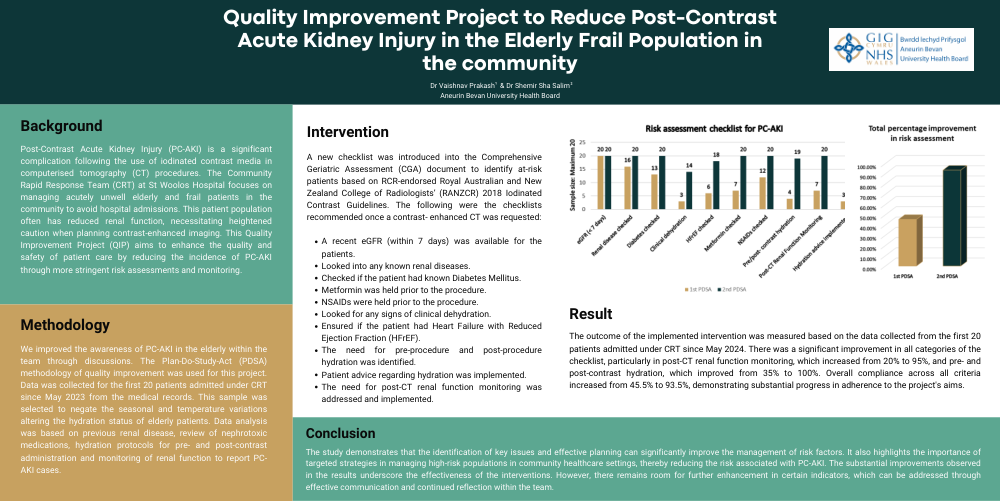
The outcome of the implemented intervention was measured based on the data collected from the first 20 patients admitted under CRT since May 2024. There was a significant improvement in all categories of the checklist, particularly in post-CT renal function monitoring, which increased from 20% to 95%, and pre- and post-contrast hydration, which improved from 35% to 100%. Overall compliance across all criteria increased from 45.5% to 93.5%, demonstrating substantial progress in adherence to the project's aims.
Conclusions:
The study demonstrated that the identification of key issues and effective planning can significantly improve the management of risk factors. It also highlights the importance of targeted strategies in managing high-risk populations in community healthcare settings, thereby reducing the risk associated with PC-AKI. The substantial improvements observed in the results underscore the effectiveness of the interventions. However, there remains room for further enhancement in certain indicators, which can be addressed through effective communication and continued reflection within the team.