11 posters, 7 topics, 32 authors, 14 institutions
ePostersLive by SciGen Technologies S.A. All rights reserved.
Clinical Radiology Quality Improvement ePoster Competition 2024
22 NOVEMBER, 2024 | LONDON, UK
41
The team huddle: Utilising a team communication and feedback platform for effective improvement of radiology department pregnancy check compliance in a district general hospital.
Poster Presenter
Authors
Affiliations
Part of Topic
Service quality
Huddle Up! Utilising a team communication and feedback platform for effective improvement of radiology
department pregnancy check compliance in a district general hospital
Local issue
Pregnancy check compliance is suboptimal due to
inconsistent and missing criteria demonstrated.
Background
Effective team communication and feedback is
linked to improved work performance. 1,2 One platform for this
is the team huddle; a regular, semi formal gathering of team
members for the purpose of relaying important information,
raising concerns, acknowledging good performance and
discussing improvements in practice etc. 3 The aim of this study
is to assess the effect on pregnancy check compliance when
relevant information and feedback is included as part of the
team huddle.
Pregnancy checks are an essential aspect of any radiology
department in ensuring the protection of an unborn foetus
from the potential harms of ionising radiation. 4,5 It is not only
important that checks are made on all appropriate patients for
all appropriate radiological examinations, but that they are
also accurately recorded and stored for future reference,
whether that be for audit or legal purposes
Morning team huddles have been a comparatively new
addition to our imaging department’s routine, where
previously information was distributed primarily by e mail or
at formal audit and radiographer meetings.
Methods
Using the integrated statistical software of the computerised radiology information solution (CRIS), data
were collected on a monthly basis to return all patient examinations applicable for pregnancy check performance.
Baseline data were collected for two calendar months prior to intervention, which commenced at the beginning of
March 2024. Non compliance with local Employer’s Procedures was measured and stratified into causes and by area
of department (i.e. A&E x ray, General x ray). Once ready, the results were relayed at the next team huddle and
subsequent 1 2 huddles to allow for variation in staffing each day. Infographic results for the current month were
displayed in a common work area alongside the previous month’s results to help visualise progress.
Intervention
Verbal and infographic feedback of performance at team huddles. This included highlighting aspects in
need of greatest improvement, advice on how to achieve this and reminders of the hospital protocols in regards to
pregnancy checking
Criteria
To achieve positive compliance, the
pregnancy check form had to:
1) Be scanned onto the CRIS system
2) Display three valid points of patient identification
3) Be signed by the patient
4) Be dated by the patient
5) Be signed by the radiographer
If any one of these conditions were not met, the check
was recorded as not compliant.
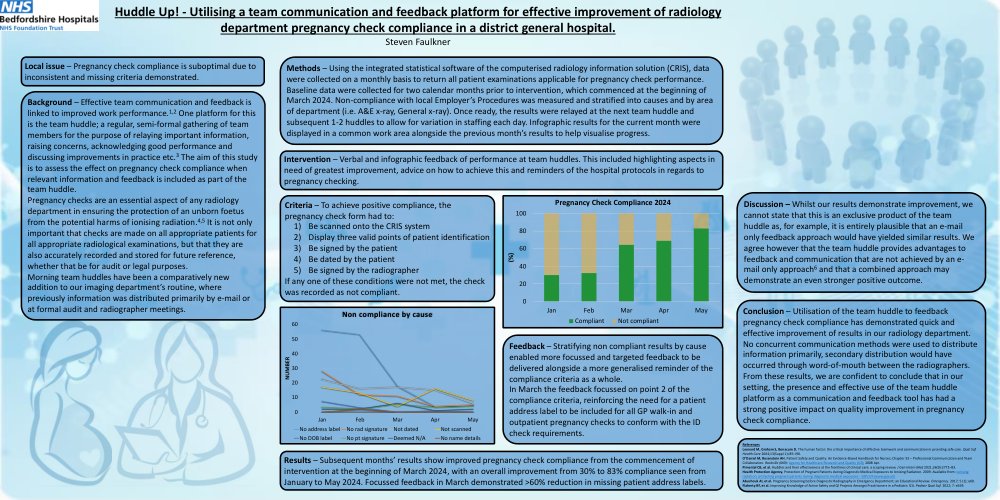
Feedback
Stratifying non compliant results by cause
enabled more focussed and targeted feedback to be
delivered alongside a more generalised reminder of the
compliance criteria as a whole.
In March the feedback focussed on point 2 of the
compliance criteria, reinforcing the need for a patient
address label to be included for all GP walk in and
outpatient pregnancy checks to conform with the ID
check requirements.
Results
Subsequent months’ results show improved pregnancy check compliance from the commencement of
intervention at the beginning of March 2024, with an overall improvement from 30% to 83% compliance seen from
January to May 2024 . Focussed feedback in March demonstrated >60% reduction in missing patient address
Discussion
Whilst our results demonstrate improvement, we
cannot state that this is an exclusive product of the team
huddle as, for example, it is entirely plausible that an e mail
only feedback approach would have yielded similar results. We
agree however that the team huddle provides advantages to
feedback and communication that are not achieved by an e
mail only approach 6 and that a combined approach may
demonstrate an even stronger positive outcome.
Conclusion
Utilisation of the team huddle to feedback
pregnancy check compliance has demonstrated quick and
effective improvement of results in our radiology department.
No concurrent communication methods were used to distribute
information primarily, secondary distribution would have
occurred through word of mouth between the radiographers.
From these results, we are confident to conclude that in our
setting, the presence and effective use of the team huddle
platform as a communication and feedback tool has had a
strong positive impact on quality improvement in pregnancy
check compliance.