11 posters, 7 topics, 32 authors, 14 institutions
ePostersLive by SciGen Technologies S.A. All rights reserved.
Clinical Radiology Quality Improvement ePoster Competition 2024
22 NOVEMBER, 2024 | LONDON, UK
35
Extended Trauma CT Head Coverage – Are we detecting cervical spine fractures or just increasing the radiation exposure?
Poster Presenter
Authors
Affiliations
Part of Topic
Radiation dose/IR(ME)R
Extended Trauma CT Head Coverage – Are we detecting cervical spine fractures or just increasing the radiation exposure?
Background
As the frequency of CT head acquisitions in the context of minor trauma rises, patients are increasingly likely to undergo multiple scans in their lifetime. The resulting cumulative radiation exposure is a clear concern. As a result we have an ever increasing responsibility to reconcile dose, exposure risk and clinical benefit.
It was recently flagged that our busy District General Hospital had a higher median Dose Length Product (DLP) for CT head scans than other comparable sites. While there are many contributing factors, one possibility suggested was the extension of CT head acquisitions to cover the upper cervical spine due to historical concerns over occult spinal fractures not being detected.
Methods
All trauma CT head scans referred from our Emergency Department between 1st April – 31st May 2023 were reviewed and the DLP for all studies collated. All duplicate scans were removed. Cervical fractures and the coverage of each scan was recorded. The 2nd cycle involved repeating the same process over a 2 week period (1st – 14th May 2024).
Intervention
We presented our results at a departmental meeting and all involved agreed that the inferior extent of a CT head should be limited to the skull base. Local protocols were updated and disseminated over a couple of months with departmental teaching, prior to a second cycle review.
Results
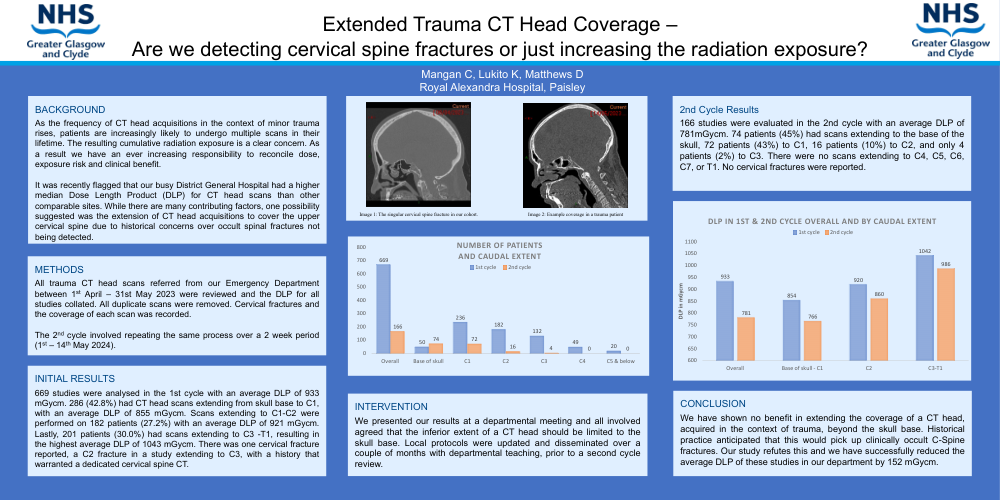
1st cycle: 669 studies were analysed in the 1st cycle with an average DLP of 933 mGycm. 286 (42.8%) had CT head scans extending from skull base to C1, with an average DLP of 855 mGycm. Scans extending to C1-C2 were performed on 182 patients (27.2%) with an average DLP of 921 mGycm. Lastly, 201 patients (30.0%) had scans extending to C3 -T1, resulting in the highest average DLP of 1043 mGycm. There was one cervical fracture reported, a C2 fracture in a study extending to C3, with a history that warranted a dedicated cervical spine CT.
2nd cycle: 166 studies were evaluated in the 2nd cycle with an average DLP of 781mGycm. 74 patients (45%) had scans extending to the base of the skull, 72 patients (43%) to C1, 16 patients (10%) to C2, and only 4 patients (2%) to C3. There were no scans extending to C4, C5, C6, C7, or T1. No cervical fractures were reported.
Conclusion
We have shown no benefit in extending the coverage of a CT head, acquired in the context of trauma, beyond the skull base. Historical practice anticipated that this would pick up clinically occult C-Spine fractures. Our study refutes this and we have successfully reduced the average DLP of these studies in our department by 152 mGycm.