16 posters, 11 topics, 56 authors, 21 institutions
ePostersLive by SciGen Technologies S.A. All rights reserved.
Clinical Radiology Audit ePoster Competition 2024
22 NOVEMBER, 2024 | LONDON, UK
95
Audit of CT aortogram yield in evaluation of suspected Acute Aortic Syndrome
Poster Presenter
Authors
Nikhil Nair, Geethu Punnen, Huma Khosa, Neelam Saleem, Mohd Shadab Siddique
Affiliations
Part of Topic
General
Audit of CT aortogram yield in evaluation of suspected Acute Aortic Syndrome
INTRODUCTION AND AIM
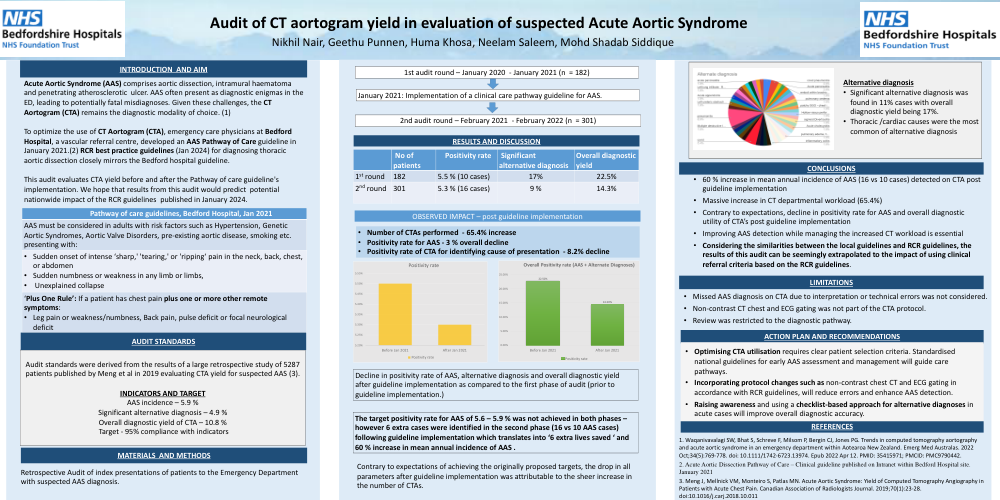
Acute Aortic Syndrome (AAS) comprises aortic dissection, intramural haematoma and penetrating atherosclerotic ulcer. AAS often present as diagnostic enigmas in the ED, leading to potentially fatal misdiagnoses. Given these challenges, the CT Aortogram (CTA) remains the diagnostic modality of choice. (1)
To optimize the use of CT Aortogram (CTA), emergency care physicians at Bedford Hospital, a vascular referral centre, developed an AAS Pathway of Care guideline in January 2021.(2) RCR best practice guidelines (Jan 2024) for diagnosing thoracic aortic dissection closely mirrors the Bedford hospital guideline.
This audit evaluates CTA yield before and after the Pathway of care guideline's implementation. We hope that results from this audit would predict potential nationwide impact of the RCR guidelines published in January 2024.
Pathway of care guidelines, Bedford Hospital, Jan 2021
AAS must be considered in adults with risk factors such as Hypertension, Genetic Aortic Syndromes, Aortic Valve Disorders, pre-existing aortic disease, smoking etc. presenting with:
Sudden onset of intense ‘sharp,' 'tearing,' or 'ripping,'pain in the neck, back, chest, or abdomen
Sudden numbness or weakness in any limb or limbs,
Unexplained collapse
Plus One Rule’: If a patient has chest pain plus one or more other remote symptoms:
Audit standards were derived from the results of a large retrospective study of 5287 patients published by Meng et al in 2019 evaluating CTA yield for suspected AAS (3).
INDICATORS AND TARGET
AAS incidence – 5.9 %
Significant alternative diagnosis – 4.9 %
Overall diagnostic yield of CTA – 10.8 %
Target - 95% compliance with indicators
MATERIALS AND METHODS
Retrospective Audit of index presentations of patients to the Emergency Department with suspected AAS diagnosis.
RESULTS AND DISCUSSION
OBSERVED IMPACT – post guideline implementation
Decline in positivity rate of AAS, alternative diagnosis and overall diagnostic yield after guideline implementation as compared to the first phase of audit (prior to guideline implementation.)
The target positivity rate for AAS of 5.6 – 5.9 % was not achieved in both phases – however 6 extra cases were identified in the second phase (16 vs 10 AAS cases) following guideline implementation which translates into ‘6 extra lives saved ‘ and 60 % increase in mean annual incidence of AAS .
Contrary to expectations of achieving the originally proposed targets, the drop in all parameters after guideline implementation was attributable to the sheer increase in the number of CTAs.
Alternative diagnosis
CONCLUSIONS
LIMITATIONS
ACTION PLAN AND RECOMMENDATIONS
REFERENCES
Waqanivavalagi SW, Bhat S, Schreve F, Milsom P, Bergin CJ, Jones PG. Trends in computed tomography aortography and acute aortic syndrome in an emergency department within Aotearoa New Zealand. Emerg Med Australas. 2022 Oct;34(5):769-778. doi: 10.1111/1742-6723.13974. Epub 2022 Apr 12. PMID: 35415971; PMCID: PMC9790442.
2. Acute Aortic Dissection Pathway of Care – Clinical guideline published on Intranet within Bedford Hospital site. January 2021
3. Meng J, Mellnick VM, Monteiro S, Patlas MN. Acute Aortic Syndrome: Yield of Computed Tomography Angiography in Patients with Acute Chest Pain. Canadian Association of Radiologists Journal. 2019;70(1):23-28. doi:10.1016/j.carj.2018.10.011