16 posters, 11 topics, 56 authors, 21 institutions
ePostersLive by SciGen Technologies S.A. All rights reserved.
Clinical Radiology Audit ePoster Competition 2024
22 NOVEMBER, 2024 | LONDON, UK
70
Integration of resuscitation training to the senior clinical radiology trainee teaching programme: Feedback from a QI pilot
Poster Presenter
Authors
Affiliations
Part of Topic
Training
Integration of resuscitation training to the senior radiology registrar teaching programme: Feedback from a QI Pilot
BACKGROUND
Many patients attending Radiology departments are acutely unwell. Local audit data at the Queen Elizabeth University Hospital (QEUH), Glasgow
showed there were 40 peri-arrest or cardiac arrest calls to the Radiology department in 2023. Often the clinical radiologist is requested to review these patients whilst they await the arrival of the emergency response team.
E-ILS was set up by the Resuscitation Council UK in 2019 and blends e-learning with face-to-face workshops1. It focuses on a variety of skills used in managing the acutely deteriorating patient, and is designed as a training tool for healthcare professionals who have had experience in acting as the first responder.
STANDARD
There is no current required standard for provision of resuscitation training to clinical radiology trainees. The Resuscitation Council UK advise that those with a duty to respond to emergencies need to be competent to perform resuscitation, depending on the level of rescue they provide2.
INDICATOR AND TARGET
Indicator
To update Clinical Radiology trainees’ resuscitation skills, and gather trainee feedback regarding the implementation of immediate life support training.
Target
100% of clinical radiology trainees who attend resuscitation training are more confident in managing deteriorating patients following the session.
METHODOLOGY
Immediate life support e-learning (e-ILS) was integrated into the West of Scotland Clinical Radiology trainee teaching schedule. E-ILS involves 4 hours of pre-course online module completion, followed by a 4-hour clinical session during which competencies are taught and assessed3. This session included clinical scenarios which were tailored specific to radiology.
The trainees were asked to complete a pre and post-course questionnaire which would give instant feedback on their opinion on whether they deemed e-ILS to be helpful and relevant to their continued training.
RESULTS
Pre-course questionnaire
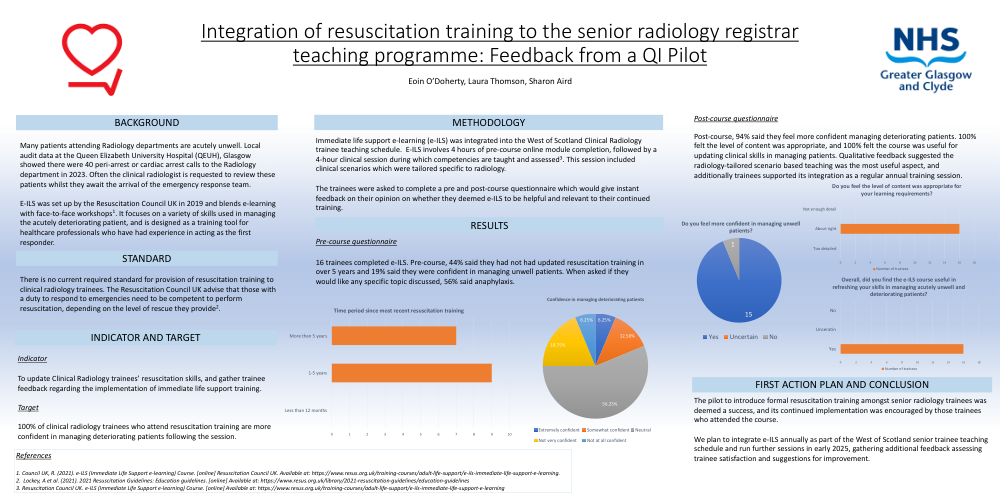
16 trainees completed e-ILS. Pre-course, 44% said they had not had updated resuscitation training in over 5 years and 19% said they were confident in managing unwell patients. When asked if they would like any specific topic discussed, 56% said anaphylaxis.
Post-course questionnaire
Post-course, 94% said they feel more confident managing deteriorating patients. 100% felt the level of content was appropriate, and 100% felt the course was useful for updating clinical skills in managing patients. Qualitative feedback suggested the radiology-tailored scenario based teaching was the most useful aspect, and additionally trainees supported its integration as a regular annual training session.
FIRST ACTION PLAN AND CONCLUSION
The pilot to introduce formal resuscitation training amongst senior radiology trainees was deemed a success, and its continued implementation was encouraged by those trainees who attended the course.
We plan to integrate e-ILS annually as part of the West of Scotland senior trainee teaching schedule and run further sessions in early 2025, gathering additional feedback assessing trainee satisfaction and suggestions for improvement.