20 posters, 13 topics, 1 sessions, 54 authors, 27 institutions
ePostersLive by SciGen Technologies S.A. All rights reserved.
Clinical Radiology Audit and Quality Improvement ePoster Competitions 2026
30 September, 2026 | London, UK

80
Replacing CT Intravenous Urography with MR Urography in Children: A Closed-Loop Audit Achieving an 87% Reduction in Collective Radiation Dose
Poster Presenter
Part of Topic
Paediatrics
Replacing CT Intravenous Urography with MR Urography in Children: A Closed-Loop Audit Achieving an 87% Reduction in Collective Radiation Dose
Umaima Majeed(1), Hania Ali(2), Iqbal Hussain Dogar(1), Afshan Noreen(1), Bilal Amjad(1), Iram Aslam Khan(1)
(1) Department of Radiology, The Children's Hospital & Institute of Child Health, Multan, Pakistan
(2) Royal Bahrain Hospital, Bahrain
BACKGROUND & OBJECTIVES
Children are substantially more radiosensitive than adults, and CT exposure in childhood carries a measurable increase in lifetime cancer risk [4]. CT intravenous urography (CT IVU) delivers among the highest paediatric doses in body imaging, whereas MR urography (MRU) provides comparable anatomical and functional information without ionising radiation [5]. At our tertiary paediatric hospital, CT IVU remained the default urographic investigation; we therefore audited practice against radiation-protection standards.
STANDARDS, INDICATORS & TARGETS
Standard: In children requiring urographic imaging, a radiation-free alternative (MRU) should be used wherever clinically appropriate, in line with RCR iRefer guidance [1], ESPR/ESUR paediatric uroradiology recommendations [2] and ALARA (as low as reasonably achievable)/Image Gently principles [6].
Indicator: Proportion of paediatric urographic examinations performed as MRU.
Target: 90% or more of studies via MRU.
METHODOLOGY
Retrospective closed-loop departmental audit of all urographic examinations in children aged 1-13 years over two equal 8-month cycles. 1st audit cycle: 1 January 2025 to 31 August 2025. Intervention: 1 September 2025. 2nd audit cycle: 1 September 2025 to 30 April 2026.
Dose estimation: for every CT IVU, dose-length product (DLP) was retrieved and effective dose estimated as DLP x age-specific conversion coefficient for abdominopelvic CT (0.030, 0.020 and 0.015 mSv.mGy-1.cm-1 for the 1-, 5- and 10-year reference phantoms respectively, nearest-phantom assignment; AAPM Report No. 96/Shrimpton et al. [3]).
RESULTS - 1ST AUDIT ROUND
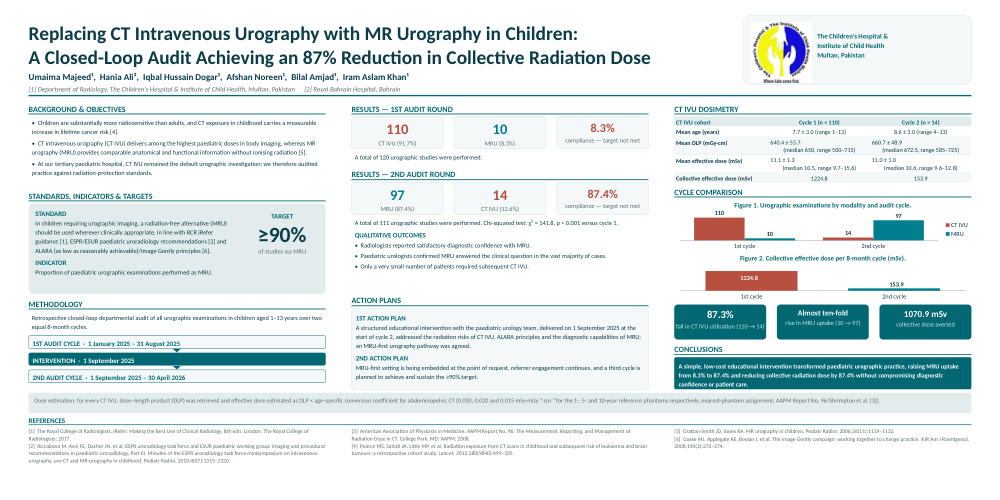
A total of 120 urographic studies were performed: 110 CT IVU (91.7%) and 10 MRU (8.3%) - target not met.
RESULTS - 2ND AUDIT ROUND
A total of 111 urographic studies were performed: 97 MRU (87.4%) and 14 CT IVU (12.6%) - target not met. Chi-squared test: chi-squared = 141.8, p < 0.001 versus cycle 1. CT IVU utilisation fell by 87.3% (110 to 14) and MRU rose almost ten-fold (10 to 97), averting 1070.9 mSv of collective effective dose.
Qualitative outcomes: Radiologists reported satisfactory diagnostic confidence with MRU. Paediatric urologists confirmed MRU answered the clinical question in the vast majority of cases. Only a very small number of patients required subsequent CT IVU.
ACTION PLANS
1st action plan: A structured educational intervention with the paediatric urology team, delivered on 1 September 2025 at the start of cycle 2, addressed the radiation risks of CT IVU, ALARA principles and the diagnostic capabilities of MRU; an MRU-first urography pathway was agreed.
2nd action plan: MRU-first vetting is being embedded at the point of request, referrer engagement continues, and a third cycle is planned to achieve and sustain the 90% target.
CONCLUSIONS
A simple, low-cost educational intervention transformed paediatric urographic practice, raising MRU uptake from 8.3% to 87.4% and reducing collective radiation dose by 87.4% without compromising diagnostic confidence or patient care.
REFERENCES
[1] The Royal College of Radiologists. iRefer: Making the Best Use of Clinical Radiology. 8th edn. London: The Royal College of Radiologists; 2017.
[2] Riccabona M, Avni FE, Dacher JN, et al. ESPR uroradiology task force and ESUR paediatric working group: imaging and procedural recommendations in paediatric uroradiology, Part III. Minutes of the ESPR uroradiology task force minisymposium on intravenous urography, uro-CT and MR-urography in childhood. Pediatr Radiol. 2010;40(7):1315-1320.
[3] American Association of Physicists in Medicine. AAPM Report No. 96: The Measurement, Reporting, and Management of Radiation Dose in CT. College Park, MD: AAPM; 2008.
[4] Pearce MS, Salotti JA, Little MP, et al. Radiation exposure from CT scans in childhood and subsequent risk of leukaemia and brain tumours: a retrospective cohort study. Lancet. 2012;380(9840):499-505.
[5] Grattan-Smith JD, Jones RA. MR urography in children. Pediatr Radiol. 2006;36(11):1119-1132.
[6] Goske MJ, Applegate KE, Boylan J, et al. The Image Gently campaign: working together to change practice. AJR Am J Roentgenol. 2008;190(2):273-274.