20 posters, 13 topics, 1 sessions, 54 authors, 27 institutions
ePostersLive by SciGen Technologies S.A. All rights reserved.
Clinical Radiology Audit and Quality Improvement ePoster Competitions 2026
30 September, 2026 | London, UK

69
Inpatient ultrasound service quality improvement project
Poster Presenter
Part of Topic
Service quality
Streamlining inpatient ultrasound scanning through Registrar-led protocolling: a four-cycle quality improvement project
George Choa1, Samia Nesar1, James Baker1, Richard Engel1, Matthew Turner2, Penelope Moyle3
Department of Radiology, Cambridge University Hospitals NHS Foundation Trust, Cambridge, UK; 1Specialist Registrar in Clinical Radiology, 2Ultrasound Department Service Manager, 3Ultrasound Department Clinical Lead
Background:
1. SpR-led protocolling of all IP US referrals
2. Formalised IP US protocol guidance created & issued
3. Protocolling integrated into existing EHR functionality (Epic) with standardised priority coding4
4. Trust-wide communication of IP US referral changes
5. Protocolling slots rescheduled due to insufficient designated time
Results:
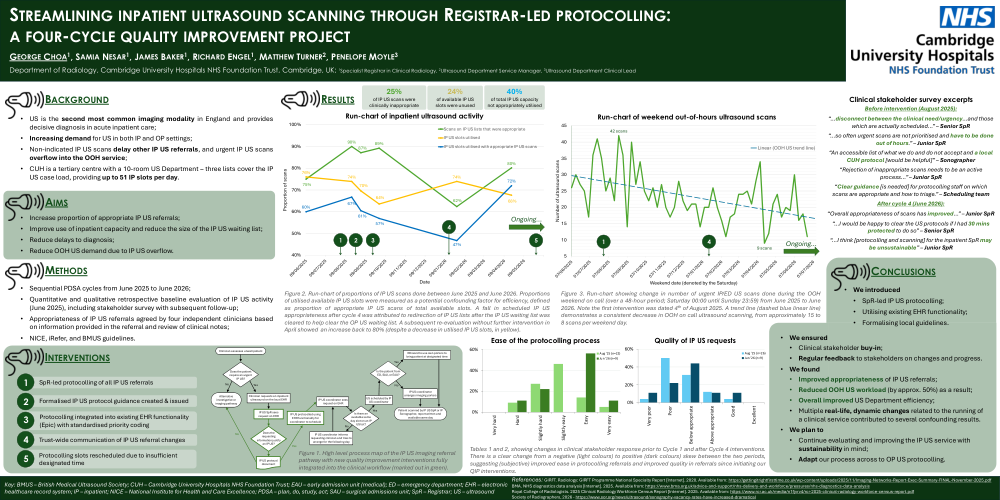
Figure 1. High level process map of the IP US imaging referral pathway with new quality improvement interventions fully integrated into the clinical workflow (marked out in green).
Figure 2. Run-chart of proportions of IP US scans done between June 2025 and June 2026. Proportions of utilised available IP US slots were measured as a potential confounding factor for efficiency, defined as proportion of appropriate IP US scans of total available slots. A fall in scheduled IP US appropriateness after cycle 4 was attributed to redirection of IP US lists after the IP US waiting list was cleared to help clear the OP US waiting list. A subsequent re-evaluation without further intervention in April showed an increase back to 80% (despite a decrease in utilised IP US slots, in yellow).
Figure 3. Run-chart showing change in number of urgent IP/ED US scans done during the OOH weekend on call (over a 48-hour period; Saturday 00:00 until Sunday 23:59) from June 2025 to June 2026. Note the first intervention was dated 4th of August 2025. A trend line (dashed blue linear line) demonstrates a consistent decrease in OOH on call ultrasound scanning, from approximately 15 to 8 scans per weekend day.
Tables 1 and 2, showing changes in clinical stakeholder response prior to Cycle 1 and after Cycle 4 interventions. There is a clear change from a negative (light colours) to positive (dark colours) skew between the two periods, suggesting (subjective) improved ease in protocolling referrals and improved quality in referrals since initiating our QIP interventions.
GIRFT. Radiology: GIRFT Programme National Specialty Report [Internet]. 2020. Available from: https://gettingitrightfirsttime.co.uk/wp-content/uploads/2025/11/Imaging-Networks-Report-Exec-Summary-FINAL-November-2025.pdf
BMA. NHS diagnostics data analysis [Internet]. 2025. Available from: https://www.bma.org.uk/advice-and-support/nhs-delivery-and-workforce/pressures/nhs-diagnostics-data-analysis
Royal College of Radiologists. 2025 Clinical Radiology Workforce Census Report [Internet]. 2025. Available from: https://www.rcr.ac.uk/media/n1fjvrv4/rcr-2025-clinical-radiology-workforce-census-report.pdf
Society of Radiographers, 2026 - https://www.sor.org/news/ultrasound/sonography-vacancy-rates-have-increased-dramatical