20 posters, 13 topics, 1 sessions, 54 authors, 27 institutions
ePostersLive by SciGen Technologies S.A. All rights reserved.
Clinical Radiology Audit and Quality Improvement ePoster Competitions 2026
30 September, 2026 | London, UK

63
To Scan or Not to Scan? An Audit of Appropriateness of CTPA Requests for Suspected Pulmonary Embolism
Poster Presenter
Authors
Affiliations
Part of Topic
Appropriateness of referral
Background
Computed tomography pulmonary angiography (CTPA) is the first-line
investigation for suspected pulmonary embolism (PE), but it carries a high
radiation dose and iodinated contrast risk. Appropriate patient selection is
therefore essential to minimise unnecessary imaging while ensuring timely
diagnosis.
This audit was designed to assess whether the Lincoln County Hospital Radiology
department is receiving appropriate CTPA referrals, based on RCR and local guidance.
Audit Standards
STD 1: 100% of referrals should include assessing pre-test probability with a PE Wells score, and use of
D-dimer if the Wells score is unlikely (<4).
STD 2:100% of referrals should follow the agreed local protocol — providing sufficient clinical detail,
including age and presenting symptoms.
Why this audit matters
CTPA delivers a substantial radiation dose. Every inappropriate scan exposes a patient
to avoidable risk without diagnostic benefit, while also consuming scanner capacity
needed for patients who genuinely require urgent imaging.
Methods
A retrospective closed-loop audit was conducted at Lincoln County Hospital
using the Royal College of Radiology (RCR) “Appropriateness of Usage of CTPA
in Suspected PE2” audit template as a framework, cross-referenced with local
CTPA vetting criteria.
Intervention
Following Cycle 1, results were presented to the Radiology and Emergency
Department teams. Educational posters summarising local CTPA referral
requirements — Wells score, D-dimer (where appropriate), and relevant
clinical information — were displayed within the Emergency Department.
Guidance was further promoted by an Emergency Medicine consultant, to increase awareness among
requesting clinicians and encourage adherence to local vetting criteria.
Results
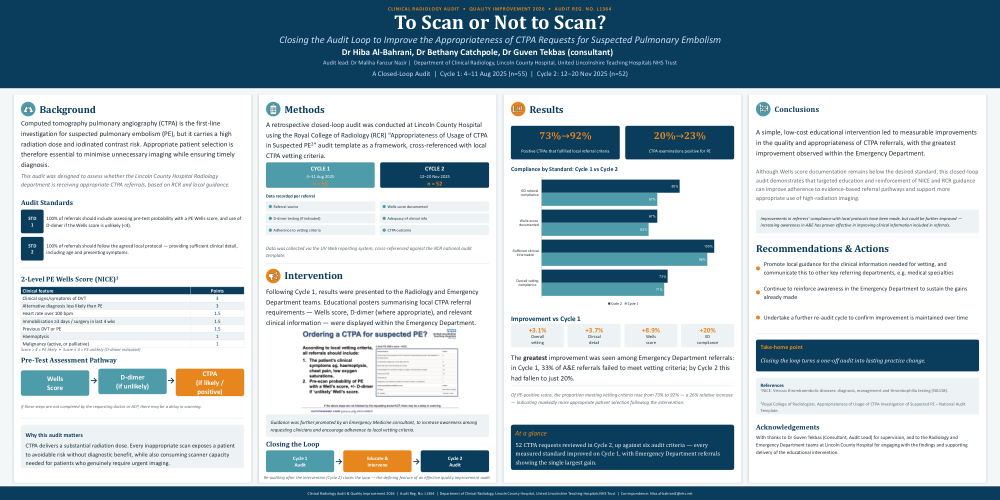
The greatest improvement was seen among Emergency Department referrals:
in Cycle 1, 33% of A&E referrals failed to meet vetting criteria; by Cycle 2 this
had fallen to just 20%.
Conclusions
A simple, low-cost educational intervention led to measurable improvements
in the quality and appropriateness of CTPA referrals, with the greatest
improvement observed within the Emergency Department.
Although Wells score documentation remains below the desired standard, this closed-loop
audit demonstrates that targeted education and reinforcement of NICE and RCR guidance
can improve adherence to evidence-based referral pathways and support more
appropriate use of high-radiation imaging.
Improvements in referrers’ compliance with local protocols have been made, but could be further improved —
increasing awareness in A&E has proven effective in improving clinical information included in referrals.
Recommendations & Actions
Promote local guidance for the clinical information needed for vetting, and
communicate this to other key referring departments, e.g. medical specialties
Continue to reinforce awareness in the Emergency Department to sustain the gains
already made
Undertake a further re-audit cycle to confirm improvement is maintained over time