20 posters, 13 topics, 1 sessions, 54 authors, 27 institutions
ePostersLive by SciGen Technologies S.A. All rights reserved.
Clinical Radiology Audit and Quality Improvement ePoster Competitions 2026
30 September, 2026 | London, UK

48
Closed-loop audit assessing turnaround times of out-of-hours CT scans outsourced to teleradiology
Poster Presenter
Part of Topic
IT/PACS
Background:
• 95% of UK NHS trusts outsource to teleradiology providers.1
• £216m was spent in 2024 by the NHS on private teleradiology providers1. Teleradiology can increase reporting capacity for overstretched local services, improving temporal and geographic access to reporting. In one retrospective cohort study, implementation of a teleradiology service significantly increased the percentage of CTPAs reported within optimal & acceptable turnaround times.2
• However, both the ACR and RCR recognise the implementation of teleradiology poses additional technological challenges, in particular challenges with systems integration.3,4
• This audit was conducted due to an apparent mismatch between externally reported performance from Everlight Radiology®, the Royal Free hospital (RFH) teleradiology provider and anecdotal real-world experience from A&E for CT turnaround times.
Audit Standards:
• RCR standards for the provision of teleradiology within the UK recommends that there should be “systems in place for rapid, secure transfer and review of images”, “results integrated into the base hospitals RIS/PACS and EPR in a timely manner” and that providers be “subject to the same governance framework as the rest of the service”.5
• NICE guidelines on head injury (NG 232) advises that a “provisional written radiology report [is] available within 1 hour of a CT scan” for people aged 16+ who have sustained head injury that meet the risk factors.6
Methodology:
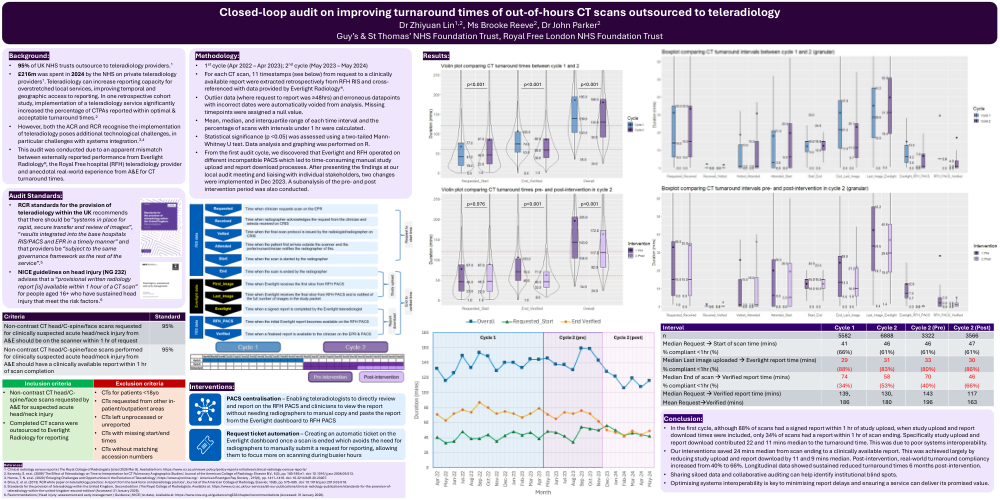
• 1st cycle (Apr 2022 – Apr 2023); 2nd cycle (May 2023 – May 2024)
• For each CT scan, 11 timestamps (see below) from request to a clinically available report were extracted retrospectively from RFH RIS and cross-referenced with data provided by Everlight Radiology®.
• Outlier data (where request to report was ≥48hrs) and erroneous datapoints with incorrect dates were automatically voided from analysis. Missing timepoints were assigned a null value.
• Mean, median, and interquartile range of each time interval and the percentage of scans with intervals under 1 hr were calculated.
• Statistical significance (p <0.05) was assessed using a two-tailed Mann-Whitney U test. Data analysis and graphing was performed on R.
• From the first audit cycle, we discovered that Everlight and RFH operated on different incompatible PACS which led to time-consuming manual study upload and report download processes. After presenting the findings at our local audit meeting and liaising with individual stakeholders, two changes were implemented in Dec 2023. A subanalysis of the pre- and post intervention period was also conducted.
Conclusion:
• In the first cycle, although 88% of scans had a signed report within 1 hr of study upload, when study upload and report download times were included, only 34% of scans had a report within 1 hr of scan ending. Specifically study upload and report download contributed 22 and 11 mins median to the turnaround time. This was due to poor systems interoperability.
• Our interventions saved 24 mins median from scan ending to a clinically available report. This was achieved largely by reducing study upload and report download by 11 and 9 mins median. Post-intervention, real-world turnaround compliancy increased from 40% to 66%. Longitudinal data showed sustained reduced turnaround times 6 months post-intervention.
• Sharing siloed data and collaborative auditing can help identify institutional blind spots.
• Optimising systems interoperability is key to minimising report delays and ensuring a service can deliver its promised value.
References
1.Clinical radiology census reports | The Royal College of Radiologists [cited 2026 Mar 9]. Available from: https://www.rcr.ac.uk/news-policy/policy-reports-initiatives/clinical-radiology-census-reports/
2.Kennedy, S. et al. (2009) ‘The Effect of Teleradiology on Time to Interpretation for CT Pulmonary Angiographic Studies’, Journal of the American College of Radiology. Elsevier B.V., 6(3), pp. 180-189.e1. doi: 10.1016/j.jacr.2008.09.013.
3.Hanna, T. N. et al. (2020) ‘Emerging Challenges and Opportunities in the Evolution of Teleradiology’, https://www.ajronline.org/. American Roentgen Ray Society , 215(6), pp. 1411–1416. doi: 10.2214/AJR.20.23007.
4.Silva, E. et al. (2013) ‘ACR white paper on teleradiology practice: A report from the task force on teleradiology practice’, Journal of the American College of Radiology. Elsevier, 10(8), pp. 575–585. doi: 10.1016/j.jacr.2013.03.018.
5.Standards for the provision of teleradiology within the United Kingdom, Second edition | The Royal College of Radiologists. Available at: https://www.rcr.ac.uk/our-services/all-our-publications/clinical-radiology-publications/standards-for-the-provision-of-teleradiology-within-the-united-kingdom-second-edition/ (Accessed: 31 January 2026).
6.Recommendations | Head injury: assessment and early management | Guidance | NICE (no date). Available at: https://www.nice.org.uk/guidance/ng232/chapter/recommendations (Accessed: 31 January 2026).