29 posters, 13 topics, 90 authors, 29 institutions
ePostersLive by SciGen Technologies S.A. All rights reserved.
Clinical Radiology Audit and Quality Improvement ePoster Competition 2025
18 NOVEMBER, 2025 | LONDON, UK

88
New Protocol for Investigating Reported Dense Vessels on Outsourced CT Head
Poster Presenter
Part of Topic
Neuroradiology
Follow Up Imaging of Reported Hyperdense Vessels on Outsourced CT Heads: A Quality Improvement Project
Background
The aim of this audit is to assess the frequency of which outsourced CT head reports raise concern of a hyperdense intracranial vessel. From there we aim to assess how often these patients have a CT angiography and how frequently these investigations confirm a thrombus.
Introduction
Initially we reviewed the reports of 1200 consecutive outsourced CT Heads performed from April to May 2024, to assess the frequency of which dense vessels are reported. We then performed a text search on the UHS PACS system to identify cases where dense vessels were reported in the report. A total of 107 scans were identified using this method.
Results
This audit concludes that the overall rate at which the outsourcing company reports suspected hyperdense vessels is relatively low (1.75%). Given the volume of scans that are sent to them (above 15,000 per annum), this still represents a significant number of possible additional scans.
Intervention
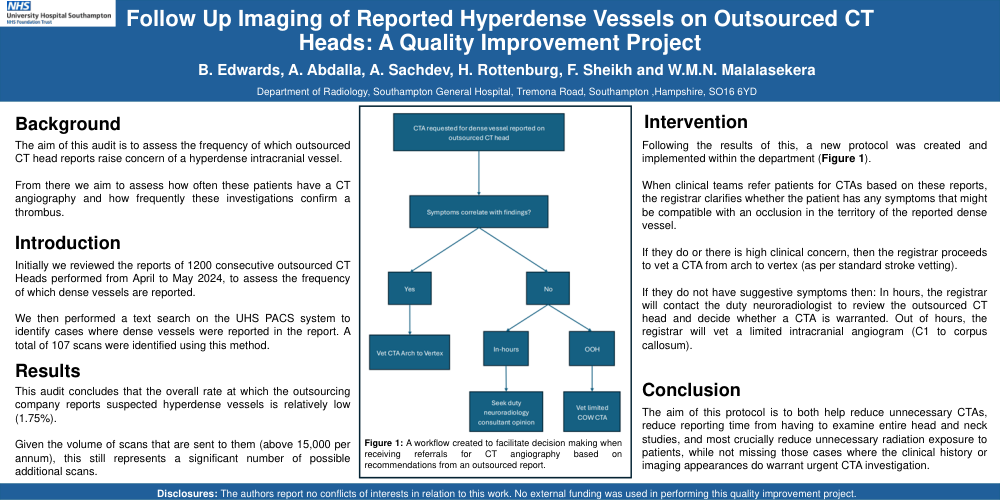
Following the results of this, a new protocol was created and implemented within the department (Figure 1). When clinical teams refer patients for CTAs based on these reports, the registrar clarifies whether the patient has any symptoms that might be compatible with an occlusion in the territory of the reported dense vessel. If they do or there is high clinical concern, then the registrar proceeds to vet a CTA from arch to vertex (as per standard stroke vetting). If they do not have suggestive symptoms then: In hours, the registrar will contact the duty neuroradiologist to review the outsourced CT head and decide whether a CTA is warranted. Out of hours, the registrar will vet a limited intracranial angiogram (C1 to corpus callosum).
Conclusion
The aim of this protocol is to both help reduce unnecessary CTAs, reduce reporting time from having to examine entire head and neck studies, and most crucially reduce unnecessary radiation exposure to patients, while not missing those cases where the clinical history or imaging appearances do warrant urgent CTA investigation.