29 posters, 13 topics, 90 authors, 29 institutions
ePostersLive by SciGen Technologies S.A. All rights reserved.
Clinical Radiology Audit and Quality Improvement ePoster Competition 2025
18 NOVEMBER, 2025 | LONDON, UK

86
Evaluating the Radiological Reporting and Subsequent Clinical Management of Incidental Coronary Artery Calcification (CAC) in Primary CT Skeletal Surveys (pCTSS) for Patients with Suspected Multiple Myeloma (MM) in a Large Teaching Hospital
Poster Presenter
Part of Topic
Chest
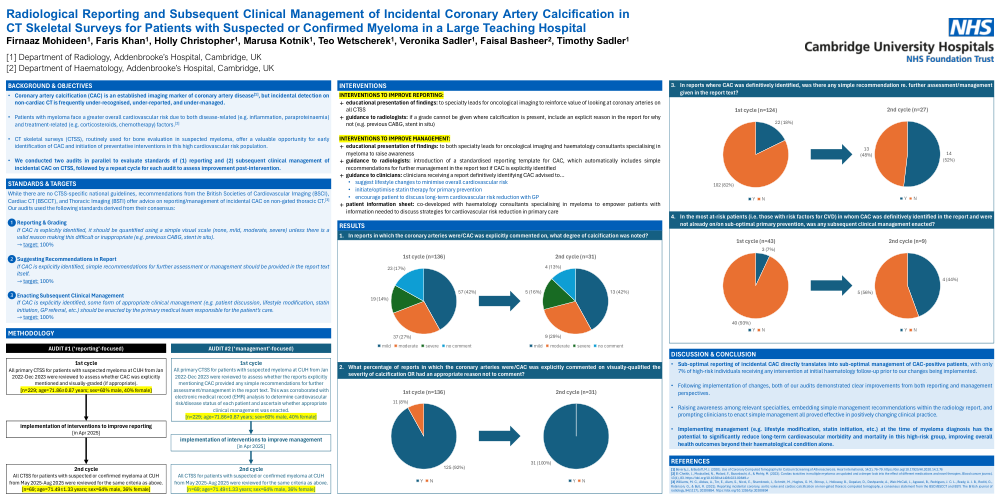
Radiological Reporting and Subsequent Clinical Management of Incidental Coronary Artery Calcification in CT Skeletal Surveys for Patients with Suspected or Confirmed Myeloma in a Large Teaching Hospital
Firnaaz Mohideen 1, Faris Khan 1, Holly Christopher 1, Marusa Kotnik 1, Teo Wetscherek 1, Veronika Sadler 1, Faisal Basheer 2, Timothy Sadler 1
[1] Department of Radiology, Addenbrooke’s Hospital, Cambridge, UK
[2] Department of Haematology, Addenbrooke’s Hospital, Cambridge, UK
BACKGROUND & OBJECTIVES
STANDARDS & TARGETS
While there are no CTSS-specific national guidelines, recommendations from the British Societies of Cardiovascular Imaging (BSCI), Cardiac CT (BSCCT), and Thoracic Imaging (BSTI) offer advice on reporting/management of incidental CAC on non-gated thoracic CT.[3] Our audits used the following standards derived from their consensus:
1. Reporting & Grading
If CAC is explicitly identified, it should be quantified using a simple visual scale (none, mild, moderate, severe) unless there is a valid reason making this difficult or inappropriate (e.g. previous CABG, stent in situ).
→ target: 100%
2. Suggesting Recommendations in Report
If CAC is explicitly identified, simple recommendations for further assessment or management should be provided in the report text itself.
→ target: 100%
3. Enacting Subsequent Clinical Management
If CAC is explicitly identified, some form of appropriate clinical management (e.g. patient discussion, lifestyle modification, statin initiation, GP referral, etc.) should be enacted by the primary medical team responsible for the patient’s care.
→ target: 100%
METHODOLOGY
INTERVENTIONS
INTERVENTIONS TO IMPROVE REPORTING:
- educational presentation of findings: to specialty leads for oncological imaging to reinforce value of looking at coronary arteries on all CTSS
- guidance to radiologists: if a grade cannot be given where calcification is present, include an explicit reason in the report for why not (e.g. previous CABG, stent in situ)
INTERVENTIONS TO IMPROVE MANAGEMENT:
- educational presentation of findings: to both specialty leads for oncological imaging and haematology consultants specialising in myeloma to raise awareness
- guidance to radiologists: introduction of a standardised reporting template for CAC, which automatically includes simple recommendations for further management in the report text if CAC is explicitly identified
- guidance to clinicians: clinicians receiving a report definitively identifying CAC advised to…
> suggest lifestyle changes to minimise overall cardiovascular risk
> initiate/optimise statin therapy for primary prevention
> encourage patient to discuss long-term cardiovascular risk reduction with GP
- patient information sheet: co-developed with haematology consultants specialising in myeloma to empower patients with information needed to discuss strategies for cardiovascular risk reduction in primary care
RESULTS
1. In reports in which the coronary arteries were/CAC was explicitly commented on, what degree of calcification was noted?
2. What percentage of reports in which the coronary arteries were/CAC was explicitly commented on visually-qualified the severity of calcification OR had an appropriate reason not to comment?
3. In reports where CAC was definitively identified, was there any simple recommendation re. further assessment/management given in the report text?
4. In the most at-risk patients (i.e. those with risk factors for CVD) in whom CAC was definitively identified in the report and were not already on/on sub-optimal primary prevention, was any subsequent clinical management enacted?
DISCUSSION & CONCLUSION
REFERENCES
[1] Beverly, J., & Budoff, M. J. (2020). Use of Coronary Computed Tomography for Calcium Screening of Atherosclerosis. Heart international, 14(2), 76–79. https://doi.org/10.17925/HI.2020.14.2.76
[2] El-Cheikh, J., Moukalled, N., Malard, F., Bazarbachi, A., & Mohty, M. (2023). Cardiac toxicities in multiple myeloma: an updated and a deeper look into the effect of different medications and novel therapies. Blood cancer journal, 13(1), 83. https://doi.org/10.1038/s41408-023-00849-z
[3] Williams, M. C., Abbas, A., Tirr, E., Alam, S., Nicol, E., Shambrook, J., Schmitt, M., Hughes, G. M., Stirrup, J., Holloway, B., Gopalan, D., Deshpande, A., Weir-McCall, J., Agrawal, B., Rodrigues, J. C. L., Brady, A. J. B., Roditi, G., Robinson, G., & Bull, R. (2021). Reporting incidental coronary, aortic valve and cardiac calcification on non-gated thoracic computed tomography, a consensus statement from the BSCI/BSCCT and BSTI. The British journal of radiology, 94(1117), 20200894. https://doi.org/10.1259/bjr.20200894