29 posters, 13 topics, 90 authors, 29 institutions
ePostersLive by SciGen Technologies S.A. All rights reserved.
Clinical Radiology Audit and Quality Improvement ePoster Competition 2025
18 NOVEMBER, 2025 | LONDON, UK
82
Ultrasound Guided Core Needle Biopsy (CNB) in Investigation of a Thyroid Nodule -Results in 150Patients.
Poster Presenter
Authors
Affiliations
Part of Topic
Ultrasound
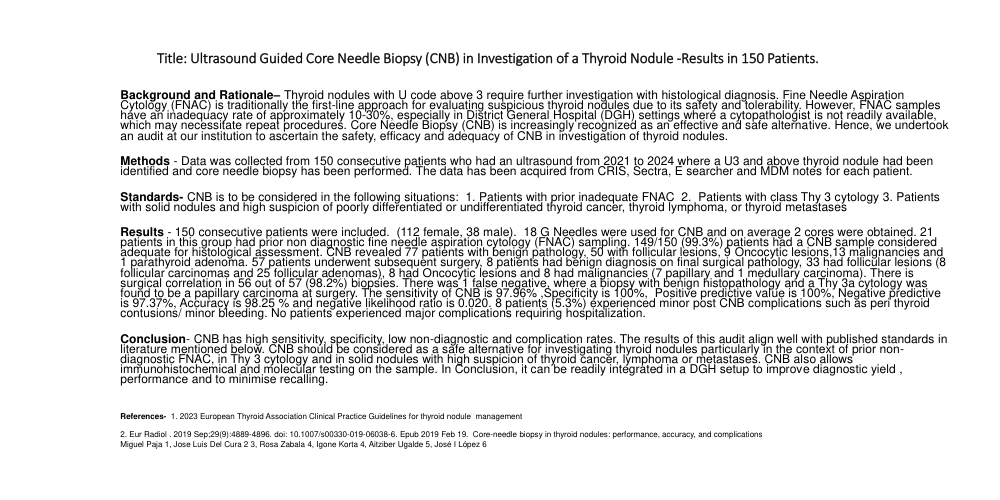
Title: Ultrasound Guided Core Needle Biopsy (CNB) in Investigation of a Thyroid Nodule- Results in 150 Patients.
Background and Rationale
Thyroid nodules with U code above 3 require further investigation with histological diagnosis. Fine Needle Aspiration
Cytology (FNAC) is traditionally the first line approach for evaluating suspicious thyroid nodules due to its safety and tolerab ility. However, FNAC samples
have an inadequacy rate of approximately 10 30%, especially in District General Hospital (DGH) settings where a cytopathologist is not readily available,
which may necessitate repeat procedures. Core Needle Biopsy (CNB) is increasingly recognized as an effective and safe alternative. Hence, we undertook
an audit at our institution to ascertain the safety, efficacy and adequacy of CNB in investigation of thyroid nodules.
Methods
Data was collected from 150 consecutive patients who had an ultrasound from 2021 to 2024 where a U3 and above thyroid nodule had been
identified and core needle biopsy has been performed. The data has been acquired from CRIS, Sectra, E searcher and MDM notes for each patient.
Standards
CNB is to be considered in the following situations: 1. Patients with prior inadequate FNAC 2. Patients with class Thy 3 c yto logy 3. Patients
with solid nodules and high suspicion of poorly differentiated or undifferentiated thyroid cancer, thyroid lymphoma, or thyroid metastases.
Results
150 consecutive patients were included. (112 female, 38 male). 18 G Needles were used for CNB and on average 2 cores were obtained. 21
patients in this group had prior non diagnostic fine needle aspiration cytology (FNAC) sampling. 149/150 (99.3%) patients had a CNB sample considered
adequate for histological assessment. CNB revealed 77 patients with benign pathology, 50 with follicular lesions, 9 Oncocytic lesions,13 malignancies and
1 parathyroid adenoma. 57 patients underwent subsequent surgery, 8 patients had benign diagnosis on final surgical pathology, 33 had follicular lesions (8
follicular carcinomas and 25 follicular adenomas), 8 had Oncocytic lesions and 8 had malignancies (7 papillary and 1 medullary carcinoma). There is
surgical correlation in 56 out of 57 (98.2%) biopsies. There was 1 false negative, where a biopsy with benign histopathology and a Thy 3a cytology was
found to be a papillary carcinoma at surgery. The sensitivity of CNB is 97.96% ,Specificity is 100%, Positive predictive val ue is 100%, Negative predictive
is 97.37%, Accuracy is 98.25 % and negative likelihood ratio is 0.020. 8 patients (5.3%) experienced minor post CNB complicat ion s such as peri thyroid
contusions/ minor bleeding. No patients experienced major complications requiring hospitalization.
Conclusion
CNB has high sensitivity, specificity, low non diagnostic and complication rates. The results of this audit align well with published standards in
literature mentioned below. CNB should be considered as a safe alternative for investigating thyroid nodules particularly in the context of prior non
diagnostic FNAC, in Thy 3 cytology and in solid nodules with high suspicion of thyroid cancer, lymphoma or metastases. CNB also allows
immunohistochemical and molecular testing on the sample. In Conclusion, CNB can be readily integrated in a DGH setup to improve diagnostic yield ,
performance and to minimise recalling.
References
1. 2023 European Thyroid Association Clinical Practice Guidelines for thyroid nodule management
2. Eur Radiol . 2019 Sep;29(9):4889 4896. doi : 10.1007/s00330 019 06038 6. Epub 2019 Feb 19. Core needle biopsy in thyroid nodules: performance, accuracy, and complications. Miguel Paja 1, Jose Luis Del Cura 2 3, Rosa Zabala 4, Igone Korta 4, Aitziber Ugalde 5, José I López 6