29 posters, 13 topics, 90 authors, 29 institutions
ePostersLive by SciGen Technologies S.A. All rights reserved.
Clinical Radiology Audit and Quality Improvement ePoster Competition 2025
18 NOVEMBER, 2025 | LONDON, UK

79
Refining the use of CXR AI findings for the prioritisation of CXR reporting– A QIP
Poster Presenter
Authors
Affiliations
Part of Topic
AI
Background
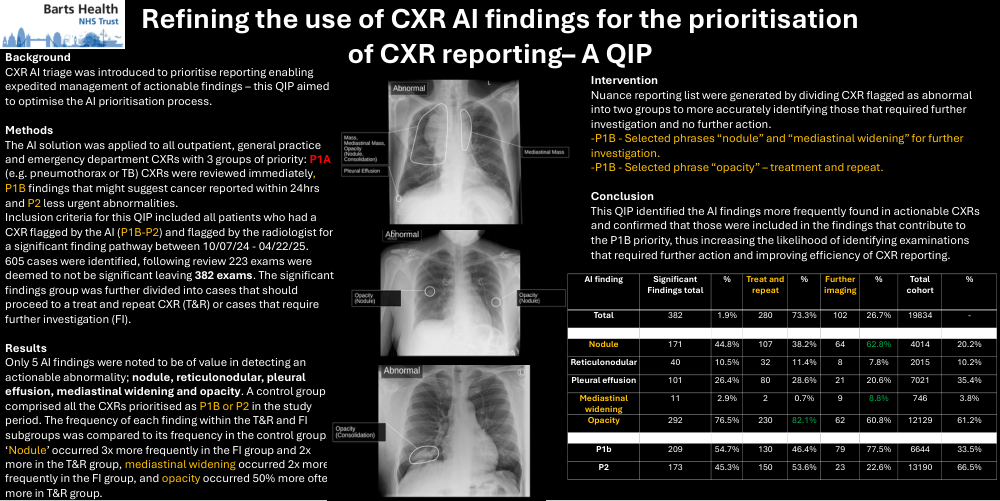
CXR AI triage was introduced to prioritise reporting enabling expedited management of actionable findings – this QIP aimed to optimise the AI prioritisation process.
Methods
The AI solution was applied to all outpatient, general practice and emergency department CXRs with 3 groups of priority: P1A (e.g. pneumothorax orTB) CXRs were reviewed immediately, P1B findings that might suggest cancer reported within 24hrs and P2 less urgent abnormalities.
Inclusion criteria for this QIP included all patients who had a CXR flagged by the AI (P1B-P2) and flagged by the radiologist for a significant finding pathway between 10/07/24 - 04/22/25.
605 cases were identified, following review 223 examswere deemed to not be significant leaving 382 exams. The significant findings group was further divided into cases that should proceed to a treat and repeat CXR (T&R) or cases that require further investigation (FI).
Results
Only 5 AI findings were noted to be of value in detecting an actionable abnormality; nodule, reticulonodular, pleural effusion, mediastinal widening and opacity. A control group comprised all the CXRs prioritised as P1B or P2 in the study period. The frequency of each finding within the T&R and FI subgroups was compared to its frequency in the control group. ‘Nodule’ occurred 3x more frequently in the FI group and 2x more in the T&R group, mediastinal widening occurred 2x more frequently in the FI group, and opacity occurred 50% more often more in T&R group.
Intervention
Nuance reporting list were generated by dividing CXR flagged as abnormal into two groups to more accurately identifying those that required further investigation and no further action.
-P1B - Selected phrases “nodule” and “mediastinal widening” for further investigation.
-P1B - Selected phrase “opacity” – treatment and repeat.
Conclusion
This QIP identified the AI findings more frequently found in actionable CXRs and confirmed that those were included in the findings that contribute to the P1B priority, thus increasing the likelihood of identifying examinations that required further action and improving efficiency of CXR reporting. .