29 posters, 13 topics, 90 authors, 29 institutions
ePostersLive by SciGen Technologies S.A. All rights reserved.
Clinical Radiology Audit and Quality Improvement ePoster Competition 2025
18 NOVEMBER, 2025 | LONDON, UK

39
Improving radiology work prioritisation through implementation of smart worklists
Poster Presenter
Part of Topic
IT/PACS
Improving radiology work prioritisation through implementation of smart worklists.
Introduction
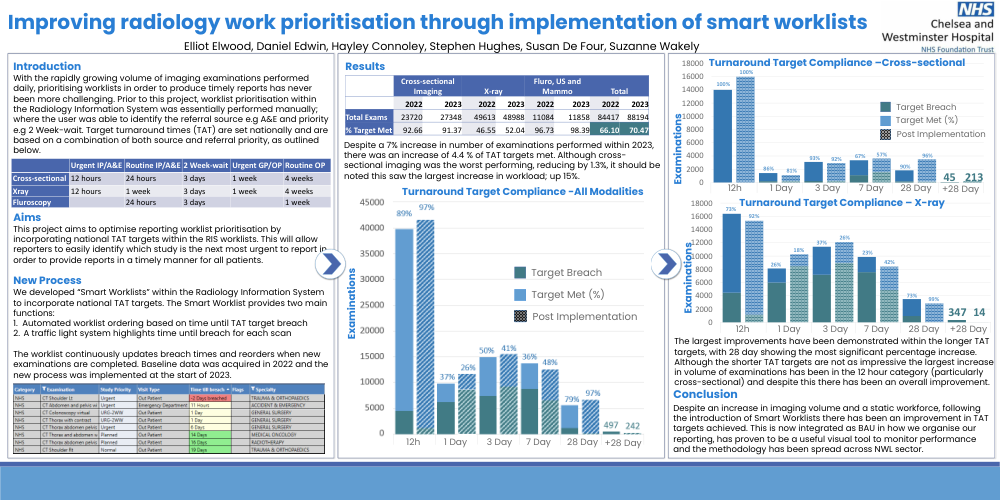
With the rapidly growing volume of imaging examinations performed daily, prioritising worklists in order to produce timely reports has never been more challenging. Prior to this project, worklist prioritisation within the Radiology Information System was essentially performed manually; where the user was able to identify the referral source e.g A&E and priority e.g 2 Week-wait. Target turnaround times (TAT) are set nationally and are based on a combination of both source and referral priority, as outlined below.
Aims
This project aims to optimise reporting worklist prioritisation by incorporating national TAT targets within the RIS worklists. This will allow reporters to easily identify which study is the next most urgent to report in order to provide reports in a timely manner for all patients.
New Process
We developed “Smart Worklists” within the Radiology Information System to incorporate national TAT targets. The Smart Worklist provides two main functions:
1. Automated worklist ordering based on time until TAT target breach
2. A traffic light system highlights time until breach for each scan
The worklist continuously updates breach times and reorders when new examinations are completed. Baseline data was acquired in 2022 and the new process was implemented at the start of 2023.
Results
Despite a 7% increase in number of examinations performed within 2023, there was an increase of 4.4 % of TAT targets met. Although cross-sectional imaging was the worst performing, reducing by 1.3%, it should be noted this saw the largest increase in workload; up 15%. The largest improvements have been demonstrated within the longer TAT targets, with 28 day showing the most significant percentage increase. Although the shorter TAT targets are not as impressive the largest increase in volume of examinations has been in the 12 hour category (particularly cross-sectional) and despite this there has been an overall improvement.
Conclusion
Despite an increase in imaging volume and a static workforce, following the introduction of Smart Worklists there has been an improvement in TAT targets achieved. This is now integrated as BAU in how we organise our reporting, has proven to be a useful visual tool to monitor performance and the methodology has been spread across NWL sector.