372 posters, 1 audios, 13 topics, 29 sessions, 1,035 authors, 449 institutions
ePostersLive by SciGen Technologies S.A. All rights reserved.
51st Annual Regional Anesthesiology and Acute Pain Medicine Meeting
April 16 - 18, 2026 | Phoenix, Arizona

2314379
Real-World Preliminary Evaluation of Ketamine Infusions for Chronic Pain in Patients with Elevated Distress
Poster Presenter
Authors
Christopher Phillips, Casey Landefeld, Wilson Lam, Carlos Pino, Krista Highland, Tracy Rupp
Affiliations
Naval Medical Forces Pacific, Naval Medical Center San Diego; Uniformed Services University, Uniformed Services University, Defense and Veterans Center for Integrative Pain Management; Henry M. Jackson Foundation for the Advancement of Military Medicine
Part of Topic
Scientific Abstracts > Chronic Pain
Introduction
- Ketamine, although off-label, has demonstrated efficacy for both chronic pain and psychiatric symptoms including for those who have not responded to prior treatments.
- Real-world effectiveness of ketamine infusions within chronic pain management settings remains needed.
- It is unclear whether patients with elevated pre-infusion distress experience similar changes in pain-related outcomes.
Methods
This prospective, observational study received IRB approval from Naval Medical Center San Diego (NMCSD) IRB (#NMCSD.2019.0074).
Participants: Adult patients with chronic pain ages 24-52 years receiving 3-4 ketamine infusions, off-label for chronic pain, (dose = 0.5 mg per kg over 60 minutes) within 12 weeks.
Measures: Patients completed several Patient-Reported Outcomes Measurement Information System (PROMIS) scales and the Defense and Veterans Pain Rating Scale. Average distress was the average of PROMIS Anger, Anxiety, and Depression T-scores. Elevated distress was defined as pre-treatment average distress score >60.
Analyses: After completing descriptive statistics for the full sample, a generalized additive model (GAM) evaluated the primary outcome, post-treatment past 7-day pain intensity, while accounting for pre-treatment pain intensity, the number of sessions attended, days between first and last assessment, age, and average distress. The GAM was repeated for the secondary outcomes, PROMIS Physical Function and PROMIS Pain Interference. Significance was p < 0.05.
Results
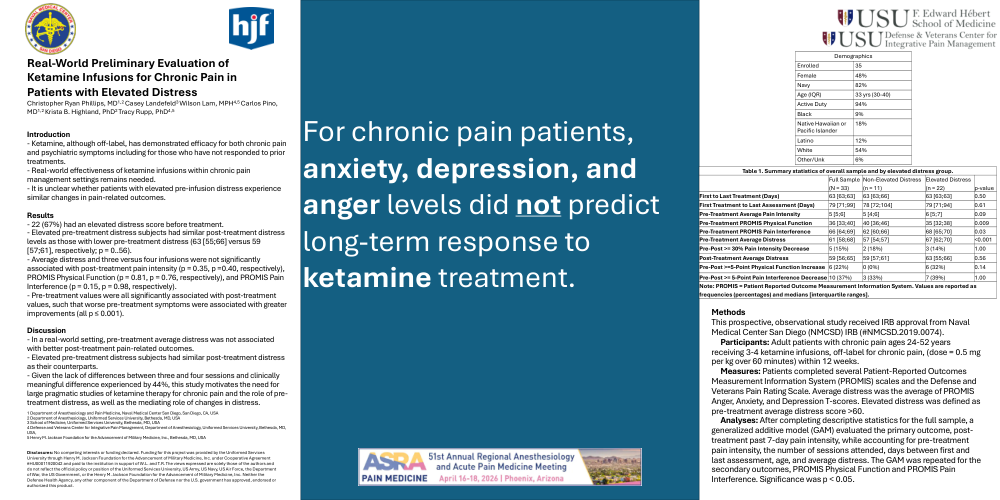
- 22 (67%) had an elevated distress score before treatment.
- Elevated pre-treatment distress subjects had similar post-treatment distress levels as those with lower pre-treatment distress (63 [55;66] versus 59 [57;61], respectively; p = 0..56).
- Average distress and three versus four infusions were not significantly associated with post-treatment pain intensity (p = 0.35, p =0.40, respectively), PROMIS Physical Function (p = 0.81, p = 0.76, respectively), and PROMIS Pain Interference (p = 0.15, p = 0.98, respectively).
- Pre-treatment values were all significantly associated with post-treatment values, such that worse pre-treatment symptoms were associated with greater improvements (all p ≤ 0.001).
Discussion
- In a real-world setting, pre-treatment average distress was not associated with better post-treatment pain-related outcomes.
- Elevated pre-treatment distress subjects had similar post-treatment distress as their counterparts.
- Given the lack of differences between three and four sessions and clinically meaningful difference experienced by 44%, this study motivates the need for large pragmatic studies of ketamine therapy for chronic pain and the role of pre-treatment distress, as well as the mediating role of changes in distress.