372 posters, 1 audios, 13 topics, 29 sessions, 1,035 authors, 449 institutions
ePostersLive by SciGen Technologies S.A. All rights reserved.
51st Annual Regional Anesthesiology and Acute Pain Medicine Meeting
April 16 - 18, 2026 | Phoenix, Arizona

2314291
Regional Anesthesia Exposure in U.S. Anesthesiology Residency Programs and Its Association with RAAPM Fellowship Pursuit
Poster Presenter
Authors
Affiliations
Part of Topic
Scientific Abstracts > Education
Introduction:
•Regional Anesthesia and Acute Pain Medicine (RAAPM) fellowships have experienced persistently high vacancy rates, with nearly half of available positions remaining unfilled in the 2024 match.
•This study evaluates anesthesiology residency program characteristics associated with greater pursuit of RAAPM fellowship training.
Materials/Methods:
•Retrospective cross-sectional study of all ACGME-accredited U.S. anesthesiology residency programs.
•Program-level data were collected from publicly available sources, including program websites and institutional materials; programs were contacted directly when information was unavailable.
•Residency programs’ characteristics were analyzed and compared with the number of residents matching into RAAPM fellowships (2023–2025) to identify factors associated with higher fellowship pursuit.
Results:
•Fellowship match outcomes were identified for 45 anesthesiology residency programs with publicly available data across the past three fellowship match cycles. Among these programs, most were university-based (57.8%) and large programs (>10 residents/year, 60%). An in-house RA fellowship was present in 35.6% of programs. Regional Anesthesia (RA)-trained leadership was uncommon (PD: 4.4%; APD: 8.9%).
•Nearly 47% of programs produced no RA fellows, while the top five programs accounted for 45% of all matches, indicating substantial variability in fellowship output.
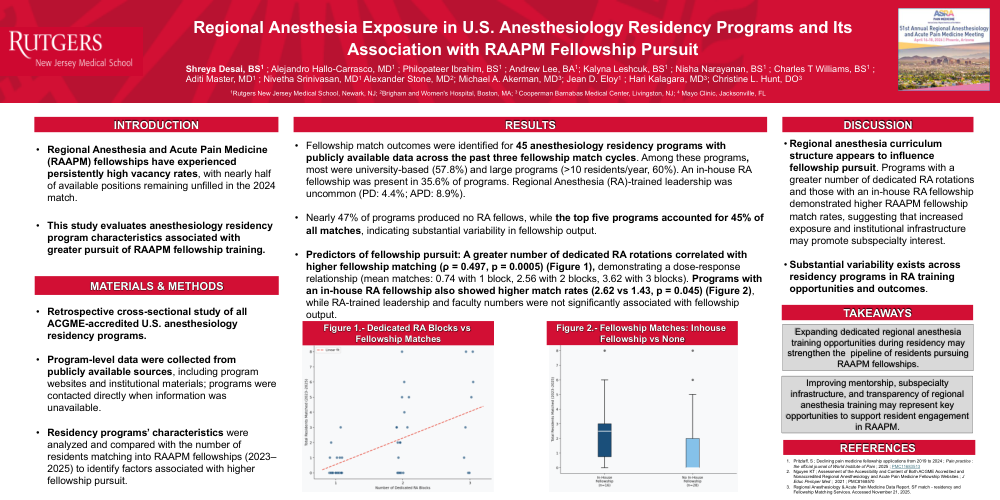
•Predictors of fellowship pursuit: A greater number of dedicated RA rotations correlated with higher fellowship matching (ρ = 0.497, p = 0.0005) (Figure 1), demonstrating a dose-response relationship (mean matches: 0.74 with 1 block, 2.56 with 2 blocks, 3.62 with 3 blocks). Programs with an in-house RA fellowship also showed higher match rates (2.62 vs 1.43, p = 0.045) (Figure 2), while RA-trained leadership and faculty numbers were not significantly associated with fellowship output.
Discussion:
•Regional anesthesia curriculum structure appears to influence fellowship pursuit. Programs with a greater number of dedicated RA rotations and those with an in-house RA fellowship demonstrated higher RAAPM fellowship match rates, suggesting that increased exposure and institutional infrastructure may promote subspecialty interest.
•Substantial variability exists across residency programs in RA training opportunities and outcomes.
Takeaways:
•Expanding dedicated regional anesthesia training opportunities during residency may strengthen the pipeline of residents pursuing RAAPM fellowships.
•Improving mentorship, subspecialty infrastructure, and transparency of regional anesthesia training may represent key opportunities to support resident engagement in RAAPM.