372 posters, 1 audios, 13 topics, 29 sessions, 1,035 authors, 449 institutions
ePostersLive by SciGen Technologies S.A. All rights reserved.
51st Annual Regional Anesthesiology and Acute Pain Medicine Meeting
April 16 - 18, 2026 | Phoenix, Arizona

2313483
Clinical accuracy and reliability of point-of-care ultrasound for perioperative diaphragmatic assessment: a scoping review
Poster Presenter
Authors
Eduardo Yamaguchi, Diogo Conceicao, Marina Englesakis, Anahi Perlas
Affiliations
Part of Topic
Scientific Abstracts > Education
Background
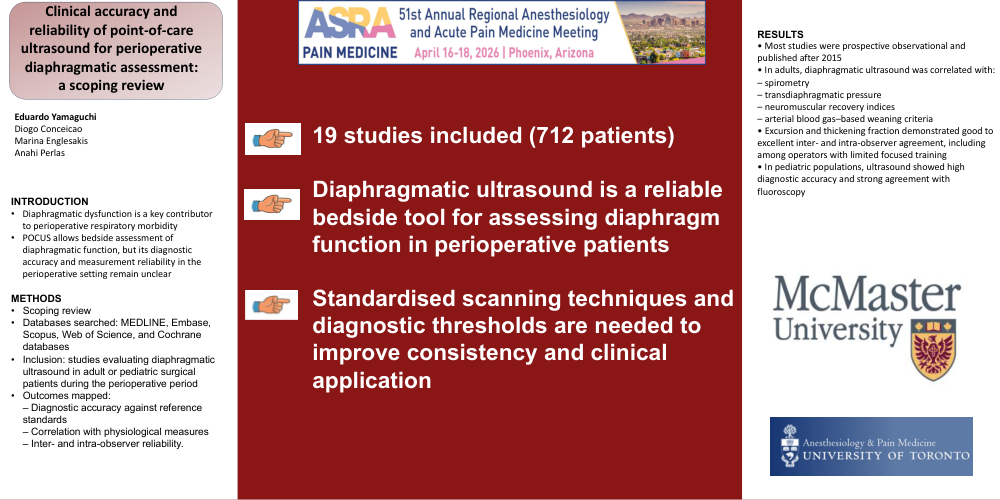
Diaphragmatic dysfunction is a common contributor to perioperative respiratory morbidity. Point-of-care ultrasound enables non-invasive bedside assessment of diaphragmatic structure and motion and is increasingly used in perioperative practice. However, despite its widespread clinical adoption, the diagnostic performance and measurement reliability of diaphragmatic ultrasound in the perioperative setting have not been systematically evaluated. This scoping review aimed to map the available evidence on perioperative diaphragmatic ultrasound, with particular emphasis on its reliability, reproducibility, and agreement with established reference standards.
Methods
A scoping review was conducted in accordance with Joanna Briggs Institute methodology and reported as per PRISMA-ScR. A protocol was registered on the Open Science Framework. Comprehensive searches of MEDLINE, MEDLINE ePubs and In-Process Citations, EMBASE, Scopus, Web of Science, and 2 Cochrane databases were undertaken. Eligible studies included paediatric or adult surgical patients in whom diaphragmatic ultrasound was performed during the perioperative period. Data were charted to describe study characteristics, ultrasound techniques, reference standards, and measures of diagnostic accuracy and inter- and intra-observer agreement.
Results
Nineteen studies comprising 712 patients met inclusion criteria. Most studies were prospective observational designs and were published after 2015. In adult populations, diaphragmatic ultrasound showed variable but generally positive correlations with spirometric indices, transdiaphragmatic pressure, electrophysiological measures, neuromuscular recovery, and arterial blood gas–based weaning criteria. Clinically relevant excursion and thickening cut-offs were reported in several settings, although thresholds were inconsistent across studies. Inter- and intra-observer agreement for diaphragmatic excursion and thickening fraction was generally good to excellent, including among operators with limited focused training. In pediatric populations, diaphragmatic ultrasound demonstrated high diagnostic accuracy and strong agreement with fluoroscopy, with excellent interobserver reliability.
Conclusions
Perioperative diaphragmatic ultrasound demonstrates acceptable reliability and reproducibility, with overall good agreement against established reference standards. Ultrasound-derived measures provide clinically relevant information on diaphragmatic mechanics and neuromuscular function, although heterogeneity in techniques and outcome definitions limits comparability. Standardisation of acquisition protocols, reporting, and reference thresholds, together with further studies linking ultrasound findings to clinical outcomes, are needed to define its optimal role in perioperative care.