372 posters, 1 audios, 13 topics, 29 sessions, 1,035 authors, 449 institutions
ePostersLive by SciGen Technologies S.A. All rights reserved.
51st Annual Regional Anesthesiology and Acute Pain Medicine Meeting
April 16 - 18, 2026 | Phoenix, Arizona

2318488
Intralipid Administration with Complete Reversal of Peripheral Nerve Blocks: A Case Report
Poster Presenter
Authors
Affiliations
Part of Topic
Scientific Abstracts > Regional Anesthesia
Intralipid Administration with Complete Reversal of Peripheral Nerve Blocks: A Case Report
Ashton Pike, MD, Ryan Ivie, MD, Nathalie Lunden, MD
Department of Anesthesiology at Oregon Health and Science University – Portland, OR
Intravenous lipid emulsion (ILE) is a well-established therapy for local anesthetic systemic toxicity (LAST); however, accumulating case reports suggest that ILE may also reverse established peripheral nerve blockade independent of systemic toxicity1-3. Proposed mechanisms include lipid sequestration and altered tissue pharmacokinetics of amide local anesthetics. We present a case in which ILE was administered out of precaution in the absence of LAST, followed by resolution of a previously functioning peripheral nerve block.
Materials and Methods
As this case report contains no patient-identifiable information, it is exempt from Institutional Review Board (IRB) review requirements per institutional IRB policy; documentation is available upon request. Informed consent was waived per IRB policy. Intravenous lipid emulsion was administered off-label as a precautionary measure in the setting of intraoperative hemodynamic instability. No Investigational New Drug (IND) approval was required.
Case Report
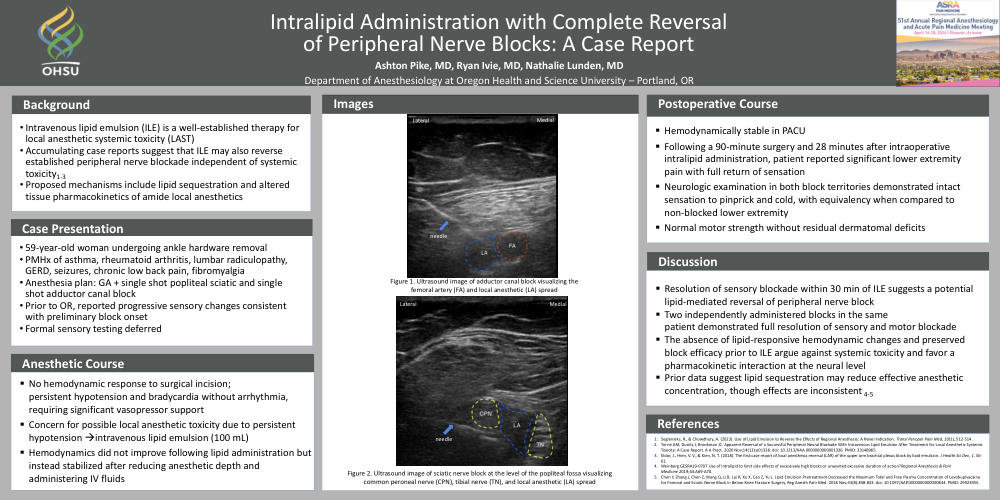
A 59 year old, 93 kg woman, with a lean body weight (LBW) of 52.1, undergoing ankle hardware removal, received preoperative popliteal sciatic and adductor canal single-shot blocks using 30 mL total 0.5% bupivacaine under ultrasound guidance with minimal sedation. Prior to OR transport, the patient reported progressive sensory changes consistent with preliminary block onset. Formal sensory testing was deferred due to the plan for general anesthesia. Following induction, the patient developed persistent hypotension and bradycardia without arrhythmia, requiring significant vasopressor support. Importantly, there were no hemodynamic responses to surgical incision, supporting the presence of a functioning peripheral nerve block. Given concern for possible local anesthetic effects, intravenous lipid emulsion (100 mL) was administered as a precaution. Hemodynamics did not improve following lipid administration but stabilized after reducing anesthetic depth and administering intravenous fluid.
Postoperatively, following the 91 minute surgery and 28 min after intralipid administration, the patient reported significant lower extremity pain with full return of sensation. Formal neurologic examination in both block territories demonstrated intact pinprick and cold sensation, normal motor strength, and no residual dermatomal deficits. The resolution of sensory blockade within 30 min of ILE administration suggests a potential lipid-mediated reversal of peripheral nerve block.
Discussion
This case suggests that intravenous lipid emulsion may reverse peripheral nerve blockade independent of LAST. Two independently administered blocks in the same patient demonstrated complete resolution of sensory and motor blockade. The absence of lipid-responsive hemodynamic changes and preserved intraoperative block efficacy argue against systemic toxicity and favor a pharmacokinetic interaction at the neural level. Prior data suggest lipid sequestration may reduce effective anesthetic concentration, though effects are inconsistent 4-5. Further controlled studies are warranted.


References
-
Seglenieks, R., & Chowdhury, A. (2023). Use of Lipid Emulsion to Reverse the Effects of Regional Anesthesia: A Novel Indication. Transl Perioper Pain Med, 10(1), 512-514.
-
Torrie AM, Dunitz J, Brookman JC. Apparent Reversal of a Successful Peripheral Neural Blockade With Intravenous Lipid Emulsion After Treatment for Local Anesthetic Systemic Toxicity: A Case Report. A A Pract. 2020 Nov;14(13):e01336. doi: 10.1213/XAA.0000000000001336. PMID: 33148965.
-
Eldor, J., Hien, V. V., & Kien, N. T. (2018). The first case report of local anesthesia reversal (LAR) of the upper arm brachial plexus block by lipid emulsion. J Health Sci Dev, 1, 56-61.
-
Weinberg GESRA19-0707 Use of intralipid to limit side effects of excessively high blocks or unwanted excessive duration of action? Regional Anesthesia & Pain Medicine 2019;44:A69-A70.
-
Chen Y, Zhang J, Chen Z, Wang Q, Li B, Lai R, Xu X, Cao Z, Yu L. Lipid Emulsion Pretreatment Decreased the Maximum Total and Free Plasma Concentration of Levobupivacaine for Femoral and Sciatic Nerve Block in Below-Knee Fracture Surgery. Reg Anesth Pain Med. 2018 Nov;43(8):838-843. doi: 10.1097/AAP.0000000000000834. PMID: 29923955.