372 posters, 1 audios, 13 topics, 29 sessions, 1,035 authors, 449 institutions
ePostersLive by SciGen Technologies S.A. All rights reserved.
51st Annual Regional Anesthesiology and Acute Pain Medicine Meeting
April 16 - 18, 2026 | Phoenix, Arizona

2316097
Preoperative Versus Postoperative Paravertebral Catheters in Minimally Invasive Cardiac Surgery
Poster Presenter
Authors
Affiliations
Part of Topic
Scientific Abstracts > Regional Anesthesia
Introduction and Objectives:
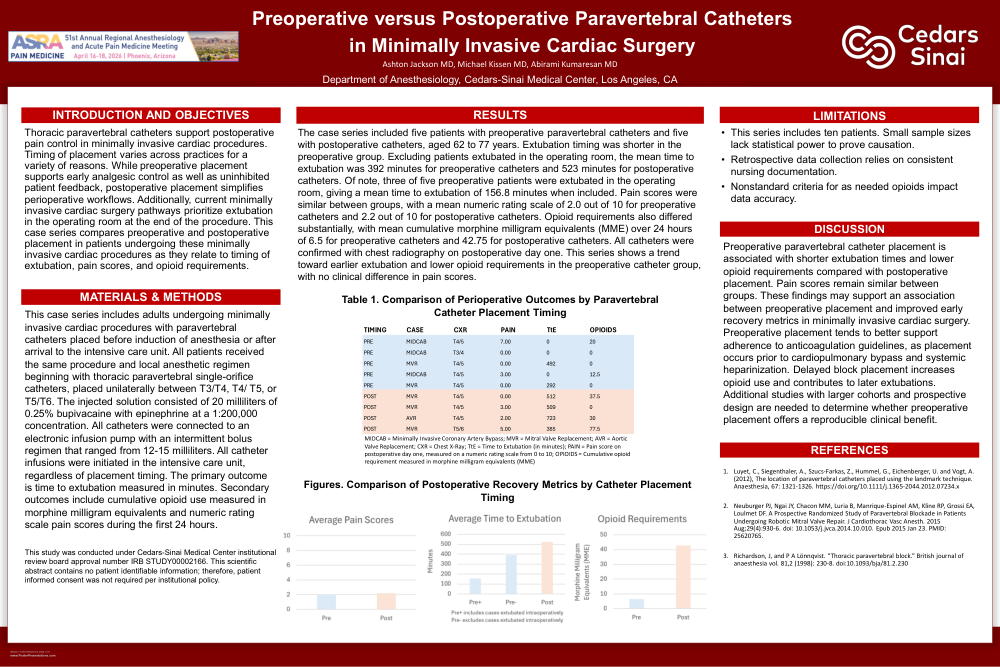
Thoracic paravertebral catheters support postoperative pain control in minimally invasive cardiac procedures. Timing of placement varies across practices for a variety of reasons. While preoperative placement supports early analgesic control as well as uninhibited patient feedback, postoperative placement simplifies perioperative workflow and adherence to anticoagulation recommendations. This case series compares preoperative and postoperative placement in patients undergoing these minimally invasive cardiac procedures as they relate to timing of extubation, pain scores, and opioid requirements.
Materials & Methods:
This case series includes adults undergoing minimally invasive cardiac procedures with paravertebral catheters placed before induction of anesthesia or after arrival to the intensive care unit. All patients received the same procedure and local anesthetic regimen beginning with thoracic paravertebral single-orifice catheters, placed unilaterally between T3/T4, T4/ T5, or T5/T6. The injected solution consisted of 20 milliliters of 0.25% bupivacaine with epinephrine at a 1:200,000 concentration. All catheters were connected to an electronic infusion pump with an intermittent bolus regimen that ranged from 12-15 milliliters. All catheter infusions were initiated in the intensive care unit, regardless of placement timing. The primary outcome is time to extubation measured in minutes. Secondary outcomes include cumulative opioid use measured in morphine milligram equivalents and numeric rating scale pain scores during the first 24 hours.
This study was conducted under Cedars-Sinai Medical Center institutional review board approval number IRB STUDY00002166.
Results:
The case series included five patients with preoperative paravertebral catheters and five with postoperative catheters, aged 62 to 77 years. Extubation timing was shorter in the preoperative group. Excluding patients extubated in the operating room, the mean time to extubation was 392 minutes for preoperative catheters and 523 minutes for postoperative catheters. Of note, three of five preoperative patients were extubated in the operating room, giving a mean time to extubation of 156.8 minutes when included. Pain scores were similar between groups, with a mean numeric rating scale of 2.0 out of 10 for preoperative catheters and 2.2 out of 10 for postoperative catheters. Opioid requirements also differed substantially, with mean cumulative morphine milligram equivalents (MME) over 24 hours of 6.5 for preoperative catheters and 42.75 for postoperative catheters. All catheters were confirmed with chest radiography on postoperative day 1. This series shows a trend toward earlier extubation and lower opioid requirements in the preoperative catheter group, with no clinical difference in pain scores.
Discussion:
Preoperative paravertebral catheter placement is associated with shorter extubation times and lower opioid requirements compared with postoperative placement. Pain scores remain similar between groups. All catheters were confirmed radiographically on postoperative day one, supporting technical feasibility. These findings support a possible association between preoperative placement and improved early recovery metrics in minimally invasive cardiac surgery. Additional studies with larger cohorts and prospective design are needed to determine whether preoperative placement offers a reproducible clinical benefit.
References:
- Luyet, C., Siegenthaler, A., Szucs-Farkas, Z., Hummel, G., Eichenberger, U. and Vogt, A. (2012), The location of paravertebral catheters placed using the landmark technique. Anaesthesia, 67: 1321-1326. https://doi.org/10.1111/j.1365-2044.2012.07234.x
- Neuburger PJ, Ngai JY, Chacon MM, Luria B, Manrique-Espinel AM, Kline RP, Grossi EA, Loulmet DF. A Prospective Randomized Study of Paravertebral Blockade in Patients Undergoing Robotic Mitral Valve Repair. J Cardiothorac Vasc Anesth. 2015 Aug;29(4):930-6. doi: 10.1053/j.jvca.2014.10.010. Epub 2015 Jan 23. PMID: 25620765.
- Richardson, J, and P A Lönnqvist. “Thoracic paravertebral block.” British journal of anaesthesia vol. 81,2 (1998): 230-8. doi:10.1093/bja/81.2.230