372 posters, 1 audios, 13 topics, 29 sessions, 1,035 authors, 449 institutions
ePostersLive by SciGen Technologies S.A. All rights reserved.
51st Annual Regional Anesthesiology and Acute Pain Medicine Meeting
April 16 - 18, 2026 | Phoenix, Arizona

2364653
Superficial Parasternal Intercostal Plane Block for Manubrial Fracture in a Geriatric Patient with Chronic Pain
Poster Presenter
Authors
Carter Theade, Haley Hopkinson, Bobby Gosey, Josianna Henson
Affiliations
Part of Topic
Late Breaking Medically Challenging Cases
Introduction
•Current management of pain from sternal fractures relies primarily on oral, IV, and topical agents. These modalities can be associated with adverse side effects1
•Robust evidence demonstrates that superficial parasternal intercostal plane (SPIP) blocks reduce pain scores and opioid consumption after sternotomy for cardiothoracic surgery 2
•Despite similar anatomical patterns of pain, their application to traumatic sternal fractures has not been widely studied 2,3,4,5
•We report on a patient who received bilateral SPIP blocks after a traumatic manubrial fracture
Methods
•A literature review was performed investigating regional anesthesia for traumatic sternal fractures. The patient’s chart was thoroughly reviewed, and her course is reported here. At the time of the nerve block, the patient gave verbal consent to write this case report.
•It does not contain any patient-identifiable information; therefore, it is exempt from IRB review as per Colorado Multiple Institutional Review Board (COMIRB) policy.
Case
•A 73-year-old female with a history of OSA, HTN, HFrEF, T2DM, CKD, and chronic pain on opioid therapy (60 MME daily) presented with a manubrial fracture after a ground-level fall
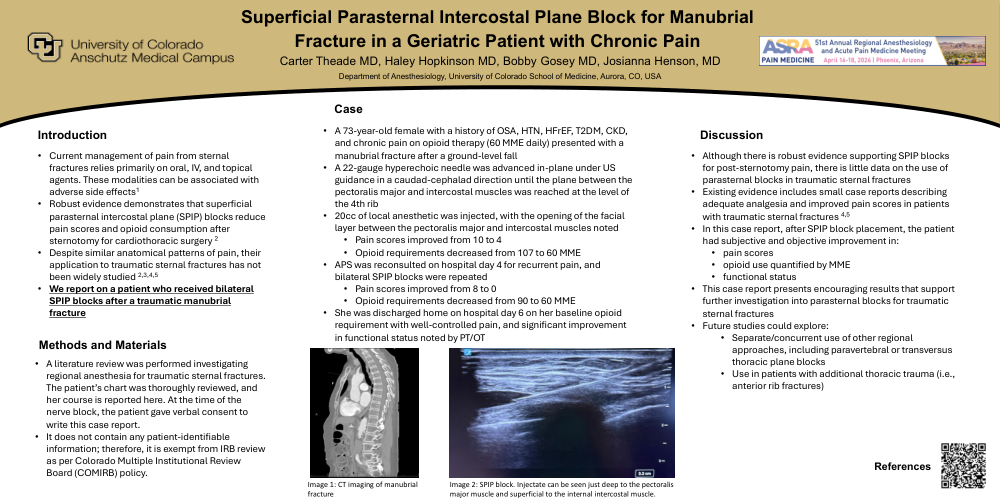
•A 22-gauge hyperechoic needle was advanced in-plane under US guidance in a caudad-cephalad direction until the plane between the pectoralis major and intercostal muscles was reached at the level of the 4th rib
•20cc of local anesthetic was injected, with the opening of the facial layer between the pectoralis major and intercostal muscles noted
•Pain scores improved from 10 to 4
•Opioid requirements decreased from 107 to 60 MME
•APS was reconsulted on hospital day 4 for recurrent pain, and bilateral SPIP blocks were repeated
•Pain scores improved from 8 to 0
•Opioid requirements decreased from 90 to 60 MME
•She was discharged home on hospital day 6 on her baseline opioid requirement with well-controlled pain, and significant improvement in functional status noted by PT/OT
Discussion
•Although there is robust evidence supporting SPIP blocks for post-sternotomy pain, there is little data on the use of parasternal blocks in traumatic sternal fractures
•Existing evidence includes small case reports describing adequate analgesia and improved pain scores in patients with traumatic sternal fractures 4,5
•In this case report, after SPIP block placement, the patient had subjective and objective improvement in:
•pain scores
•opioid use quantified by MME
•functional status
•This case report presents encouraging results that support further investigation into parasternal blocks for traumatic sternal fractures
•Future studies could explore:
•Separate/concurrent use of other regional approaches, including paravertebral or transversus thoracic plane blocks
•Use in patients with additional thoracic trauma (i.e., anterior rib fractures)