372 posters, 1 audios, 13 topics, 29 sessions, 1,035 authors, 449 institutions
ePostersLive by SciGen Technologies S.A. All rights reserved.
51st Annual Regional Anesthesiology and Acute Pain Medicine Meeting
April 16 - 18, 2026 | Phoenix, Arizona

2364604
Liposomal Bupivacaine, Plain Bupivacaine, and Saline for Transversus Abdominis Plane Blocks: The CLEVELAND Randomized Trial
Poster Presenter
Authors
Elyad Ekrami, Wael Ali Sakr Esa, Busra Tok Cekmecelioglu, Harsha Nair, Karan Shah, Nour El Hage Chehade, Daniel Sessler, Alparslan Turan
Affiliations
Outcomes Research Consortium, Houston, TX, USA, Department of Anesthesiology, Cleveland Clinic, Cleveland, OH, USA, Department of Quantitative Health Sciences, Cleveland Clinic, Cleveland, OH, USA
Part of Topic
Late Breaking Scientific Abstracts
Introduction
Transversus abdominis plane (TAP) blocks are commonly used in Enhanced Recovery After Surgery pathways to reduce postoperative pain and opioid use after abdominal surgery.
TAP blocks provide abdominal wall analgesia but do not treat visceral pain, so their clinical benefit remains uncertain.
Liposomal bupivacaine may prolong analgesia after single-injection TAP blocks, but evidence compared with conventional bupivacaine is inconsistent.
The co-primary hypotheses were that opioid consumption during the first 24 postoperative hours would be greater with saline placebo than with liposomal or plain bupivacaine, and that opioid consumption during 24–48 hours would be lower with liposomal bupivacaine than with saline or plain bupivacaine.
The secondary hypothesis was that liposomal bupivacaine TAP blocks would result in longer duration of local anesthetic effect, lower pain scores during the first 72 postoperative hours, and reduced opioid requirements between 48–72 hours compared with plain bupivacaine and saline.
Methods
Design: Investigator-initiated, randomized, blinded clinical trial conducted at Cleveland Clinic.
Population: Adults aged 18–85 years undergoing elective open or laparoscopic abdominal surgery.
Randomization: Participants were randomized in a 1:1:1 ratio to receive liposomal bupivacaine TAP block, plain bupivacaine TAP block, or saline placebo TAP block.
Intervention: Pre-incision bilateral four-quadrant ultrasound-guided TAP blocks were performed. Patients, clinicians managing analgesia, nurses assessing pain, and investigators were blinded to treatment allocation.
Outcomes: The co-primary outcomes were opioid consumption expressed as morphine milligram equivalents during the first 24 hours and during 24–48 hours postoperatively. Secondary outcomes included duration of sensory block, pain scores during the first 72 postoperative hours, and opioid consumption during 48–72 hours.
Results
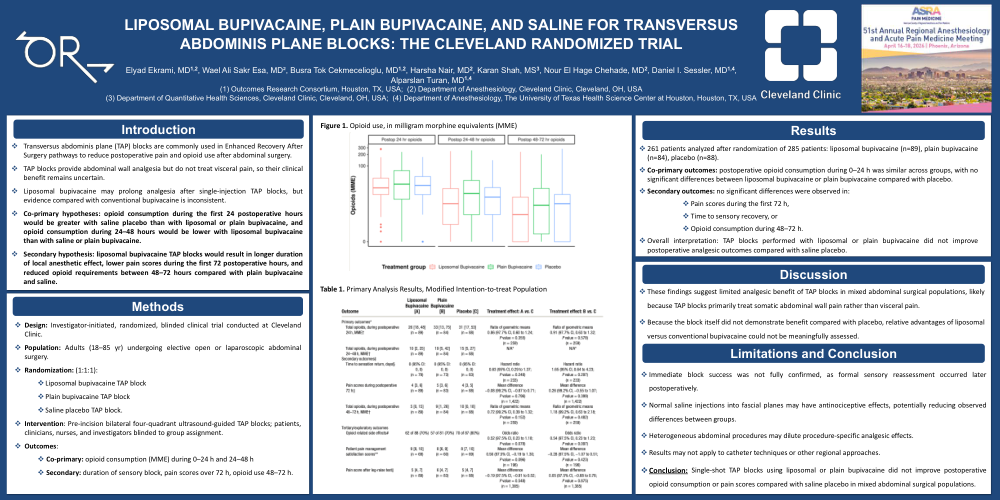
A total of 261 patients were analyzed after randomization of 285 patients: liposomal bupivacaine (n=89), plain bupivacaine (n=84), and placebo (n=88).
For the co-primary outcomes, postoperative opioid consumption during the first 24 hours was similar across groups, with no significant differences between liposomal bupivacaine or plain bupivacaine compared with placebo.
Secondary outcomes also showed no significant differences between groups. Pain scores during the first 72 hours, time to sensory recovery, and opioid consumption during 48–72 hours were comparable among the liposomal bupivacaine, plain bupivacaine, and placebo groups.
Overall, TAP blocks performed with liposomal or plain bupivacaine did not improve postoperative analgesic outcomes compared with saline placebo.
Discussion
These findings suggest limited analgesic benefit of TAP blocks in mixed abdominal surgical populations, likely because TAP blocks primarily treat somatic abdominal wall pain rather than visceral pain.
Because the block itself did not demonstrate benefit compared with placebo, relative advantages of liposomal versus conventional bupivacaine could not be meaningfully assessed.
Limitations
Immediate block success was not fully confirmed, as formal sensory reassessment occurred later postoperatively.
Normal saline injections into fascial planes may have antinociceptive effects, potentially reducing observed differences between groups.
Heterogeneous abdominal procedures may dilute procedure-specific analgesic effects.
Results may not apply to catheter techniques or other regional analgesic approaches.
Conclusion
Single-shot TAP blocks using liposomal or plain bupivacaine did not improve postoperative opioid consumption or pain scores compared with saline placebo in mixed abdominal surgical populations.