372 posters, 1 audios, 13 topics, 29 sessions, 1,035 authors, 449 institutions
ePostersLive by SciGen Technologies S.A. All rights reserved.
51st Annual Regional Anesthesiology and Acute Pain Medicine Meeting
April 16 - 18, 2026 | Phoenix, Arizona

2318770
Updated Systematic Review and Meta-Analysis of Electroacupuncture for Gastrointestinal Recovery After Gynecologic Surgery
Poster Presenter
Authors
Milton Rangel Silva Neto, Lucas Cordeiro Neves, Catherine Maria Fasano Werner, Raquel Vieira Torres, Ligia Sant’Ana Dumont, Mariana Tonelli Ricci, Hiorrana Sousa Dias, Glaudir Donato, Gabriel Lemos González, Rafaela Duarte Vergna, Miguel Chaves Lenzi, Tatiana Souza do Nascimento
Affiliations
University of Iowa, Universidade do Estado do Rio Grande do Norte, Faculdade de Medicina de Itajubá, Universidade José do Rosario Vellano, Universidade Federal de Juiz de Fora, Universidade Estadual de Londrina, Universidade Evangélica de Goiás, Universidade Christus, Universidade Federal da Paraíba, Universidade Federal do Estado do Rio de Janeiro
Part of Topic
Scientific Abstracts > Regional Anesthesia
Electroacupuncture for Gastrointestinal Function Recovery after Gynecologic Surgery: A Systematic Review and Meta-Analysis of randomized controlled trials.
Silva Neto, M.R.; Neves, L.C.; Werner, C.; Torres, R.V.; Dumont, L.; Ricci, M.; Dias, H.; Donato, G.; Dias, H.; González, G.L.;Vergna, R.D.; Lenzi, M.C.; do Nascimento, T.S.
INTRODUCTION
The existing evidence regarding the efficacy and safety of electroacupuncture (EA) in promoting gastrointestinal function recovery after gynecological surgery remains inconsistent and controversial. Therefore, this meta-analysis aimed to assess the effects of EA on postoperative gastrointestinal function recovery in patients undergoing gynecological surgical procedures.
MATERIALS AND METHODS:
Trials (CINAHL), Embase, databases were sistematically searched for randomized controlled trials (RCTs) that compared EA with other therapies or no intervention for postoperative gastrointestinal function after gynecological surgery in adults aged 18 years or over. In addition, the snowballing technique was applied, retrieving RCTs from a previous meta-analysis (1). Primary outcomes were time to first flatus (TFF), postoperative nausea and vomiting (PONV), and pain at 24h, assessed through the Visual Analogue Scale (VAS). Statistical analyses were performed using Review Manager version 5.4. Standardized mean differences (SMDs) and risk ratios (RR) were calculated as the effect measure from a random-effects model.
RESULTS:
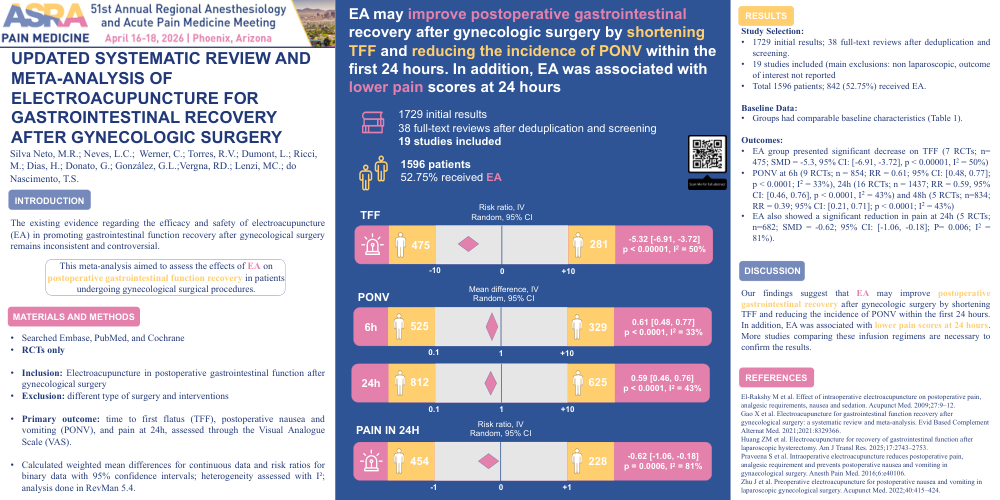
We included twenty RCTs (1596 participants) with 842 (52,75%) patients allocated to the EA group. Compared to the control group (CG), the EA group presented significant decrease on TFF (7 RCTs; n= 475; SMD = -5.3, 95% CI: [-6.91, -3.72], p < 0.00001, I 2 = 50%). On PONV at 6 h (9 RCTS; N=854; RR = 0.61; 95% CI: [0.48, 0.77]; p < 0.0001; I 2 = 33%), 24 h (16 RCTs; n=1437; RR = 0.59, 95% CI: [0.46, 0.76], p < 0.0001, I 2 = 43%) and 48 h (5 RCTs; n=834; RR = 0.39; 95% CI: [0.21, 0.71]; p <0.0001; I 2 = 43%). EA also showed a significant reduction in pain at 24h (5 RCTs; n=682; SMD = -0.62; 95% CI: [-1.06, -0.18]; P= 0.006; I 2 = 81%).


Figure 2. Meta-analysis of postoperative nausea and vomiting (PONV) at 8h, 24h, and 48h. Electroacupuncture (EA) significantly reduced the risk of PONV across all time points (P<0.00001), with moderate overall heterogeneity (I² = 37%)

Figure 3. Meta-analysis of time to first flatus. The experimental group showed a significant reduction in recovery time compared to control (MD -5.32; 95% CI [-6.91, -3.72]; P<0.00001; I² = 50%).

Figure 4. Meta-analysis of pain scores (VAS). The experimental group showed significantly lower pain scores than the control group (MD -0.62; P=0.006), with high heterogeneity (I²=81%).
DISCUSSION:
Our findings suggest that EA may improve postoperative gastrointestinal recovery after gynecologic surgery by shortening TFF and reducing the incidence of PONV within the first 24 hours. In addition, EA was associated with lower pain scores at 24 hours postoperatively. However, the overall quality of evidence ranged from low to very low, highlighting the need for large, high-quality randomized controlled trials.
REFERENCES
-
El-Rakshy M, Clark SC, Thompson J, Thant M. Effect of intraoperative electroacupuncture on postoperative pain, analgesic requirements, nausea and sedation: a randomised controlled trial. Acupunct Med. 2009 Mar;27(1):9-12. doi: 10.1136/aim.2008.000075. PMID: 19369187.
-
Gao X, Zhang Y, Zhang Y, Ku Y, Guo Y. Electroacupuncture for Gastrointestinal Function Recovery after Gynecological Surgery: A Systematic Review and Meta-Analysis. Evid Based Complement Alternat Med. 2021 Dec 21;2021:8329366. doi: 10.1155/2021/8329366. PMID: 34970326; PMCID: PMC8714373.
-
Huang ZM, Wang Y, Ni MC, Deng L, Wang YZ. Electroacupuncture for recovery of gastrointestinal function after laparoscopic hysterectomy surgery: a prospective, randomized, controlled trial. Am J Transl Res. 2025 Apr 15;17(4):2743-2753. doi: 10.62347/WNTO7078. PMID: 40385060; PMCID: PMC12082527.
-
Praveena Seevaunnamtum S, Bhojwani K, Abdullah N. Intraoperative Electroacupuncture Reduces Postoperative Pain, Analgesic Requirement and Prevents Postoperative Nausea and Vomiting in Gynaecological Surgery: A Randomised Controlled Trial. Anesth Pain Med. 2016 Oct 29;6(6):e40106. doi: 10.5812/aapm.40106. PMID: 28975075; PMCID: PMC5560591.
-
Zhu J, Li S, Wu W, Guo J, Wang X, Yang G, Lu Z, Ji F, Zou R, Zheng Z, Zheng M. Preoperative electroacupuncture for postoperative nausea and vomiting in laparoscopic gynecological surgery: a randomized controlled trial. Acupunct Med. 2022 Oct;40(5):415-424. doi: 10.1177/09645284221076517. Epub 2022 Mar 1. PMID: 35229627.