372 posters, 1 audios, 13 topics, 29 sessions, 1,035 authors, 449 institutions
ePostersLive by SciGen Technologies S.A. All rights reserved.
51st Annual Regional Anesthesiology and Acute Pain Medicine Meeting
April 16 - 18, 2026 | Phoenix, Arizona

2318748
Analgesic techniques for pain management in non-neonatal circumcision: a network meta-analysis
Poster Presenter
Authors
Gabriel Lemos González, Gustavo Roberto Minetto Wegner, Bruno Francisco Minetto Wegner, Iaci Luisa Lopes Mattos, Lucas Cordeiro Neves, Mariana Tonelli Ricci, Raquel Vieira Torres, Catherine Maria Fasano Werner, Tatiana Souza Nascimento
Affiliations
UNIRIO, University of Iowa, Universidade Federal do Rio Grande do Sul, Universidade Federal do Estado do Rio de Janeiro - UNIRIO, Universidade Federal da Fronteira Sul, Faculdade de Medicina de Itajubá, Universidade José do Rosario Vellano, Universidade Federal de Juiz de Fora, Universidade Estadual de Londrina
Part of Topic
Scientific Abstracts > Regional Anesthesia
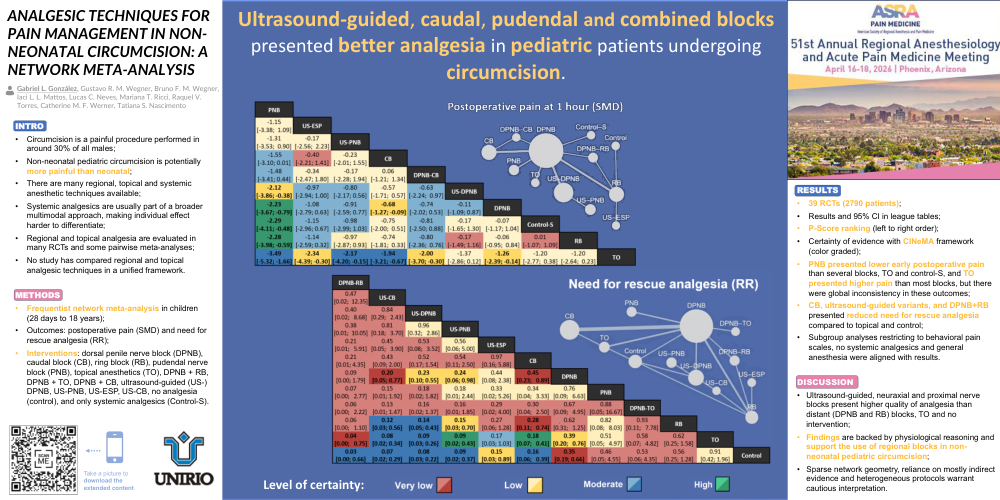
ANALGESIC TECHNIQUES FOR PAIN MANAGEMENT IN NON-NEONATAL CIRCUMCISION: A NETWORK META-ANALYSIS Gabriel L. González , Gustavo R. M. Wegner, Bruno F. M. Wegner, Iaci L. L. Mattos, Lucas C. Neves, Mariana T. Ricci, Raquel V. Torres, Catherine M. F. Werner, Tatiana S. Nascimento INTRO • Circumcision is a painful procedure performed in around 30% of all males; • Non-neonatal pediatric circumcision is potentially more painful than neonatal; • There are many regional, topical and systemic anesthetic techniques available; • Systemic analgesics are usually part of a broader multimodal approach, making individual effect harder to differentiate; • Regional and topical analgesia are evaluated in many RCTs and some pairwise meta-analyses; Non-Cognitive Predictors of Student Success: A Predictive Validity Comparison Between Domestic and International Students • No study has compared regional and topical analgesic techniques in a unified framework. METHODS • Frequentist network meta-analysis in children (28 days to 18 years); • Outcomes: postoperative pain (SMD) and need for rescue analgesia (RR); • Interventions: dorsal penile nerve block (DPNB), caudal block (CB), ring block (RB), pudendal nerve block (PNB), topical anesthetics (TO), DPNB + RB, DPNB + TO, DPNB + CB, ultrasound-guided (US-) DPNB, US-PNB, US-ESP, US-CB, no analgesia (control), and only systemic analgesics (Control-S). Take a picture to download the extended content Ultrasound-guided, caudal, pudendal and combined blocks presented better analgesia in pediatric patients undergoing circumcision. Level of certainty: RESULTS • 39 RCTs (2790 patients); • Results and 95% CI in league tables; • P-Score ranking (left to right order); • Certainty of evidence with CINeMA framework (color graded); Non-Cognitive Predictors of Student Success: • PNB presented lower early postoperative pain than several blocks, TO and control-S, and TO presented higher pain than most blocks, but there were global inconsistency in these outcomes; A Predictive Validity Comparison Between Domestic and International Students • CB, ultrasound-guided variants, and DPNB+RB presented reduced need for rescue analgesia compared to topical and control; • Subgroup analyses restricting to behavioral pain scales, no systemic analgesics and general anesthesia were aligned with results. DISCUSSION • Ultrasound-guided, neuraxial and proximal nerve blocks present higher quality of analgesia than distant (DPNB and RB) blocks, TO and no intervention; • Findings are backed by physiological reasoning and support the use of regional blocks in non-neonatal pediatric circumcision; • Sparse network geometry, reliance on mostly indirect evidence and heterogeneous protocols warrant cautious interpretation.