372 posters, 1 audios, 13 topics, 29 sessions, 1,035 authors, 449 institutions
ePostersLive by SciGen Technologies S.A. All rights reserved.
51st Annual Regional Anesthesiology and Acute Pain Medicine Meeting
April 16 - 18, 2026 | Phoenix, Arizona

2318700
University of Iowa Health Care Anesthesia Department Gastric POCUS Training Initiative
Poster Presenter
Authors
Affiliations
Part of Topic
Scientific Abstracts > Education
Introduction
•Pulmonary aspiration of gastric contents is a rare but potentially catastrophic perioperative complication
•Despite ASA fasting guidelines, aspiration risk has become increasingly uncertain with the widespread use of glucagon-like peptide-1 receptor agonists (GLP-1RAs)
•Point-of-care gastric ultrasound (gastric POCUS) has emerged as a rapid bedside tool to evaluate gastric contents and aspiration risk
Goals
•Implement a standardized gastric POCUS training program
•Improve provider confidence in image acquisition and interpretation
•Evaluate educational impact using survey-based outcomes
Methods
•This educational initiative does not contain identifiable patient information thus is exempt from IRB review requirements as per University of Iowa policy
Workshop Structure
•One-hour sessions led by two POCUS-trained instructors, occurring from August to October 2025
•15-minute didactic presentation to review indications, technique, interpretation of findings, and clinical application of gastric POCUS
•Hands-on scanning session of two standardized patients – one appropriately NPO and the other having recently consumed a full meal
•Subsequent real-time scanning as NPO patient drinks carbonated liquid to see change in exam and perform validated measurements
Outcome assessment
•Pre- and post-test knowledge assessments
•Pre- and post-test self-reported confidence and competency using a 5-point Likert scale
•6-month follow-up assessment of both knowledge and self-reported competency (ongoing)
Training Sessions
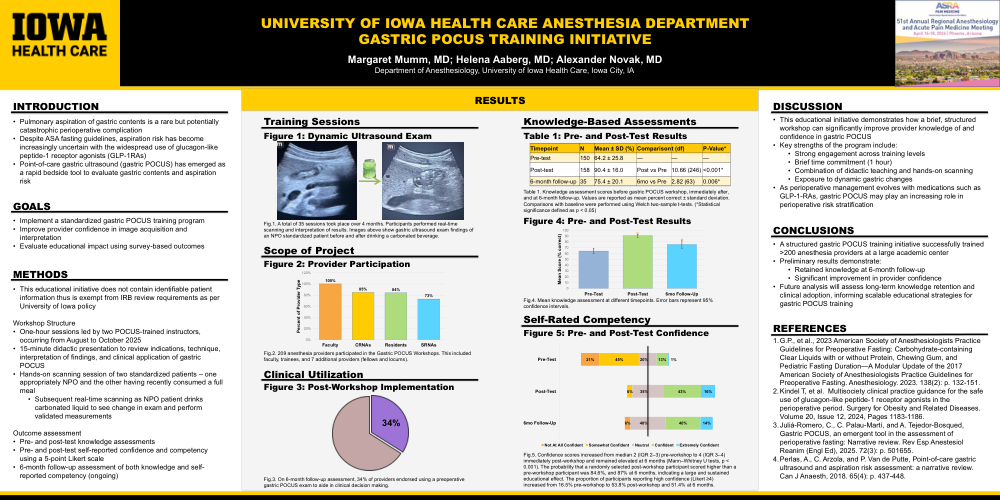
Fig.1. A total of 35 sessions took place over 4 months. Participants performed real-time scanning and interpretation of results. Images above show gastric ultrasound exam findings of an NPO standardized patient before and after drinking a carbonated beverage.
Scope of Project
Fig.2. 209 anesthesia providers participated in the Gastric POCUS Workshops. This included faculty, trainees, and 7 additional providers (fellows and locums).
Clinical Utilization
Fig.3. On 6-month follow-up assessment, 34% of providers endorsed using a preoperative gastric POCUS exam to aide in clinical decision making.
Knowledge-Based Assessments
Table 1. Knowledge assessment scores before gastric POCUS workshop, immediately after, and at 6-month follow-up. Values are reported as mean percent correct ± standard deviation. Comparisons with baseline were performed using Welch two-sample t-tests. (*Statistical significance defined as p < 0.05)
Self-Rated Competency
Fig.5. Confidence scores increased from median 2 (IQR 2–3) pre-workshop to 4 (IQR 3–4) immediately post-workshop and remained elevated at 6 months (Mann–Whitney U tests, p < 0.001). The probability that a randomly selected post-workshop participant scored higher than a pre-workshop participant was 84.6%, and 87% at 6 months, indicating a large and sustained educational effect. The proportion of participants reporting high confidence (Likert ≥4) increased from 16.5% pre-workshop to 53.8% post-workshop and 51.4% at 6 months.
Discussion
•This educational initiative demonstrates how a brief, structured workshop can significantly improve provider knowledge of and confidence in gastric POCUS
•Key strengths of the program include:
•Strong engagement across training levels
•Brief time commitment (1 hour)
•Combination of didactic teaching and hands-on scanning
•Exposure to dynamic gastric changes
•As perioperative management evolves with medications such as GLP-1-RAs, gastric POCUS may play an increasing role in perioperative risk stratification
Conclusions
•A structured gastric POCUS training initiative successfully trained >200 anesthesia providers at a large academic center
•Preliminary results demonstrate:
•Retained knowledge at 6-month follow-up
•Significant improvement in provider confidence
•Future analysis will assess long-term knowledge retention and clinical adoption, informing scalable educational strategies for gastric POCUS training