372 posters, 1 audios, 13 topics, 29 sessions, 1,035 authors, 449 institutions
ePostersLive by SciGen Technologies S.A. All rights reserved.
51st Annual Regional Anesthesiology and Acute Pain Medicine Meeting
April 16 - 18, 2026 | Phoenix, Arizona

2318628
Hospital-Level Neuraxial Anesthesia Use and Racial Disparities in Elective Total Joint Arthroplasty Across a Multihospital System
Part of Topic
Scientific Abstracts > Regional Anesthesia
Introduction
Total hip and knee arthroplasties are among the most common surgical procedures in the United States, projected to exceed four million cases annually by 2030.(1) Although both general and neuraxial anesthesia are acceptable approaches, neuraxial anesthesia is associated with better perioperative outcomes.(2) Unfortunately, racial minority patients receive regional anesthesia at lower rates.(3) This study explored hospital-level factors that may contribute to these disparities, eventually providing evidence for future interventions to promote more equitable anesthesia care.(4)
Materials and Methods
This is a retrospective review of elective primary total knee and hip arthroplasties in adults performed between August 2015 and August 2025 at a multi-hospital healthcare system in the Mid-Atlantic region of the U.S. All the emergent, revision, and bilateral cases were excluded. Patient and surgery data were extracted from electronic medical records in a de-identified manner, including patient demographic information, self-reported race and ethnicity, comorbidities, date and type of surgery, hospital, surgeon, and key postoperative outcomes. The primary outcome of interest was the type of anesthesia used for surgery, either general or neuraxial; anesthetic practices for each hospital were calculated using all cases available. Statistical analysis included a mixed-effects logistic regression clustered by primary surgeon, accounting for significant confounders including age, sex, Charlson comorbidities index, history of bleeding disorders or anticoagulant use, ASA, BMI, type of surgery, and hospital surgical volume. This study was approved by the local IRB.
Results/Case Report
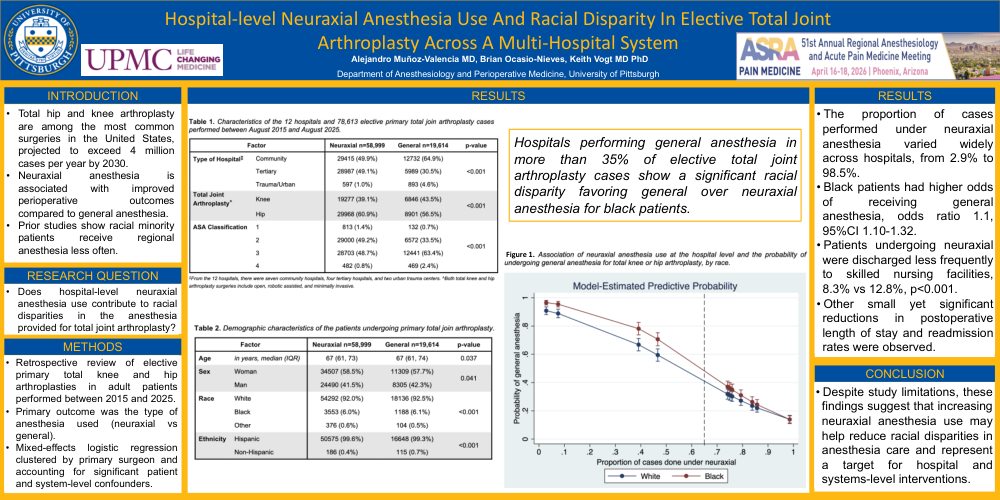
A total of 78,613 cases of primary joint arthroplasty were performed between 2015 and 2025; most were primary total knee arthroplasties 38,899(59.8%). Overall, 45,816(58.3%) patients were women, the medianage was 67(IQR:61-74) years, and most were classified as ASA 3(52.3%),Tables 1-2. Of note, only 301(0.4%)patients identified as Hispanic. The proportion of cases performed under neuraxial anesthesia varied widely across hospitals, ranging from 2.9% to 98.5%, with a median of 79.4%(IQR:74.1-85.7%), Figure 1. The mixed-effects adjusted logistic regression model demonstrated a good statistical fit, AUC:0.83(95%CI:0.83-0.84). The model results showed that black patients were associated with higher odds of receiving general rather than neuraxial anesthesia (OR:1.21;95%CI:1.10–1.32;p< 0.001). There was also a significant hospital-level association between the proportion of neuraxial anesthesia and the magnitude of racial disparity in general anesthesia use,p:0.002, Figure 2. In fact, according to model-predicted probabilities, a statistically significant racial disparity in anesthetic technique emerges when approximately >35% of total joint arthroplasty cases are performed under general anesthesia, p< 0.001. This study also identified differences in postoperative outcomes. Neuraxial patients were discharged less frequently to skilled nursing facilities, 8.3% vs 12.8%,p< 0.001. Other small yet significant differences were noted in postoperative length of stay and readmission rates, Table 3.
Discussion
In this study, black patients were more likely to receive general anesthesia for elective primary total joint arthroplasty. According to model-predicted probabilities, hospitals performing general anesthesia in >35% ofcases may face a disparity favoring general over neuraxial anesthesia for black patients. Despite study limitations, these findings suggest that supporting broader use of neuraxial anesthesia could be a strategy to reduce racial disparities in anesthesia care, and an opportunity for hospital- and system-level interventions.