372 posters, 1 audios, 13 topics, 29 sessions, 1,035 authors, 449 institutions
ePostersLive by SciGen Technologies S.A. All rights reserved.
51st Annual Regional Anesthesiology and Acute Pain Medicine Meeting
April 16 - 18, 2026 | Phoenix, Arizona

2318547
Consideration of cephalosporin as first-choice antibiotic for total joint arthroplasty, does documented penicillin allergy matter?
Part of Topic
Scientific Abstracts > Regional Anesthesia
Introduction
Avoidance of cephalosporins in patients reporting penicillin allergy has been associated with increased infection risk after total hip and knee arthroplasty (TJA)[1, 2, 4]. This, next to the inaccuracy of patient-reported penicillin allergy, has resulted in increased use of these antibiotics in this patient population, which raises concerns about antibiotic-related adverse effects[1]. We investigated the association between documented penicillin allergy and adverse events from cephalosporins in patients undergoing TJA.
Material and Methods
This retrospective cohort study was approved by our Institutional Review Board (IRB#2012-050). The Premier Healthcare database, a claims database representing >25% of US hospitals, was queried from 2016-2023 and patients were followed up until hospital discharge. All adults undergoing elective TJA were included. Variables of interest were documented penicillin allergy, cephalosporin use and adverse events due to cephalosporin or other beta-lactams. Using Cochran-Armitage tests, we aimed to describe secular trends of documented penicillin allergy, cephalosporin use and adverse events due to cephalosporin or other beta-lactams. Among those with penicillin allergy, we described secular trends of cephalosporin use and adverse events due to cephalosporin or other beta-lactams.
Results
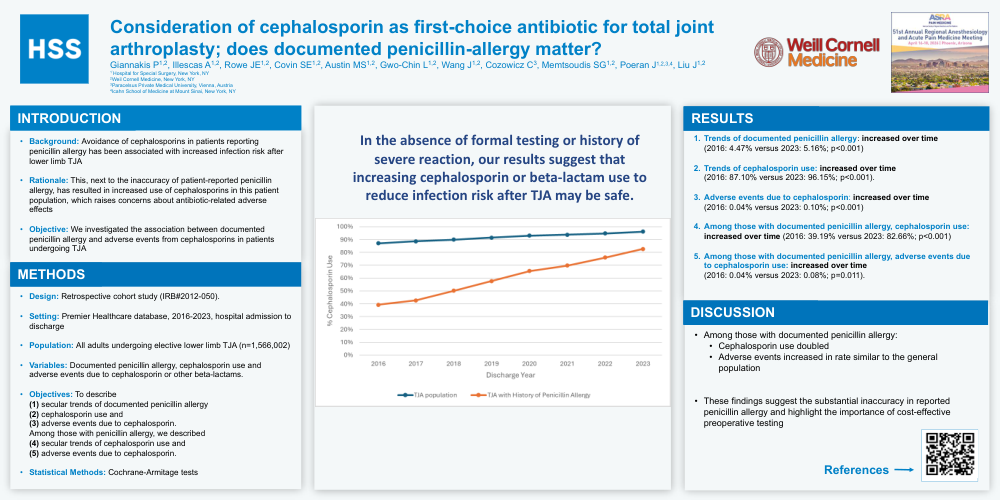
A total of 1,566,002 TJAs were included in the analysis. Incidence of documented penicillin allergy increased over time (2016: 4.47% versus 2023: 5.16%; p<0.001) as did use of cephalosporins +(2016: 87.10% versus 2023: 96.15%; p<0.001). Adverse events due to cephalosporin or other beta-lactams also increased over time (2016: 0.04% versus 2023: 0.10%; p<0.001). Among those with documented penicillin allergy, cephalosporin use noticeably increased over time (2016: 39.19% versus 2023: 82.66%; p<0.001) and adverse events due to cephalosporin or other beta-lactams increased over time in a fashion similar to the general population (2016: 0.04% versus 2023: 0.08%; p=0.011).
Discussion
From 2016-2023, cephalosporin use in patients with documented penicillin allergy doubled, with adverse event rising in parallel to the general TJA population. These findings suggest substantial inaccuracy in reported penicillin allergy and highlight the importance of cost-effective preoperative testing[3]. In the absence of formal testing or history of severe reaction, our results suggest that increasing cephalosporin or beta-lactam use to reduce infection risk after TJA may be safe.