372 posters, 1 audios, 13 topics, 29 sessions, 1,035 authors, 449 institutions
ePostersLive by SciGen Technologies S.A. All rights reserved.
51st Annual Regional Anesthesiology and Acute Pain Medicine Meeting
April 16 - 18, 2026 | Phoenix, Arizona

2318543
Successful Regional Anesthesia Technique in a Patient With Chronic Inflammatory Demyelinating Polyneuropathy (CIDP)
Part of Topic
Scientific Abstracts > Regional Anesthesia
Chronic inflammatory demyelinating polyneuropathy (CIDP): immune-
mediated peripheral neuropathy characterized by progressive,
predominantly motor weakness, symmetric involvement of limbs and
sensory loss. It includes segmental demyelination of peripheral nerves,
endoneurial inflammatory infiltration and electrophysiological changes
Regional Anesthesia use is still a topic on debate due to the theoretical
risk of further neurological deficts and nerve injuries
METHODS
This case report describes the perioperative use of regional anesthesia on
a patient with CIPD. Informed patient consent obtained and exemption
from Institutional Review Board review per hospital policy.
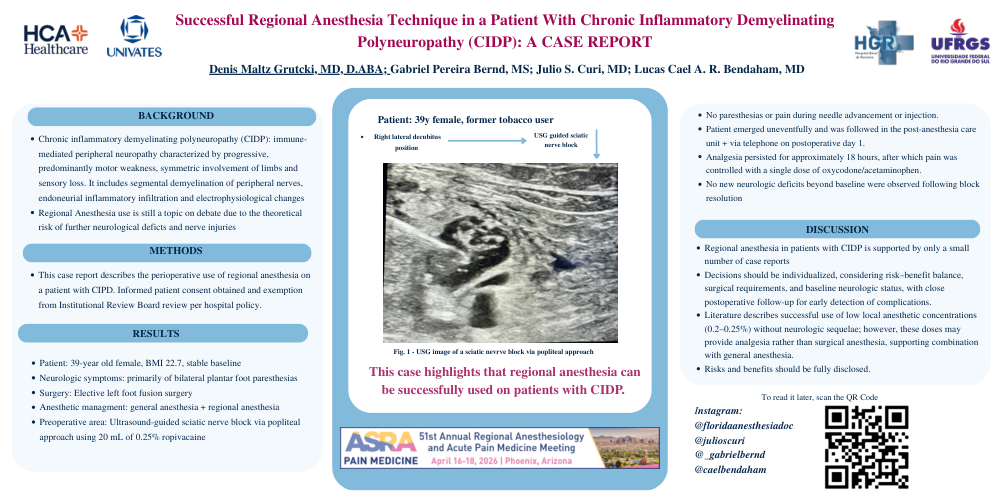
Patient: 39y female, former tobacco user
Right lateral decubitus
position
USG guided sciatic
nerve block
No paresthesias or pain during needle advancement or injection.
Patient emerged uneventfully and was followed in the post-anesthesia care
unit + via telephone on postoperative day 1.
Analgesia persisted for approximately 18 hours, after which pain was
controlled with a single dose of oxycodone/acetaminophen.
No new neurologic deficits beyond baseline were observed following block
resolution
RESULTS
Patient: 39-year old female, BMI 22.7, stable baseline
Neurologic symptoms: primarily of bilateral plantar foot paresthesias
Surgery: Elective left foot fusion surgery
Anesthetic managment: general anesthesia + regional anesthesia
Preoperative area: Ultrasound-guided sciatic nerve block via popliteal
approach using 20 mL of 0.25% ropivacaine
No paresthesias or pain during needle advancement or injection.
Patient emerged uneventfully and was followed in the post-anesthesia care
unit + via telephone on postoperative day 1.
Analgesia persisted for approximately 18 hours, after which pain was
controlled with a single dose of oxycodone/acetaminophen.
No new neurologic deficits beyond baseline were observed following block
resolution
DISCUSSION
Regional anesthesia in patients with CIDP is supported by only a small
number of case reports
Decisions should be individualized, considering risk–benefit balance,
surgical requirements, and baseline neurologic status, with close
postoperative follow-up for early detection of complications.
Literature describes successful use of low local anesthetic concentrations
(0.2–0.25%) without neurologic sequelae; however, these doses may
provide analgesia rather than surgical anesthesia, supporting combination
with general anesthesia.
Risks and benefits should be fully disclosed.