372 posters, 1 audios, 13 topics, 29 sessions, 1,035 authors, 449 institutions
ePostersLive by SciGen Technologies S.A. All rights reserved.
51st Annual Regional Anesthesiology and Acute Pain Medicine Meeting
April 16 - 18, 2026 | Phoenix, Arizona

2318454
A Retrospective Study of Pre- and Post-operative PROMs Completion Patterns in TJA: Total Knee Patients
Poster Presenter
Part of Topic
Scientific Abstracts > Regional Anesthesia
#2318454: A Retrospective Study of Pre- and Post-operative PROMs Completion Patterns in TJA: Total Knee Patients
Pa Thor, PhD; Kethy Jules-Elysee, MD; Yunyu Xiao, PhD; JashvantPoeran, MD/PhD; Zeev Kain, MD, MBA
Introduction
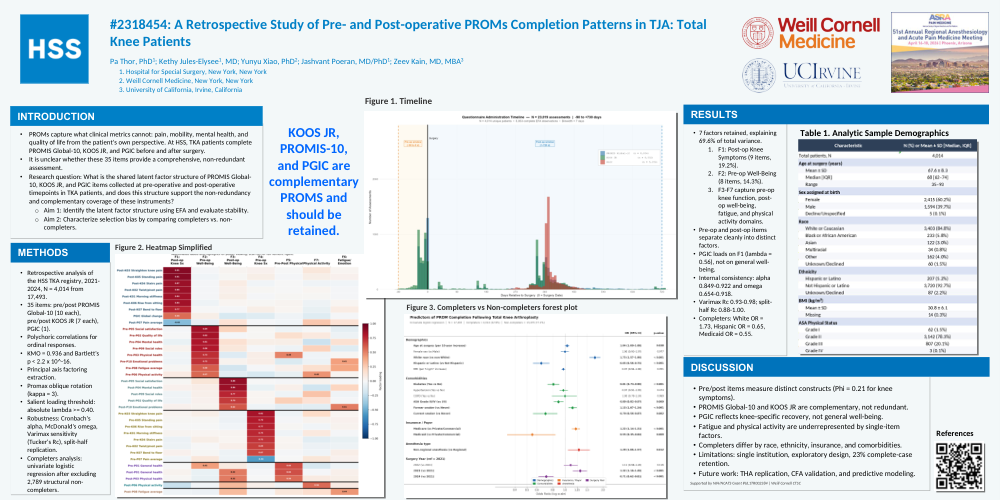
Patient-reported outcome measures (PROMs) are critical for perioperative assessment, (i.e., functionalrecovery, mobilization, and discharge readiness). Understanding item/domain overlaps and missing datapatterns can help anesthesiologists and teams decide if measurements could supplement the other forspecific sub-items, improving interpretability and reducing information loss in TJA. Our study quantifiesmissing data patterns for the GH-10 and HOOS-JR/KOOS-JR measures in THA and TKA, and assesses pre- andpost-operative completion rates given patient-specific characteristics and perioperative variables.
Materials and Methods
We performed a retrospective pre-post observational analysis on adult patients undergoing primary THA orTKA at the Hospital for Special Surgery in New York City. Responses from PROMIS-10 Global Health, HOOS-JR(THA), and KOOS-JR (TKA) were collected from the electronic health record at predefined preoperative andpostoperative periods. Demographic data, comorbid conditions, perioperative factors, type of anesthetic,length of stay (LOS), and discharge status were collected. Descriptive statistics detailed patient characteristicsboth overall and by operation type. PROM measurement for THA and TKA procedures were classified intofour completion patterns at each timepoint pair: 1) missing preop and missing postop, 2) complete preopand complete postop, 3) complete preop and missing postop, and 4) missing preop and complete postop.This study received IRB approval by our institutional IRB#2025-1122.
Results/Case Report
The cohort included 42,853 total joint arthroplasty procedures, with 40,367 cases occurring after HSSincorporated PROM into their EHR (MacLean et al., 2021) to allow a full 90-day preoperative capture window.The completion of PROM differed based on the instrument and the timing. For PROMIS Global Health-10(GH10), 61.1% of all procedures had both preoperative and postoperative assessments completed. Thecompletion rates were about the same for hip (60.7%) and knee (61.5%) procedures. Approximately one-quarter of cases had preoperative GH10 completed without a corresponding postoperative response.
Joint-specific PROM completion was more variable. Among the THA cases, 24.0% had complete HOOS-JR pre-and postoperative assessments, while 14.8% had preoperative completion only. For TKA, 25.7% of cases hadcomplete KOOS-JR pre- and postoperative data, with an additional 15.1% completing preoperative surveysonly. Postoperative-only completion was uncommon across all PROM instruments.
Hypertension (51.3%) and diabetes (11.4%) were among the most common comorbidities. Regionalanesthesia was used in 97.0% of cases. The average procedure time was 91.2±26.8 minutes, and the medianlength of stay (LOS) was 1.35±1.51 days, with 96.6% of patients discharged home.
Discussion
GH-10 and HOOS-JR/KOOS-JR show overlap in pain and basic physical measures, however missing datapatterns vary. PROMs provide significant pre- to postoperative patient-reported pain and functional data atscale via the EHR system. Improvements in perioperative processes, regional anesthetic techniques, andPROM administration may help anesthesiologists and teams assess postoperative pain, support earlydischarge, and reduce measurement attrition. Optimizing PROM capture during acute recovery may helpperioperative pain services evaluate pain treatment regimens after TJA.
References:
1. MacLean, C. H., Antao, V. C., Fontana, M. A., Sandhu, H. S., & McLawhorn, A. S. (2021). PROMs:opportunities, challenges, and unfinished business.
NEJM Catalyst Innovations in Care Delivery, 2(11).
2. Hung, I. Y., Jevsevar, D. S., Simonson, T., & Kain, Z. N. (2025). Practical Implications of Value-Based Carein the Setting of Ambulatory Surgery Centers.
The Journal of Arthroplasty, 40(2), 268-271.