372 posters, 1 audios, 13 topics, 29 sessions, 1,035 authors, 449 institutions
ePostersLive by SciGen Technologies S.A. All rights reserved.
51st Annual Regional Anesthesiology and Acute Pain Medicine Meeting
April 16 - 18, 2026 | Phoenix, Arizona

2318380
Perioperative Use of Intravenous Buprenorphine for Acute Pain — a Case Series
Poster Presenter
Authors
Affiliations
Part of Topic
Scientific Abstracts > Acute Pain
Title: Perioperative Use of Intravenous Buprenorphine for Acute Pain – a Case Series
Authors: T. Kyle Harrison, Oluwatobi O. Hunter, Jimmy K. Wong, Peter Barelka, Edward R. Mariano
Introduction:
Intravenous buprenorphine has been FDA-approved for acute pain since 1981. Buprenorphine has been shown to be a highly effective analgesic.1 However, its use in the perioperative period is rare, with less than 20% of clinicians prescribing any formulation of buprenorphine in the past year. 2 While available evidence supports single-dose intraoperative methadone 3, data on similar use of buprenorphine are lacking. Therefore, we present our institutional experience implementing intravenous buprenorphine in the perioperative setting.
Intravenous buprenorphine is a partial mu agonist and kappa antagonist that has been FDA-approved for acute pain management since 1981 due to its efficacy and safety profile. In surgical patients, buprenorphine has been shown to reduce the average pain intensity as well the need for rescue analgesia.1 However, its use in the perioperative period is rare, with less than 20% of clinicians prescribing any formulation of buprenorphine in the past year. 2 While available evidence supports single-dose intraoperative methadone 3, data on similar use of buprenorphine are lacking despite theoretical advantages in terms of opioid-related adverse events. Therefore, we present our institutional experience implementing intravenous buprenorphine in the perioperative setting.
Methods:
With IRB approval and waiver of informed consent, this retrospective chart review was conducted at a single tertiary care Veterans Affairs hospital. Patients who underwent surgical procedures between November 1, 2024, and December 31, 2025, and received at least one dose of intravenous buprenorphine during their surgical procedure were included. Data were collected from the electronic medical record, reviewed, and presented as descriptive statistics.
Results:
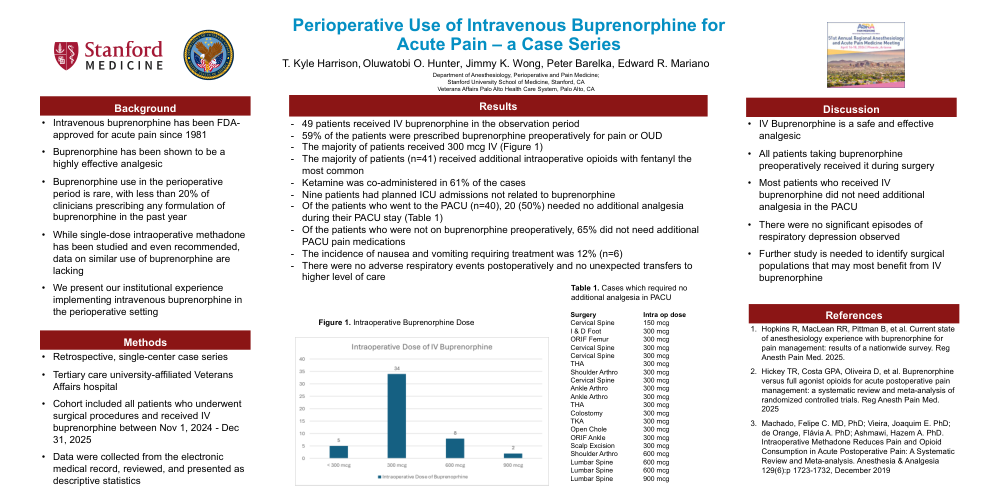
Forty-nine patients had surgery during the study period and received intravenous buprenorphine intraoperatively. The majority of patients (59%) were not prescribed buprenorphine preoperatively. The most common surgery category was orthopedic (n=21), followed by neurosurgical-spine (n=11), general (n=11) and cardiothoracic (n=6). One patient received spinal anesthesia, and two patients received monitored anesthesia care; the rest received general anesthesia. The intraoperative buprenorphine dose was <300 mcg in 5 cases, 300 mcg in 34 cases, 600 mcg in 8 cases, and 900 mcg in 2 cases. Most patients (n=41) received additional intraoperative opioids, with fentanyl being the most common. Ketamine was co-administered in 30 cases (61%). Of the patients who went to the PACU (n=40), 20 (50%) needed no additional analgesia during their PACU stay. Of the patients who were not on buprenorphine preoperatively, 65% did not need additional PACU pain medications. Nine patients had planned ICU admissions not related to buprenorphine. There were no adverse respiratory events postoperatively and no transfers to higher level of care. The incidence of nausea and vomiting requiring treatment was 12% (n=6).
Conclusion:
Intravenous buprenorphine is a safe and effective intraoperative analgesic. The ease of use, often as a single intraoperative dose that provides extended-duration analgesia with minimal opioid-related adverse events, has facilitated rapid adoption at our institution. Further work should focus on which cases and/or which patients may benefit most from intravenous buprenorphine and how it may compare to hydromorphone or other long-active opioids such as methadone in similar situations.
Table 1
No additional analgesia required in the PACU
|
Surgery |
Intra op dose |
|
Cervical Spine |
150 mcg |
|
I & D Foot |
300 mcg |
|
ORIF Femur |
300 mcg |
|
Cervical Spine |
300 mcg |
|
Cervical Spine |
300 mcg |
|
THA |
300 mcg |
|
Shoulder Arthroscopy |
300 mcg |
|
Cervical Spine |
300 mcg |
|
Ankle Arthroscopy |
300 mcg |
|
Ankle Arthroscopy |
300 mcg |
|
THA |
300 mcg |
|
Colostomy Take Down |
300 mcg |
|
TKA |
300 mcg |
|
Open Chole |
300 mcg |
|
ORIF Ankle |
300 mcg |
|
Scalp Mass Excision |
300 mcg |
|
Shoulder Arthroscopy |
600 mcg |
|
Lumbar Spine |
600 mcg |
|
Lumbar Spine |
600 mcg |
|
Lumbar Spine |
900 mcg |
References:
- Hopkins R, MacLean RR, Pittman B, et al. Current state of anesthesiology experience with buprenorphine for pain management: results of a nationwide survey. Reg Anesth Pain Med. Published online May 13, 2025. doi:10.1136/rapm-2025-106692
- Hickey TR, Costa GPA, Oliveira D, et al. Buprenorphine versus full agonist opioids for acute postoperative pain management: a systematic review and meta-analysis of randomized controlled trials. Reg Anesth Pain Med. Published online January 2, 2025. doi:10.1136/rapm-2024-106014
- Machado, Felipe C. MD, PhD*; Vieira, Joaquim E. PhD*; de Orange, Flávia A. PhD†; Ashmawi, Hazem A. PhD*. Intraoperative Methadone Reduces Pain and Opioid Consumption in Acute Postoperative Pain: A Systematic Review and Meta-analysis. Anesthesia & Analgesia 129(6):p 1723-1732, December 2019. | DOI: 10.1213/ANE.0000000000004404