372 posters, 1 audios, 13 topics, 29 sessions, 1,035 authors, 449 institutions
ePostersLive by SciGen Technologies S.A. All rights reserved.
51st Annual Regional Anesthesiology and Acute Pain Medicine Meeting
April 16 - 18, 2026 | Phoenix, Arizona

2318153
Evaluation of the GRACE model to teach regional anesthesia at a Resource-Limited Setting in India.
Part of Topic
Scientific Abstracts > Education
Title: Evaluation of the GRACE model to teach regional anesthesia at a Resource-Limited Setting in India.
Mia Zonies, BA1, Niyam Reddy, BA2, Juliet Rowe, MPH1, Jashvant Poeran, MD, PhD1, Swetha Pakala, MD1,3
1Hospital for Special Surgery, Department of Anesthesiology, Critical Care & Pain Management, New York, NY, USA
2Pepperdine University, Malibu, CA, USA
3Department of Anesthesiology, Weill Cornell Medicine, New York, NY, USA
4Osmania General Hospital, Afzal Gunj, Hyderabad, Telangana, India
Introduction
Surgical disease is an under-addressed burden in low-income countries (LICs), necessitating an increase in anesthesia collaboration programs to enhance perioperative care. In 2017, a model for teaching and evaluating a regional anesthesia program, the GRACE initiative, was introduced in Ghana. Building on this foundation, this study applies the GRACE model to a LIC site in Hyderabad, India, and evaluates its impact on peripheral nerve block use in clinical practice compared to pre-implementation levels.
Materials and Methods
This study received approval from our IRB (IRB #2019-0321). In 2019, anesthesiologists from the Hospital for Special Surgery utilized the GRACE (Global Regional Anesthesia Curricular Engagement) model to develop a customized regional anesthesia curriculum, train thirteen anesthesiologists at Osmania General Hospital (OGH), and evaluate the change in participant skills and knowledge. Additionally, to assess changes in clinical practice, a retrospective review of surgical records at OGH was conducted to gather data on pre-operative diagnoses, surgical procedures, anesthesia types, anesthetic medications administered, peripheral nerve block (PNB) types, supplementary interventions, and the performing providers. Data collection occurred at five distinct one-month intervals: prior to the intervention in May 2019; and subsequently in July 2019, December 2019, March 2023, and May 2024. Paired Wilcoxon rank-sum tests were used for the pre- and post-intervention comparison of clinical and knowledge assessment scores, and Chi-squared tests were conducted to analyze trends in PNB utilization over time.
Results
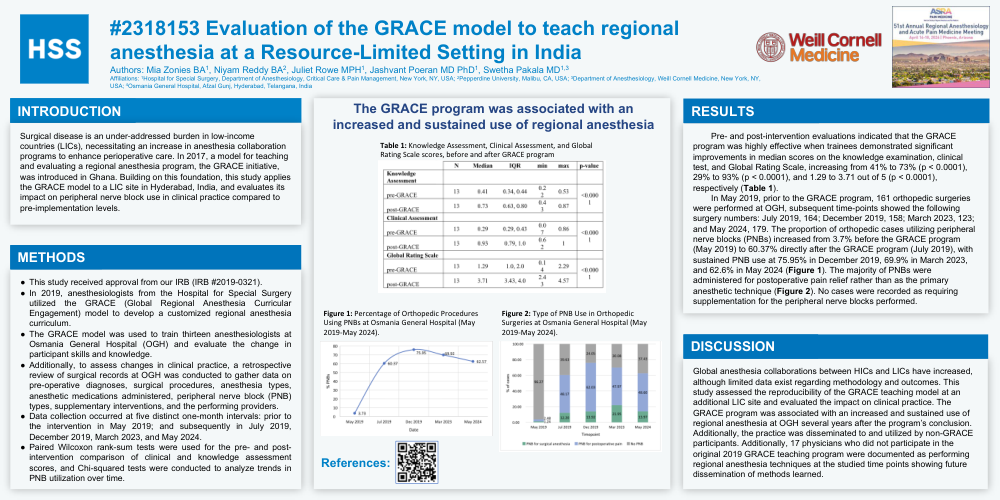
Pre- and post-intervention evaluations indicated that the GRACE program was highly effective. Trainees demonstrated significant improvements in median scores on the knowledge examination, clinical test, and Global Rating Scale, increasing from 41% to 73% (p< 0.0001), 29% to 93% (p< 0.0001), and 1.29 to 3.71 out of 5 (p< 0.0001), respectively (Table 1).
In May 2019, prior to the GRACE program, 161 orthopedic surgeries were performed at OGH. Subsequent time-points showed the following surgery numbers: July 2019, 164; December 2019, 158; March 2023, 123; and May 2024, 179. The proportion of orthopedic cases utilizing peripheral nerve blocks (PNBs) increased from 3.7% before the GRACE program (May 2019) to 60.37% directly after the GRACE program (July 2019), with sustained PNB use at 75.95% in December 2019, 69.9% in March 2023, and 62.6% in May 2024 (Figure 1). The majority of PNBs were administered for postoperative pain relief rather than as the primary anesthetic technique (Figure 2). No cases were recorded as requiring supplementation for the peripheral nerve blocks performed. Additionally, 17 physicians who did not participate in the original 2019 GRACE teaching program were documented as performing regional anesthesia techniques at the studied time points.
Discussion
Global anesthesia collaborations between HICs and LICs have increased, although limited data exist regarding methodology and outcomes. This study assessed the reproducibility of the GRACE teaching model at an additional LIC site and evaluated the impact on clinical practice. The GRACE program was associated with an increased and sustained use of regional anesthesia at OGH several years after the program’s conclusion. Additionally, the practice was disseminated to and utilized by non-GRACE participants.
References
- Lee S, Onye A, Latif A. Emergency Anesthesia in Resource-Limited Areas. Adv Anesth. 2020;38:209-227. doi:10.1016/j.aan.2020.09.005
- Dohlman LE, Kwikiriza A, Ehie O. Benefits and Barriers to Increasing Regional Anesthesia in Resource-Limited Settings. Local Reg Anesth. 2020;13:147-158. Published 2020 Oct 22. doi:10.2147/LRA.S236550
- Brouillette MA, Aidoo AJ, Hondras MA, et al. Regional anesthesia training model for resource-limited settings: a prospective single-center observational study with pre-post evaluations. Reg Anesth Pain Med. 2020;45(7):528-535. doi:10.1136/rapm-2020-101550
- Glasgow RE, Vogt TM, Boles SM. Evaluating the public health impact of health promotion interventions: the RE-AIM framework. American Journal of Public Health. 1999 Sep;89(9):1322-7