372 posters, 1 audios, 13 topics, 29 sessions, 1,035 authors, 449 institutions
ePostersLive by SciGen Technologies S.A. All rights reserved.
51st Annual Regional Anesthesiology and Acute Pain Medicine Meeting
April 16 - 18, 2026 | Phoenix, Arizona

2318124
Trends in Blood Product and Blood Conservation Device Utilization in Lumbar Spinal Fusion: A Population-Based Study (2013—2023)
Poster Presenter
Authors
Periklis Giannakis, Alex Illescas, Junying Wang, Juliet Rowe, Alexander Zehetner, Jiabin Liu, Stavros Memtsoudis, Crispiana Cozowicz
Affiliations
Department of Anesthesiology, Critical Care and Pain Medicine, Paracelsus Medical University, Salzburg, Austria, Hospital for Special Surgery, New York, USA, Paracelsus Medical University, Salzburg, Austria
Part of Topic
Scientific Abstracts > Regional Anesthesia
Trends in Blood Product and Blood Conservation Device Utilization in Lumbar Spinal Fusion: A
Population-Based Study (2013–2023)
Giannakis P1,2, Poeran J1,2, Illescas A1,2, Wang J1,2, Rowe JE1,2, Zehetner A3, Liu J1,2
, Memtsoudis SG1,2
, Cozowicz C3
1Hospital for Special Surgery, New York, NY
2Weil Cornell Medicine, New York, NY
3Paracelsus Medical University, Vienna, Austria
INTRODUCTION
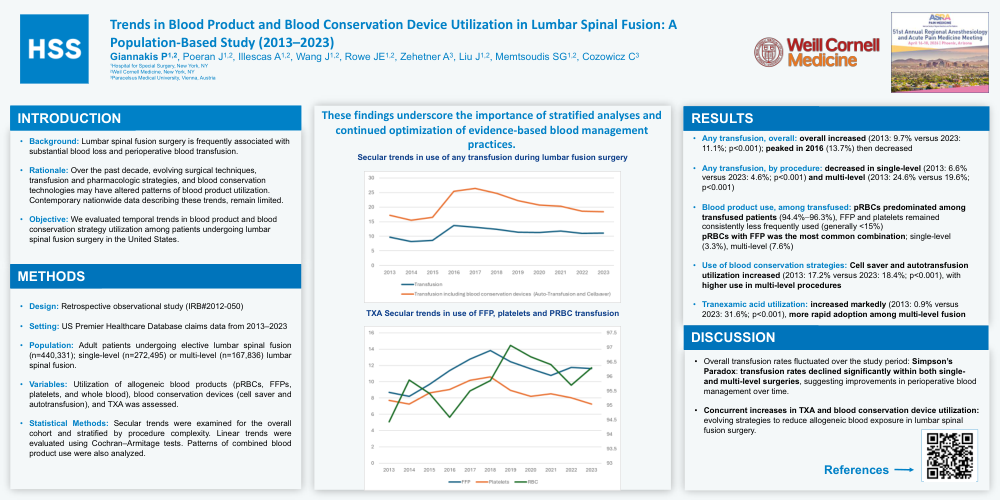
These findings underscore the importance of stratified analyses and
continued optimization of evidence-based blood management
practices.
Secular trends in use of any transfusion during lumbar fusion surgery
RESULTS
• Background: Lumbar spinal fusion surgery is frequently associated with
substantial blood loss and perioperative blood transfusion.
• Rationale: Over the past decade, evolving surgical techniques,
transfusion and pharmacologic strategies, and blood conservation
technologies may have altered patterns of blood product utilization.
Contemporary nationwide data describing these trends, remain limited.
• Objective: We evaluated temporal trends in blood product and blood
conservation strategy utilization among patients undergoing lumbar
spinal fusion surgery in the United States.
METHODS
• Design: Retrospective observational study (IRB#2012-050)
• Setting: US Premier Healthcare Database claims data from 2013–2023
• Population: Adult patients undergoing elective lumbar spinal fusion
(n=440,331); single-level (n=272,495) or multi-level (n=167,836) lumbar
spinal fusion.
• Variables: Utilization of allogeneic blood products (pRBCs, FFPs,
platelets, and whole blood), blood conservation devices (cell saver and
autotransfusion), and TXA was assessed.
• Statistical Methods: Secular trends were examined for the overall
cohort and stratified by procedure complexity. Linear trends were
evaluated using Cochran–Armitage tests. Patterns of combined blood
product use were also analyzed.
TXA Secular trends in use of FFP, platelets and PRBC transfusion
• Any transfusion, overall: overall increased (2013: 9.7% versus 2023:
11.1%; p<0.001); peaked in 2016 (13.7%) then decreased
• Any transfusion, by procedure: decreased in single-level (2013: 6.6%
versus 2023: 4.6%; p<0.001) and multi-level (2013: 24.6% versus 19.6%;
p<0.001)
• Blood product use, among transfused: pRBCs predominated among
transfused patients (94.4%–96.3%), FFP and platelets remained
consistently less frequently used (generally <15%)
pRBCs with FFP was the most common combination; single-level
(3.3%), multi-level (7.6%)
• Use of blood conservation strategies: Cell saver and autotransfusion
utilization increased (2013: 17.2% versus 2023: 18.4%; p<0.001), with
higher use in multi-level procedures
• Tranexamic acid utilization: increased markedly (2013: 0.9% versus
2023: 31.6%; p<0.001), more rapid adoption among multi-level fusion
DISCUSSION
• Overall transfusion rates fluctuated over the study period: Simpson’s
Paradox: transfusion rates declined significantly within both single-
and multi-level surgeries, suggesting improvements in perioperative blood
management over time.
• Concurrent increases in TXA and blood conservation device utilization:
evolving strategies to reduce allogeneic blood exposure in lumbar spinal
fusion surgery.
References