372 posters, 1 audios, 13 topics, 29 sessions, 1,035 authors, 449 institutions
ePostersLive by SciGen Technologies S.A. All rights reserved.
51st Annual Regional Anesthesiology and Acute Pain Medicine Meeting
April 16 - 18, 2026 | Phoenix, Arizona

2317968
Cross-sectional assessment of preoperative gastric content with ultrasound in patients taking GLP-1 agonists
Poster Presenter
Authors
Oliver Panzer, Maya Tailor, Juliet Rowe, Michael Singleton, Kanupriya Kumar, William Manson, Hari Kalagara, Nibras Bughrara, Anahita Dabo-Trubelja, Marissa Weber, Eric Heinz, Stephen Haskins, William Qiao, Miriam Sheetz, Alex Illescas, Kayla Bernstein, Mariel Maramba, Mahtab Sheikh, Jayanta Chowdhury, Sheila Carr, Tatum Gee, Eduard Shaykhinurov, Justas Lauzadis, Jashvant Poeran, Anahi Perlas
Affiliations
Hospital for Special Surgery, Department of Anesthesiology, Critical Care, and Pain Management, Hospital for Special Surgery, Department of Anesthesiology, University of Virginia Health System, Department of Anesthesiology and Perioperative Medicine, Mayo Clinic, Department of Anesthesiology, Albany Medical College, Department of Anesthesiology and Critical Care Medicine, Memorial Sloan Kettering Cancer Center, Department of Anesthesiology, Weill Cornell Medicine, Department of Anesthesiology and Critical Care Medicine, George Washington University, Department of Anesthesiology and Pain Medicine, University Health Network
Part of Topic
Scientific Abstracts > Emerging Technology
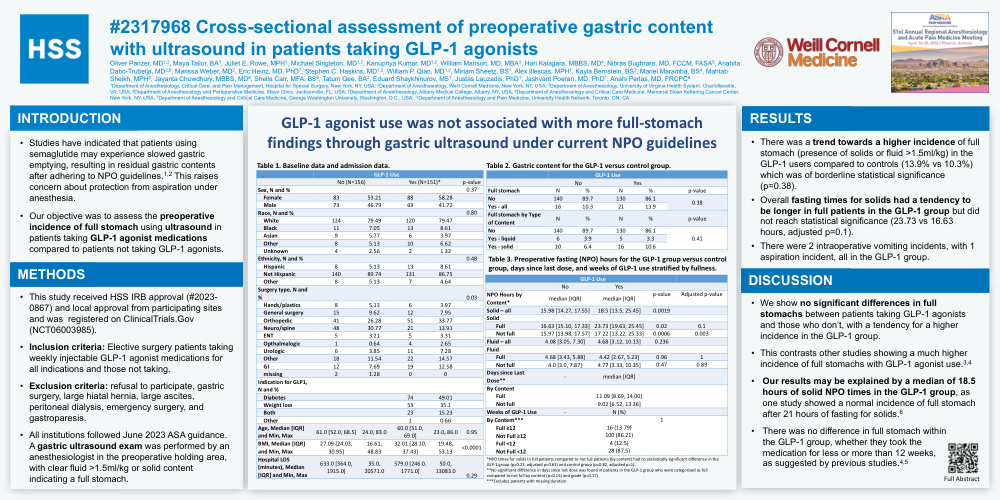
#2317968 Cross-sectional assessment of preoperative gastric content with ultrasound in patients taking GLP-1 agonists
Oliver Panzer, MD1,2, Maya Tailor, BA1, Juliet E. Rowe, MPH1, Michael Singleton, MD1,2, Kanupriya Kumar, MD1,2, William Manson, MD, MBA3, Hari Kalagara, MBBS, MD4, Nibras Bughrara, MD, FCCM, FASA5, Anahita Dabo-Trubelja, MD2,6, Marissa Weber, MD2, Eric Heinz, MD, PhD7, Stephen C. Haskins, MD1,2, William P. Qiao, MD1,2, Miriam Sheetz, BS1, Alex Illescas, MPH1, Kayla Bernstein, BS3, Mariel Maramba, BS4, Mahtab Sheikh, MPH5, Jayanta Chowdhury, MBBS, MD8, Sheila Carr, MFA, BS6, Tatum Gee, BA2, Eduard Shaykhinurov, MS7, Justas Lauzadis, PhD1, Jashvant Poeran, MD, PhD1, Anahi Perlas, MD, FRCPC8
1Department of Anesthesiology, Critical Care, and Pain Management, Hospital for Special Surgery, New York, NY, USA;
2Department of Anesthesiology, Weill Cornell Medicine, New York, NY, USA;
3Department of Anesthesiology, University of Virginia Health System, Charlottesville, VA, USA;
4Department of Anesthesiology and Perioperative Medicine, Mayo Clinic, Jacksonville, FL, USA;
5Department of Anesthesiology, Albany Medical College, Albany, NY, USA;
6Department of Anesthesiology and Critical Care Medicine, Memorial Sloan Kettering Cancer Center, New York, NY, USA;
7Department of Anesthesiology and Critical Care Medicine, George Washington University, Washington, D.C., USA;
8Department of Anesthesiology and Pain Medicine, University Health Network, Toronto, ON, CA
Introduction
Concerns are growing that patients on glucagon-like peptide 1 (GLP-1) agonists may not be adequately protected from aspiration under anesthesia due to current preoperative fasting (NPO) guidelines. Studies have indicated that patients using semaglutide may experience slowed gastric emptying, resulting in residual gastric contents after adhering to NPO guidelines.1,2 Our objective was to assess the preoperative incidence of full stomach using ultrasound in patients taking GLP-1 agonist medications compared to patients not taking GLP-1 agonists.
Methods
This multi-center, prospective, cross-sectional observational study was approved by the Hospital for Special Surgery Institutional Review Board (IRB#2023-0867) and registered on ClinicalTrials.Gov (NCT06003985) with local IRB approval from participating sites. Elective surgery patients taking weekly injectable GLP-1 agonist medications for all indications and those not taking them were included. Exclusion criteria were refusal to participate, gastric surgery, large hiatal hernia, large ascites, peritoneal dialysis, emergency surgery, and gastroparesis. All institutions followed the ASA guidance issued on June 2023. Data on NPO duration, GLP-1 use, surgery details, and symptoms were collected. A gastric ultrasound exam was performed by an anesthesiologist in the preoperative holding area, with clear fluid >1.5ml/kg or solid content indicating a full stomach. The primary outcome of full stomach was analyzed using chi-square or Fisher testing, and secondary outcome of NPO time was analyzed using Mann-Whitney U testing (with Benjamin-hochberg correction applied for multiple testing).
Results
A total of 354 patients were enrolled between August 29, 2023 and January 31, 2025 (Figure 1). Baseline data were similar between the GLP-1 group and controls except for body mass index and surgery type. The most common reason for GLP-1 use was Diabetes Mellitus (74, 49.01%), with others using for weight loss or both (Table 1). There was a trend towards a higher incidence of full stomach (presence of solids or fluid >1.5ml/kg) in the GLP-1 users compared to controls (13.9% vs 10.3%) which was of borderline statistical significance (p=0.38). In the GLP-1 group, the median number of days since last dose was 9.19 [6.67, 13.85] and most (76.82%) patients used GLP-1 agonist medications for ≥12 weeks, with no difference in full stomach based on GLP-1 agonist use for <12 or ≥12 weeks. Overall fasting times for solids had a tendency to be longer in full patients in the GLP-1 group but did not reach statistical significance (23.73 vs 16.63 hours, adjusted p=0.1). NPO times for solids had a tendency to be shorter in empty patients in both groups, but this was not statistically significant. NPO times for fluids were largely the same between groups (Table 3). There were 2 intraoperative vomiting incidents, with 1 aspiration incident, all in the GLP-1 group.
Discussion
We show no significant differences in full stomachs between patients taking GLP-1 agonists and those who don’t, with a tendency for a higher incidence in the GLP-1 group. This contrasts other studies showing a much higher incidence of full stomachs with GLP-1 agonist use,3,4 There was no difference in full stomach within the GLP-1 group, whether they took the medication for less or more than 12 weeks, as suggested by previous studies.4,5 Our results may be explained by a median of 18.5 hours of solid NPO times in the GLP-1 group, which led to empty stomachs in all GLP-1 patients in one study.6
References
- Silveira SQ, da Silva LM, de Campos Vieira Abib A, de Moura DTH, de Moura EGH, Santos LB, Ho AM, Nersessian RSF, Lima FLM, Silva MV, Mizubuti GB. Relationship between perioperative semaglutide use and residual gastric content: A retrospective analysis of patients undergoing elective upper endoscopy. J Clin Anesth. 2023 Aug;87:111091. doi: 10.1016/j.jclinane.2023.111091. Epub 2023 Mar 2. PMID: 36870274.
- Maselli DB, Camilleri M. Effects of GLP-1 and Its Analogs on Gastric Physiology in Diabetes Mellitus and Obesity. Adv Exp Med Biol. 2021;1307:171-192. doi: 10.1007/5584_2020_496. PMID: 32077010.
- Sen S, Potnuru PP, Hernandez N, Goehl C, Praestholm C, Sridhar S, Nwokolo OO. Glucagon-Like Peptide-1 Receptor Agonist Use and Residual Gastric Content Before Anesthesia. JAMA Surg. 2024 Jun 1;159(6):660-667. doi: 10.1001/jamasurg.2024.0111. PMID: 38446466; PMCID: PMC10918573.
- Wolla CD, Pecha TJ, Sirianni JM, Schorg LM, Wolf BJ, Wilson SH. Ultrasound assessment of preoperative gastric volume in fasted diabetic surgical patients: A prospective observational cohort study on the effects of glucagon-like peptide-1 agonists on gastric emptying. J Clin Anesth. 2025 Jun;104:111853. doi: 10.1016/j.jclinane.2025.111853. Epub 2025 May 4. PMID: 40324318.
- Santos, L. B. et al. Effect of various perioperative semaglutide interruption intervals on residual gastric content assessed by esophagogastroduodenoscopy: A retrospective single center observational study. J. Clin. Anesthesia 99, 111668 (2024).
- Maselli, D. B. et al. Safe Continuation of Glucagon-like Peptide 1 Receptor Agonists at Endoscopy: A Case Series of 57 Adults Undergoing Endoscopic Sleeve Gastroplasty. Obes. Surg. 34, 2369–2374 (2024).