372 posters, 1 audios, 13 topics, 29 sessions, 1,035 authors, 449 institutions
ePostersLive by SciGen Technologies S.A. All rights reserved.
51st Annual Regional Anesthesiology and Acute Pain Medicine Meeting
April 16 - 18, 2026 | Phoenix, Arizona

2317919
Associations Between Post-Partum Hemorrhage, Tranexamic Acid Use, and Postoperative Pain After Cesarean Delivery
Poster Presenter
Part of Topic
Scientific Abstracts > Acute Pain
Associations Between Post-Partum Hemorrhage, Tranexamic Acid Use, and Postoperative Pain After Cesarean Delivery
Introduction
•Post-cesarean pain remains common despite modern analgesia strategies.
•Post-partum hemorrhage occurs in up to 10% of cesarean deliveries and is commonly managed with tranexamic acid (TXA).
•Emerging preclinical data suggests TXA may impact postoperative pain through modulation of spinal neuronal signaling, including inhibition of GABA and glycine receptors and increased excitatory glutamatergic activity.
•Our study evaluates intraoperative TXA use on post-cesarean pain.
Methods
•Retrospective cohort of cesarean deliveries at the University of Illinois Hospital from Sept 2020 – Nov 2025 (n = 1,791).
•Demographic, obstetric, and clinical variables extracted from electronic medical records.
•Propensity score matching (1:1 nearest neighbor, caliper 0.2) used to create comparable TXA and non-TXA cohorts, resulting in 305 patients in each group (n = 610 total).
•Analysis: Mann-Whitney U test and Fisher exact test before matching; Wilcoxon signed-rank and Fischer exact test after matching.
•Multiple linear regression evaluated predictors of highest postoperative pain score in matched cohorts.
Results
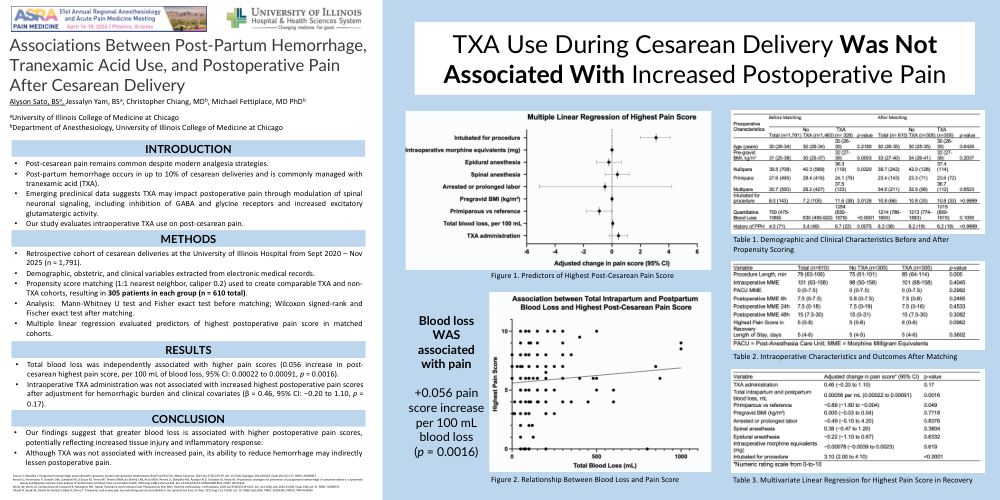
•Total blood loss was independently associated with higher pain scores (0.056 increase in post-cesarean highest pain score, per 100 mL of blood loss, 95% CI: 0.00022 to 0.00091, p = 0.0016).
•Intraoperative TXA administration was not associated with increased highest postoperative pain scores after adjustment for hemorrhagic burden and clinical covariates (β = 0.46, 95% CI: −0.20 to 1.10, p = 0.17).
Conclusion
•Our findings suggest that greater blood loss is associated with higher postoperative pain scores, potentially reflecting increased tissue injury and inflammatory response.
•Although TXA was not associated with increased pain, its ability to reduce hemorrhage may indirectly lessen postoperative pain.