372 posters, 1 audios, 13 topics, 29 sessions, 1,035 authors, 449 institutions
ePostersLive by SciGen Technologies S.A. All rights reserved.
51st Annual Regional Anesthesiology and Acute Pain Medicine Meeting
April 16 - 18, 2026 | Phoenix, Arizona

2317886
Institutional Trends in Glucagon-Like Peptide-1 Receptor Agonist Use Among Hip and Knee Arthroplasty Patients, 2021-2024
Poster Presenter
Authors
Juliet Rowe, Maya Tailor, Alexandra Sideris, Jawad Saleh, Jashvant Poeran, Daniel Maalouf, Oliver Panzer
Affiliations
Hospital for Special Surgery, Hospital for Special Surgery, Department of Anesthesiology, Critical Care & Pain Management, New York, NY, USA, Hospital for Special Surgery, Department of Anesthesiology, Critical Care & Pain Management, New York, NY, USA; Icahn School of Medicine at Mount Sinai, Institute for Healthcare Delivery Science, Hospital for Special Surgery, Department of Anesthesiology, Critical Care & Pain Management, New York, NY, USA; Weill Cornell Medicine, Department of Anesthesiology, New York, NY, USA, Hospital for Special Surgery, Department of Anesthesiology, Critical Care & Pain Management; Weill Cornell Medicine, Department of Anesthesiology, New York, NY, USA; Hospital for Special Surgery Research Institute
Part of Topic
Scientific Abstracts > Emerging Technology
Title: Institutional Trends in Glucagon-Like Peptide-1 Receptor Agonist Use Among Hip and Knee Arthroplasty Patients, 2021-2024
Juliet Rowe MPH1, Maya Tailor BA1, Alexandra Sideris PhD1,2,3, Alex Illescas MPH1, Jawad Saleh PharmD1, Jashvant Poeran MD PhD1,4, Daniel Maalouf MD MPH1,2, Oliver Panzer MD1,2
1 Hospital for Special Surgery, Department of Anesthesiology, Critical Care & Pain Management, New York, NY, USA
2 Department of Anesthesiology, Weill Cornell Medicine, New York, NY, USA
3 Hospital for Special Surgery Research Institute, Research Institute, New York, NY
4 Icahn School of Medicine at Mount Sinai, Institute for Healthcare Delivery Science, Department of Population Health Science and Policy, New York, NY, USA
Introduction
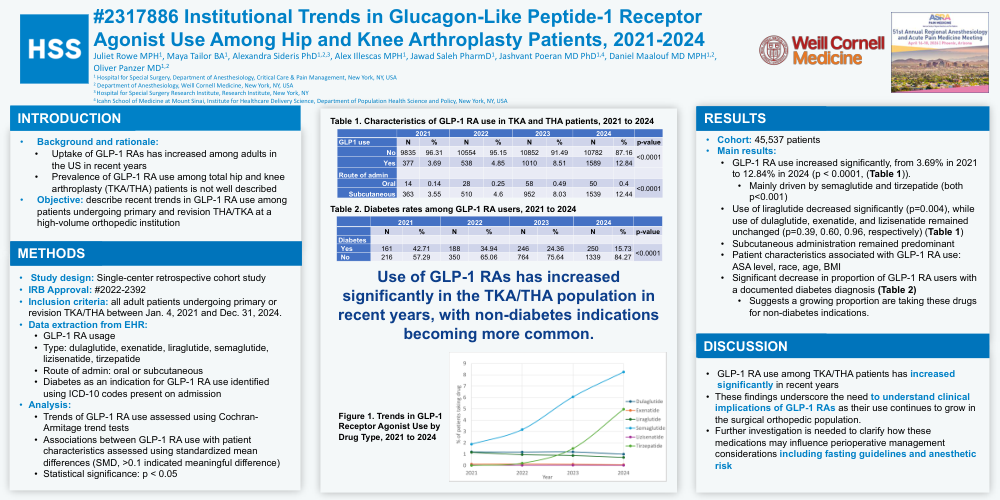
In recent years, the uptake of glucagon-like peptide-1 receptor agonists (GLP-1 RAs) has increased substantially among adults in the United States. However, the prevalence of GLP-1 RA use among total hip and knee arthroplasty (TKA/THA) patients is not well characterized. We aimed to describe recent trends of GLP-1 RA usage among patients undergoing primary and revision THA and TKA at a high-volume orthopedic institution.
Methods
This single-center retrospective cohort study was approved by our Institutional Review Board (IRB #2022-2392). All adult patients undergoing primary or revision THA or TKA between January 4, 2021 and December 31, 2024 were included in the analysis. GLP-1 RA usage was identified via electronic health record medication records, including type (dulaglutide, exenatide, liraglutide, semaglutide, lizisenatide, tirzepatide) and route of administration (oral, subcutaneous). Diabetes as an indication for GLP-1 RA use was identified using International Classification of Diseases, Tenth Revision (ICD-10) codes that were present on admission. Temporal trends of GLP-1 RA use were assessed using Cochran-Armitage trend tests, and associations with patient characteristics were assessed using standardized mean differences (SMD). Statistical significance was defined as p < 0.05, and SMDs greater than 0.1 indicated meaningful differences.
Results
Among a total of 45,537 included patients, GLP-1 RA use increased significantly from 2021 to 2024, rising from 3.69% in 2021 to 12.84% in 2024 (p < 0.0001, (Figure 1)). This upward trend was mainly driven by semaglutide and tirzepatide (Figure 2), which together accounted for 88.0% of all GLP-1 RA use in 2024. Conversely, use of liraglutide decreased significantly over the study period (p=0.004), while use of dulaglutide, exenatide, and lizisenatide remained unchanged (p=0.39, 0.60, 0.96, respectively) (Table 1). Subcutaneous administration remained the predominant route compared to oral (Table 1). Patient characteristics associated with GLP-1 RA use included ASA level, race, age, and BMI (Table 2). Specifically, there were higher rates of GLP-1 RA use among ASA 3 patients and Black patients, and GLP-1 RA users were younger and had higher BMIs, on average, compared to non-users. Additionally, there has been a significant decrease in the proportion of GLP-1 RA users with a documented diabetes diagnosis (Table 3), suggesting that a growing proportion are taking these drugs for non-diabetes indications.
Conclusion
At our high-volume orthopedic institution, GLP-1 RA use among TKA and THA patients has increased significantly from 2021 to 2024, with semaglutide and tirzepatide being the most common agents. These findings underscore the need to understand clinical implications of GLP-1 RAs as their use continues to grow in the surgical orthopedic population. Further investigation is needed to clarify how these medications may influence perioperative management considerations including fasting guidelines and anesthetic risk.