372 posters, 1 audios, 13 topics, 29 sessions, 1,035 authors, 449 institutions
ePostersLive by SciGen Technologies S.A. All rights reserved.
51st Annual Regional Anesthesiology and Acute Pain Medicine Meeting
April 16 - 18, 2026 | Phoenix, Arizona

2317580
What Are Patients Asking About Regional Anesthesia? An Analysis of Google Search Questions and Website Quality
Poster Presenter
Authors
Renee Ren, Junying Wang, Tina Chen, Mia Zonies, Alexandra Sideris, Jiabin Liu, Stavros Memtsoudis, Jashvant Poeran
Affiliations
Part of Topic
Scientific Abstracts > Education
Introduction
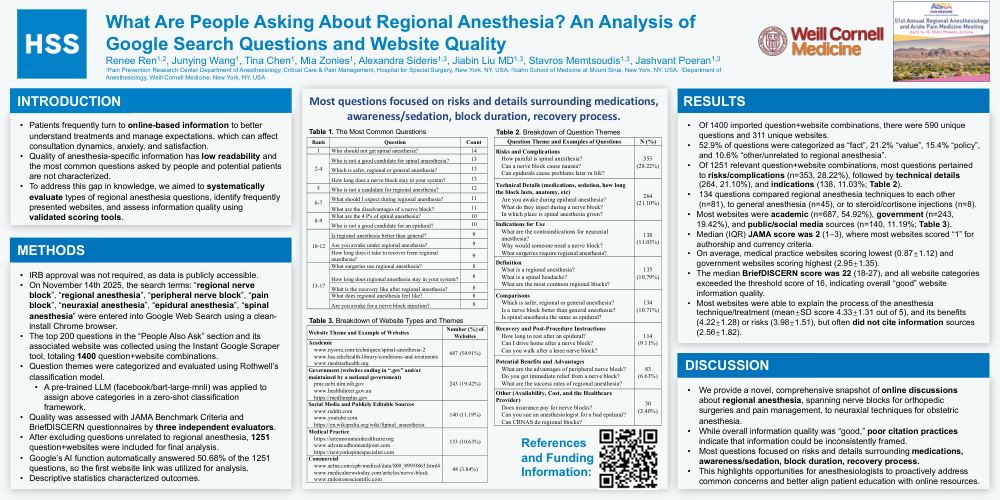
Patients frequently turn to online-based information to seek information to better understand treatments and manage expectations, which can affect consultation dynamics, anxiety, and satisfaction.1,2 However, quality of anesthesia-specific information has low readability and the most common questions asked by people and potential patients are not characterized.3 To address this gap in knowledge, we aimed to systematically evaluate types of regional anesthesia questions, identify frequently presented websites, and assess information quality using validated scoring tools.
Materials and Methods
IRB approval was not required, as data is publicly accessible. On November 14th 2025, search terms were entered into Google Web Search using a clean-install Chrome browser. Search terms were: “regional nerve block”, “regional anesthesia”, “peripheral nerve block”, “pain block”, “neuraxial anesthesia”, “epidural anesthesia”, “spinal anesthesia”. The top 200 questions in the “People Also Ask” section and its associated website was collected using the Instant Google Scraper tool, totaling 1400 question+website combinations.
Question themes were categorized and evaluated using Rothwell’s classification model. A pre-trained LLM (facebook/bart-large-mnli) was applied to assign above categories in a zero-shot classification framework.4 Website quality was assessed with JAMA Benchmark Criteria and BriefDISCERN questionnaires by three independent evaluators.5 After excluding questions unrelated to regional anesthesia, 1251 question+websites were included for final analysis. Google’s AI function automatically answered 50.68% of the 1251 questions, so the first website link was utilized for analysis. Descriptive statistics characterized outcomes.
Results/Case Report
Of the 1400 imported question+website combinations, there were 590 unique questions and 311 unique websites. The 10 most common questions are noted in Table 1. Of the 1400 results, 52.9% of questions were categorized as “fact”, 21.2% “value”, 15.4% “policy”, and 10.6% “other/unrelated to regional anesthesia”. Of the 1251 relevant question+website combinations, most questions pertained to risks/complications (n=353, 28.22%), followed by technical details (264, 21.10%), and indications (138, 11.03%; Table 2). There were 134 questions that compared regional anesthesia techniques to each other (n=81), to general anesthesia (n=45), or to steroid/cortisone injections (n=8).
Most websites were academic (n=687, 54.92%), government (n=243, 19.42%), and public/social media sources (n=140, 11.19%; Table 3). Median (IQR) JAMA score was 2 (1–3), where most websites scored “1” for authorship and currency criteria. On average, medical practice websites scoring lowest (0.87±1.12) and government websites scoring highest (2.95±1.35). The median BriefDISCERN score was 22 (18-27), and all website categories exceeded the threshold score of 16, indicating overall “good” website information quality. Most websites were able to explain the process of the anesthesia technique/treatment (mean±SD score 4.33±1.31 out of 5), and its benefits (4.22±1.28) or risks (3.98±1.51), but often did not cite information sources (2.56±1.82).
Discussion
We provide a novel, comprehensive snapshot of online discussions about regional anesthesia, spanning nerve blocks for orthopedic surgeries and pain management, to neuraxial techniques for obstetric anesthesia. While overall information quality was “good,” poor citation practices indicate that information could be inconsistently framed. Most questions focused on risks and details surrounding medications, awareness/sedation, block duration, recovery process. This highlights opportunities for anesthesiologists to proactively address common concerns and better align patient education with online resources.
References
2. de Looper M, van Weert JCM, Schouten BC, et al. The Influence of Online Health Information Seeking Before a Consultation on Anxiety, Satisfaction, and Information Recall, Mediated by Patient Participation: Field Study. J Med Internet Res. 2021;23(7):e23670. Published 2021 Jul 5. doi:10.2196/23670
3. de Looper M, van Weert JCM, Schouten BC, et al. The Influence of Online Health Information Seeking Before a Consultation on Anxiety, Satisfaction, and Information Recall, Mediated by Patient Participation: Field Study. J Med Internet Res. 2021;23(7):e23670. Published 2021 Jul 5. doi:10.2196/23670
4. Lewis M, Liu Y, Goyal N, Ghazvininejad M, Mohamed A, Levy O, Stoyanov V, Zettlemoyer L. BART: Denoising sequence-to-sequence pre-training for natural language generation, translation, and comprehension. InProceedings of the 58th annual meeting of the association for computational linguistics 2020 Jul (pp. 7871-7880). Code available from Hugging Face: https://huggingface.co/facebook/bart-large-mnli
5. Silberg WM, Lundberg GD, Musacchio RA. Assessing, controlling, and assuring the quality of medical information on the Internet: Caveant lector et viewor--Let the reader and viewer beware. JAMA. 1997;277(15):1244-1245.