372 posters, 1 audios, 13 topics, 29 sessions, 1,035 authors, 449 institutions
ePostersLive by SciGen Technologies S.A. All rights reserved.
51st Annual Regional Anesthesiology and Acute Pain Medicine Meeting
April 16 - 18, 2026 | Phoenix, Arizona

2317568
Online Questions and Information Quality Surrounding the Novel Non-Opioid Analgesic Suzetrigine: Analysis of Public Web Content
Poster Presenter
Authors
Renee Ren, Junying Wang, Tina Chen, Charles Williams, Maaz Khan, Jashvant Poeran, Alexandra Sideris
Affiliations
Part of Topic
Scientific Abstracts > Education
Introduction
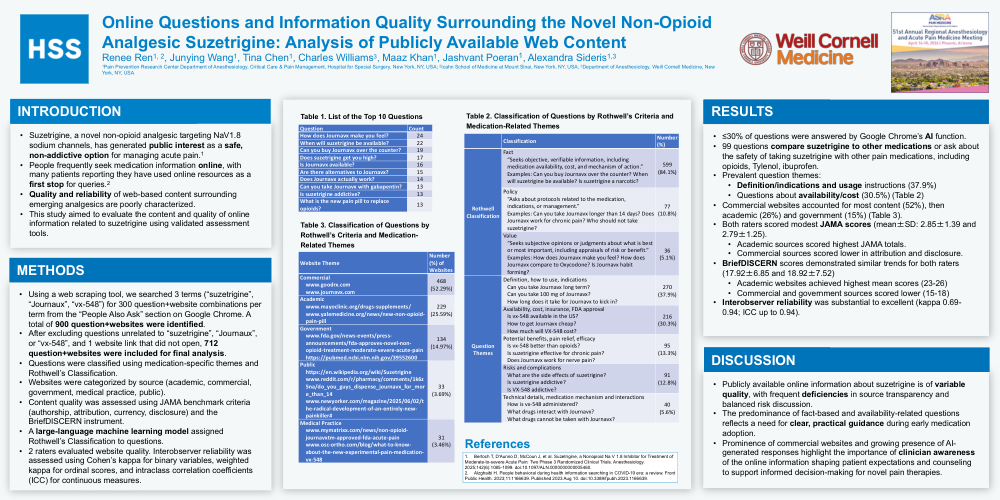
Suzetrigine, a novel non-opioid analgesic targeting NaV1.8 sodium channels, has generated public interest as a safe, non-addictive option for managing acute pain.1 People frequently seek medication information online, with many patients reporting they have used online resources as a first stop for queries.2 However, quality and reliability of web-based content surrounding emerging analgesics are poorly characterized. Thus, we aimed to evaluated the content and quality of online information related to suzetrigine using validated assessment tools.
Materials and Methods
Results/Case Report
The top ten most common questions are listed in Table 1. Up to 30% of questions were answered by Google Chrome’s AI function. Assessment of questions found that 99 questions compare suzetrigine to other medications or ask about the safety of taking suzetrigine with other pain medications, including opioids, Tylenol, ibuprofen. Analysis of question themes found that definition/indications and usage instructions (37.9%), and questions about availability/cost (30.5%) were most prevalent (Table 2).
Commercial websites accounted for most content (52%), then academic (26%) and government (15%) (Table 3). Both raters scored modest JAMA scores (mean±SD: 2.85±1.39 and 2.79±1.25). Academic sources scored highest JAMA totals and commercial sources scored lower across attribution and disclosure domains. BriefDISCERN scores demonstrated similar trends for both raters (17.92±6.85 and 18.92±7.52), with academic websites achieving highest mean scores (23-26), while commercial and government sources scored lower (15-18). Interobserver reliability was substantial to excellent (kappa 0.69-0.94; ICC up to 0.94).
Discussion
Publicly available online information about suzetrigine is of variable quality, with frequent deficiencies in source transparency and balanced risk discussion. The predominance of fact-based and availability-related questions reflects a need for clear, practical guidance during early medication adoption. Prominence of commercial websites and growing presence of AI-generated responses highlight the importance of clinician awareness of the online information shaping patient expectations and counseling to support informed decision-making for novel pain therapies.
References
1. Bertoch T, D'Aunno D, McCoun J, et al. Suzetrigine, a Nonopioid Na V 1.8 Inhibitor for Treatment of Moderate-to-severe Acute Pain: Two Phase 3 Randomized Clinical Trials. Anesthesiology. 2025;142(6):1085-1099. doi:10.1097/ALN.0000000000005460.
- Alzghaibi H. People behavioral during health information searching in COVID-19 era: a review. Front Public Health. 2023;11:1166639. Published 2023 Aug 10. doi:10.3389/fpubh.2023.1166639.