372 posters, 1 audios, 13 topics, 29 sessions, 1,035 authors, 449 institutions
ePostersLive by SciGen Technologies S.A. All rights reserved.
51st Annual Regional Anesthesiology and Acute Pain Medicine Meeting
April 16 - 18, 2026 | Phoenix, Arizona

2317559
Variations in Peripheral Nerve Block Use in Primary vs Revision Total Knee Arthroplasty: An Institutional Analysis of 19,497 Cases
Poster Presenter
Authors
Renee Ren, Periklis Giannakis, Junying Wang, Alexandra Sideris, Jashvant Poeran, Daniel Maalouf
Affiliations
Part of Topic
Scientific Abstracts > Regional Anesthesia
Introduction
Peripheral nerve blocks (PNBs) in total knee arthroplasty (TKA) reduce opioid use, shorten hospital stay, and support multimodal analgesia.1 Compared to primary TKA, revision TKA (rTKA) is associated with worse pain, and rTKA patients have higher incidences of preoperative opioid use and a history of complex pain.2 Although PNBs have been reportedly used for rTKA, no comprehensive descriptive data exists on PNBs for rTKA.3 Thus, we describe PNB utilization and outcomes for primary and rTKA.
Materials and Methods
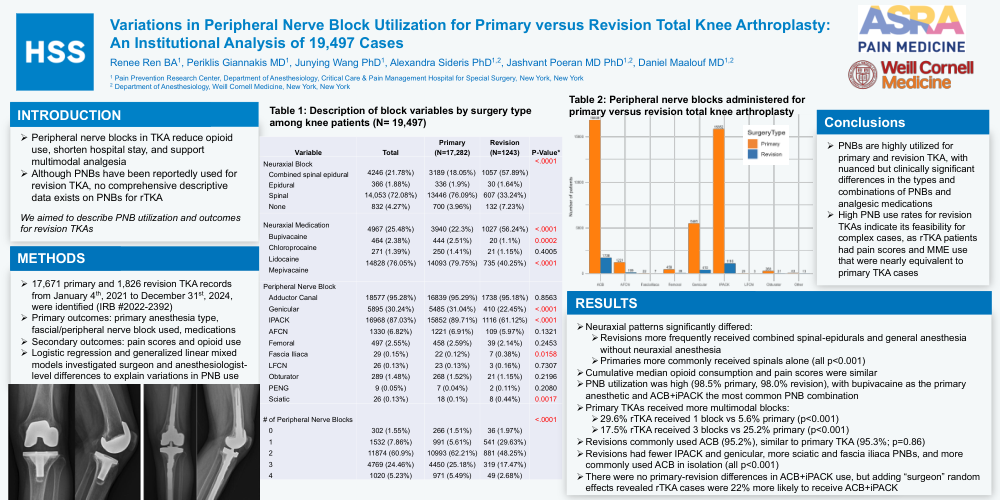
A total of 45,537 TJA records from January 4th, 2021 to December 31st, 2024, were identified (IRB #2022-2392). Demographic and perioperative data, including surgical and anesthesia details and data from the postoperative care unit (PACU), were routinely collected and included in the present analysis. Records with missing anesthetic information, non-TKA procedures, and patients < 18 years of age were excluded, yielding 17,671 primary and 1,826 rTKA cases. Primary outcomes of interest include the type of regional and neuraxial block and medication, which were administered in the operating room before the start of surgery. Secondary outcomes include postoperative pain scores and opioid requirements. Univariate analysis described demographic information and intraoperative outcomes. Logistic regression and generalized linear mixed models investigated surgeon and anesthesiologist-level differences to understand variations in PNB use.
Results/Case Report
Compared to primaries, rTKA patients had worse ASA comorbidity scores, longer operative times, more acute and chronic pain consultations, and nearly twice the hospital stay duration (all p< 0.001). Revision reasons are in Table 1. Neuraxial patterns differed: rTKA more frequently received combined spinal-epidurals and general anesthesia without neuraxial, whereas primaries more commonly received spinals alone (all p< 0.001). Opioid consumption and pain scores were similar between primary and revisions (Table 1).
PNB utilization was high (98.5% primary, 98.0% revision), with bupivacaine as the primary anesthetic and ACB+iPACK the most common PNB combination. Primary TKAs received more multimodal blocks (29.6% rTKA received 1 block vs 5.6% primary, p< 0.001; 17.5% rTKA received 3 blocks vs 25.2% primary, p< 0.001) and more commonly received intraoperative periarticular injections (76.9% vs 41.2%, p< 0.001). Revisions commonly used ACB (95.2%), similar to primary TKA (95.3%; p=0.86). Revisions had fewer IPACK and genicular, more sciatic and fascia iliaca PNBs, and more commonly used ACB in isolation (all p< 0.001; Table 1 and Figure 1). There were no primary-revision differences in ACB+iPACK use, but adding “surgeon” random effects revealed revisions were 22% more likely to receive ACB+iPACK. Thus, surgeon preferences may influence block use (Table 2).
Discussion
PNBs are highly utilized for primary and revision TKA, with nuanced but significant differences in types and combinations of PNBs and analgesic medications. High PNB use for rTKA indicate its feasibility for complex cases, as rTKA patients had pain scores and MME use in the postoperative period that were nearly equivalent to primary TKA cases. These novel findings can shape future multimodal regimens that can be tailored specifically to unique pain challenges of rTKA patients.
References
1. Fillingham YA, Hannon CP, Kopp SL, et al. The Efficacy and Safety of Regional Nerve Blocks in Total Knee Arthroplasty: Systematic Review and Direct Meta-Analysis. J Arthroplasty. Oct 2022;37(10):1906-1921 e2. doi:10.1016/j.arth.2022.03.078
2. Malahias MA, Loucas R, Loucas M, Denti M, Sculco PK, Greenberg A. Preoperative Opioid Use Is Associated With Higher Revision Rates in Total Joint Arthroplasty: A Systematic Review. J Arthroplasty. Nov 2021;36(11):3814-3821. doi:10.1016/j.arth.2021.06.017
3. Pagnotto MR, Pagnano MW. Multimodal pain management with peripheral nerve blocks for total knee arthroplasty. Instr Course Lect. 2012;61:389-95.