372 posters, 1 audios, 13 topics, 29 sessions, 1,035 authors, 449 institutions
ePostersLive by SciGen Technologies S.A. All rights reserved.
51st Annual Regional Anesthesiology and Acute Pain Medicine Meeting
April 16 - 18, 2026 | Phoenix, Arizona

2317519
Variations in Peripheral Nerve Block Use for Primary vs Revision Total Hip Arthroplasty: An Institutional Analysis of 18,525 Cases
Poster Presenter
Authors
Renee Ren, Junying Wang, Periklis Giannakis, Alexandra Sideris, Jashvant Poeran, Daniel Maalouf
Affiliations
Part of Topic
Scientific Abstracts > Regional Anesthesia
Introduction
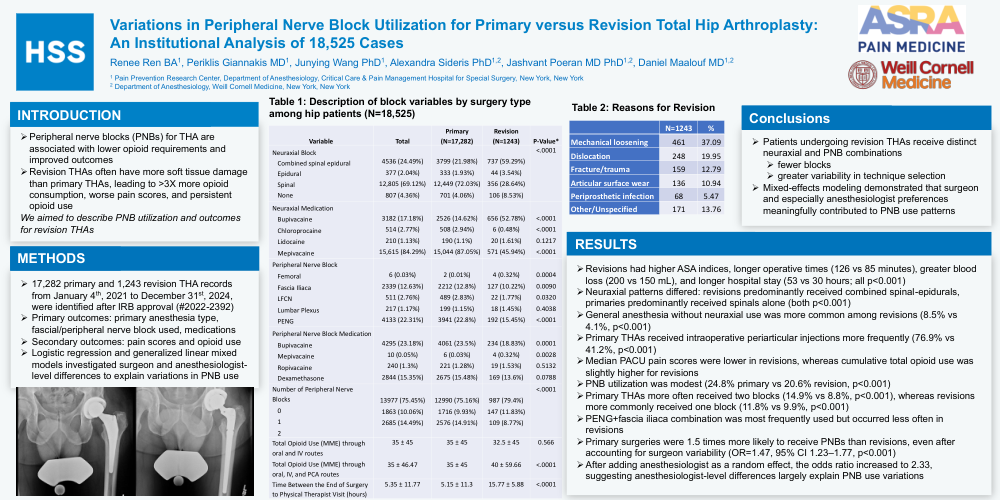
Peripheral nerve blocks (PNBs) for total hip arthroplasty (THA) are associated with lower opioid requirements and improved outcomes.1,2 Revision THAs (rTHAs) often have more soft tissue damage than primary THAs, leading to >3X more opioid consumption, worse pain scores, and persistent opioid use that warrants personalized perioperative pain management.3,4 Current literature on rTHA PNBs remains sparse, with limited exploration of PNB comparisons and combinations.5 Thus, we aimed to describe PNB utilization and outcomes for rTHA.
Materials and Methods
A total of 45,537 TJA records from January 4th, 2021 to December 31st, 2024, were identified after IRB approval (#2022-2392). Demographic and perioperative data, including surgical and anesthesia details and data from the postoperative care unit (PACU), are routinely collected and were analyzed. Records with missing anesthetic information, non-THA procedures, and patients < 18 years of age were excluded, yielding 17,282 primary and 1,243 revision THAs. Primary outcomes of interest included the primary anesthesia type, fascial/peripheral nerve block used, as well as the medications in the regional techniques, which were administered in the operating room before the start of surgery. Secondary outcomes included postoperative pain scores and opioid use. Univariate analysis described demographic information and intraoperative outcomes. Logistic regression and generalized linear mixed models investigated surgeon and anesthesiologist-level differences to explain variations in PNB use.
Results/Case Report
Compared to primary THA, rTHAs had higher ASA indices, longer operative times (126 vs 85 minutes), greater blood loss (200 vs 150 mL), and longer hospital stay (53 vs 30 hours; all p< 0.001). Neuraxial patterns differed: revisions predominantly received combined spinal-epidurals, primaries predominantly received spinals alone (both p< 0.001). General anesthesia without neuraxial use was more common among revisions (8.5% vs 4.1%, p< 0.001). Primary THAs received intraoperative periarticular injections frequently (76.9% vs 41.2%, p< 0.001). For revisions, median PACU pain scores were lower whereas cumulative total opioid use was slightly higher (Table 1). Revision reasons are described in Table 2.
PNB utilization was modest (24.8% primary vs 20.6% revision, p< 0.001). Primary THAs more often received two blocks (14.9% vs 8.8%, p< 0.001). Revisions more commonly received one block (11.8% vs 9.9%, p< 0.001). The PENG+fascia iliaca combination was most frequent but occurred less often in revisions (Figure 1).
Primary surgeries were 1.75 times more likely to receive PNBs than revisions (95% CI 1.47–2.08, p< 0.001). Accounting for surgeon variability, this association persisted (OR=1.47, 95% CI 1.23–1.77, p< 0.001). Adding anesthesiologist as a random effect increased the odds ratio to 2.33, suggesting anesthesiologist-level differences explain PNB use variation.
Discussion
At our specialized orthopedic surgical hospital, patients undergoing rTHAs receive distinct neuraxial and PNB combinations, compared to primary THAs. rTHAs received fewer blocks and greater variability in technique selection. Mixed-effects modeling demonstrated that surgeon and especially anesthesiologist preferences meaningfully contributed to PNB use patterns. These findings provide a comprehensive overview of rTHA regional anesthesia practices. Our results may help inform future efforts to understand and optimize how PNBs can be utilized for rTHAs.
References
1. McCormick BP, Sequeira SB, Hasenauer MD, McKinstry RP, Ebert FR, Boucher HR. Peripheral Nerve Blocks Are Associated With Decreased Early Medical Complications, Dislocations, and Opioid Consumption Following Total Hip Arthroplasty. Arthroplast Today. Feb 2025;31:101587. doi:10.1016/j.artd.2024.101587
2. Giannakis P, Sideris A, Illescas A, et al. Regional anaesthesia operationalisation for total hip arthroplasty in a high-volume specialised orthopaedic centre. Br J Anaesth. Oct 2025;135(4):1097-1099. doi:10.1016/j.bja.2025.06.047
3. Bernstein JA, Feng J, Mahure SA, Schwarzkopf R, Long WJ. Revision total hip arthroplasty is associated with significantly higher opioid consumption as compared to primary total hip arthroplasty in the acute postoperative period. Hip Int. Sep 2020;30(1_suppl):59-63. doi:10.1177/1120700020938324
4. Stisen MG, Pedersen AB, Sheehan KJ, Mechlenburg I. Trajectories of Opioid Use Following Revision Total Hip Arthroplasty: A Population-Based Cohort Study. J Arthroplasty. Dec 2025;40(12):3246-3253 e11. doi:10.1016/j.arth.2025.05.081
5. de Haan JB, Hernandez N, Dean S, Sen S. Surgical anesthesia for revision total hip arthroplasty with quadratus lumborum and fascia iliaca block. Proc (Bayl Univ Med Cent). Jul 2019;32(3):438-439. doi:10.1080/08998280.2019.1600179