372 posters, 1 audios, 13 topics, 29 sessions, 1,035 authors, 449 institutions
ePostersLive by SciGen Technologies S.A. All rights reserved.
51st Annual Regional Anesthesiology and Acute Pain Medicine Meeting
April 16 - 18, 2026 | Phoenix, Arizona

2317427
Peripheral Nerve Block Use in Revision Hip and Knee Arthroplasties for Periprosthetic Joint Infections: A 10-year trend analysis
Poster Presenter
Authors
Renee Ren, Juliet Rowe, Periklis Giannakis, Jashvant Poeran, Stavros Memtsoudis, Daniel Maalouf
Affiliations
Part of Topic
Scientific Abstracts > Regional Anesthesia
Introduction
Periprosthetic joint infections (PJI) are the most common cause of revision total hip and knee arthroplasty (THA, TKA), and are associated with severe postoperative pain.1 Peripheral nerve blocks (PNBs) alleviate pain and improve surgical outcomes.2 However, PNB use for PJI revisions is not studied, as knowledge of regional anesthesia for PJI cases is limited to neuraxial versus general anesthesia.3 Thus, this study characterizes PNB use for PJI revision arthroplasty cases over a 10-year period.
Materials and Methods
After IRB approval (#2012-050), 159,005 rTKAs and 110,797 rTHAs were identified from the 2013-2023 Premier Healthcare Database, which contains information from >1,400 private and academic hospitals in the United States. Of those cases, 50,207 rTKAs and 22,198 rTHAs were performed for PJIs. PJI was identified using ICD codes that were present on admission. Anesthesia type (general, neuraxial, combined) was identified using billing codes. Descriptive statistics characterized demographic data. The Cochran-Armitage trend test calculated significance in trends of PNB utilization over the years. Multivariable logistic regression assessed the odds of receiving a PNB, after adjusting for age, gender, race, ethnicity, Deyo-Charlson Comorbidity Index, year, admission type, insurance type, and hospital characteristics, with an interaction term between year and PJI.
Results/Case Report
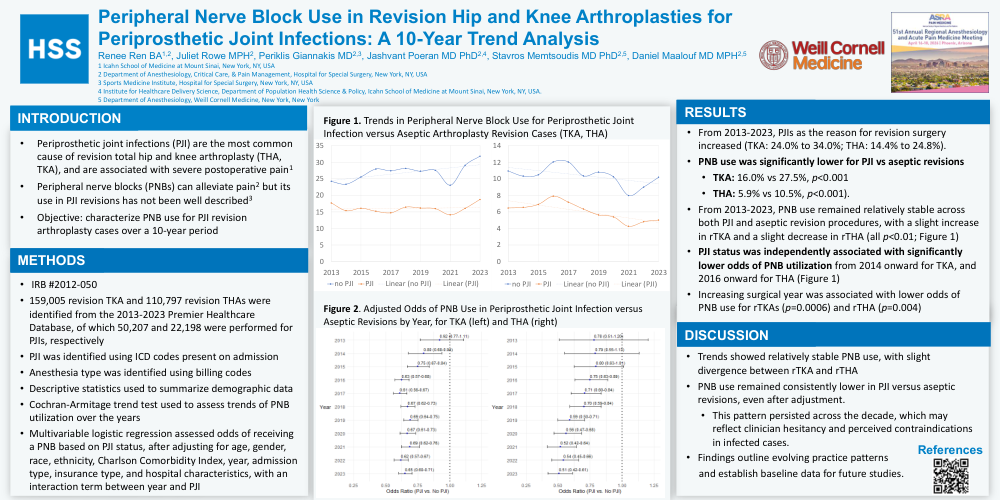
Compared with aseptic revisions, patients undergoing PJI revisions were older, had higher BMI, and worse comorbidity burden, including higher rates of diabetes, smoking, and chronic opioid use (all p< 0.05). Cases utilizing PNBs had lower rates of general anesthesia and higher rates of neuraxial anesthesia (Table 1). From 2013-2023, PJIs as the reason for revision surgery increased (TKA: 24.0% to 34.0%; THA: 14.4% to 24.8%).
PNB utilization was significantly lower for PJI versus aseptic revisions (TKA: 16.0% vs 27.5%, p< 0.001; THA: 5.9% vs 10.5%, p< 0.001). From 2013-2023, PNB use remained relatively stable across both PJI and aseptic revision procedures, with a slight increase in rTKA and a slight decrease in rTHA (all p< 0.01; Figure 1).
PJI status was independently associated with significantly lower odds of PNB utilization from 2014 onward for TKA, and 2016 onward for THA (Figure 2). Increasing surgical year was associated with lower odds of PNB use for rTKAs (p=0.0006), decreasing from OR 0.80 (95% CI 0.68–0.94) in 2014 to OR 0.65 (95% CI 0.60–0.71) in 2023. A similar pattern was observed for rTHA (p=0.004), with odds decreasing from OR 0.75 (95% CI 0.63–0.89) in 2016 to OR 0.51 (95% CI 0.42–0.61) in 2023.
Discussion
We provide a descriptive overview of PNB utilization in PJI revisions over 10 years using a large nationwide database. Temporal trends showed relatively stable use, with slight divergence between TKA and THA. PNB use remained consistently lower in PJI versus aseptic revisions, even after adjustment. This pattern persisted across the decade and may reflect clinician hesitancy and perceived contraindications in infected cases. These findings outline evolving practice patterns and establish baseline data for future studies.
References
1. Bernstein JA, Feng J, Mahure SA, Schwarzkopf R, Long WJ. Revision total hip arthroplasty is associated with significantly higher opioid consumption as compared to primary total hip arthroplasty in the acute postoperative period. Hip Int. Sep 2020;30(1_suppl):59-63. doi:10.1177/1120700020938324
2. McCormick BP, Sequeira SB, Hasenauer MD, McKinstry RP, Ebert FR, Boucher HR. Peripheral Nerve Blocks Are Associated With Decreased Early Medical Complications, Dislocations, and Opioid Consumption Following Total Hip Arthroplasty. Arthroplast Today. Feb 2025;31:101587. doi:10.1016/j.artd.2024.101587
3. Treanor A, Shimizu M, Barrett A, Byram S, Schmitt D, Brown N. Outcomes of Regional Block in Revision Total Joint Arthroplasty for Prosthetic Joint Infection. J Am Acad Orthop Surg Glob Res Rev. Sep 1 2024;8(9)doi:10.5435/JAAOSGlobal-D-24-00180