372 posters, 1 audios, 13 topics, 29 sessions, 1,035 authors, 449 institutions
ePostersLive by SciGen Technologies S.A. All rights reserved.
51st Annual Regional Anesthesiology and Acute Pain Medicine Meeting
April 16 - 18, 2026 | Phoenix, Arizona

2317389
Modifiable and nonmodifiable risk factors for postoperative urinary retention in lower extremity total joint arthroplasty patients
Poster Presenter
Authors
Brittany Keene, Amanda Lazar, Alexandra Sideris, Jashvant Poeran, Junying Wang, Elaine Yang, Daniel Maalouf
Affiliations
Part of Topic
Scientific Abstracts > Regional Anesthesia
Introduction
Literature reports the incidence of post operative urinary retention (POUR) in lower extremity total joint arthroplasty patients as 4-46%. With the wide range resulting from varying definitions of POUR, study variations, and patient demographics. Risk factors include advanced age, male sex, BPH, history of urinary retention, and glycopyrrolate administration. With conflicting evidence on BMI, ASA class, history of HTN, surgery type, volume of IV fluid administered in the OR, and surgery duration.
Methods
After approval from the hospital Institutional Review Board, retrospective chart review was conducted from June 1,2022 to December 31,2023. Inclusion criteria were patients 18 years and older who were booked as ambulatory surgery for unilateral or bilateral, total knee, total hip, or total ankle arthroplasty. In the case of duplicate MRNs, the record for the first surgical admission was used for analysis. After excluding records where a foley catheter was present on arrival to PACU and instances where catheters were inserted for reasons other than acute urinary retention, there were 7,807 patients.
Chi-squared tests with exact p-values based on Monte Carlo simulation were used to examine the marginal association between categorical variables (pre-operative baseline demographics and comorbidities, intra-op, and post-op variables) and POUR (Yes vs. No). Wilcoxon rank sum tests were used to compare unadjusted marginal differences for any continuous variables between POUR groups. Missing values were removed from the analyses. Multivariable logistic regression model was performed to examine associations between each adjusted factor and POUR, considering all continuous variable as their original continuous scale rather than being categorized. Subgroup analyses were further conducted among male and female patients for sex-specific comparisons. Odds ratios (ORs) with 95% confidence intervals (CIs) and the corresponding p-values were reported. Significance level was set as 0.05 and all analyses were conducted using SAS 9.4.
Results
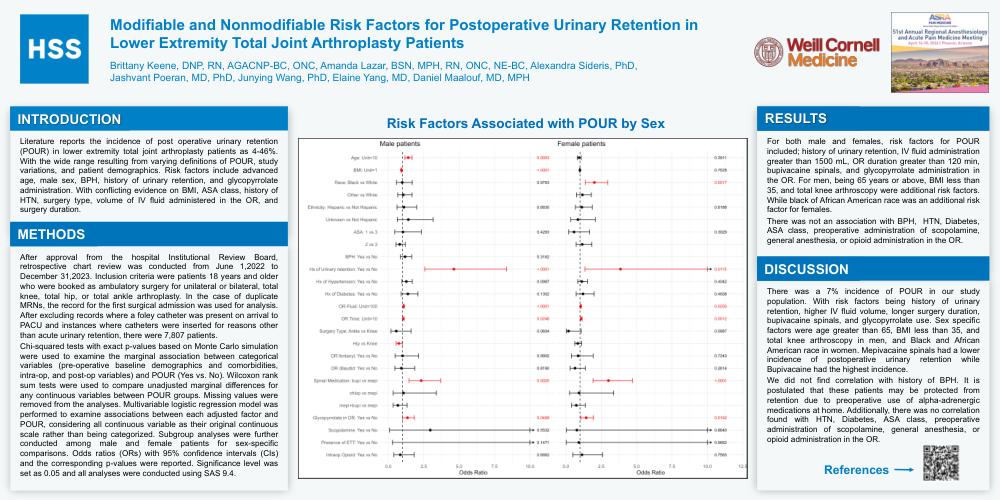
For both male and females, risk factors for POUR included; history of urinary retention, IV fluid administration greater than 1500 mL, OR duration greater than 120 min, bupivacaine spinals, and glycopyrrolate administration in the OR. For men, being 65 years or above, BMI less than 35, and total knee arthroscopy were additional risk factors. While black of African American race was an additional risk factor for females.
There was not an association with BPH, HTN, Diabetes, ASA class, preoperative administration of scopolamine, general anesthesia, or opioid administration in the OR.
Discussion
There was a 7% incidence of POUR in our study population. With risk factors being history of urinary retention, higher IV fluid volume, longer surgery duration, bupivacaine spinals, and glycopyrrolate use. Sex specific factors were age greater than 65, BMI less than 35, and total knee arthroscopy in men, and Black and African American race in women. Mepivacaine spinals had a lower incidence of postoperative urinary retention while Bupivacaine had the highest incidence.
We did not find correlation with history of BPH. It is postulated that these patients may be protected from retention due to preoperative use of alpha-adrenergic medications at home. Additionally, there was no correlation found with HTN, Diabetes, ASA class, preoperative administration of scopolamine, general anesthesia, or opioid administration in the OR.