372 posters, 1 audios, 13 topics, 29 sessions, 1,035 authors, 449 institutions
ePostersLive by SciGen Technologies S.A. All rights reserved.
51st Annual Regional Anesthesiology and Acute Pain Medicine Meeting
April 16 - 18, 2026 | Phoenix, Arizona

2317042
Adding genicular and anterior femoral cutaneous nerve blocks for knee arthroplasty analgesia, randomized double blinded trial
Poster Presenter
Authors
Maya Tailor, Juliet Rowe, Mia Zonies, Angela Puglisi, Marko Popovic, Alex Illescas, David Kim, William Qiao, Stephanie Cheng, Enrique Goytizolo, Christopher Li, Douglas Wetmore, Jonathan Beathe, David Mayman, Brian Chalmers, Alejandro Gonzalez Della Valle, Michael Ast, Gwo-Chin Lee, Jonathan Vigdorchik, Danyal Nawabi, Miriam Sheetz, Justas Lauzadis, Pa Thor, Jiabin Liu
Affiliations
Hospital for Special Surgery, Department of Anesthesiology, Critical Care, and Pain Management, Hospital for Special Surgery, Department of Orthopedic Surgery, Hospital for Special Surgery
Part of Topic
Scientific Abstracts > Regional Anesthesia
#2317042 Adding genicular and anterior femoral cutaneous nerve blocks for knee arthroplasty analgesia, randomized double blinded trial
Maya Tailor, BA1, Juliet E. Rowe, MPH1, Mia Zonies, BA1, Angela Puglisi, BS1, Marko Popovic, BS1, Alex Illescas, MPH1, David H. Kim, MD1,2, William P. Qiao, MD1,2, Stephanie I. Cheng, MD, DABMA, FAAMA1,2, Enrique A. Goytizolo, MD1,2, Christopher J. Li, MD1,2, Douglas S. Wetmore, MD1,2, Jonathan C. Beathe, MD1,2, David J. Mayman, MD3, Brian P. Chalmers, MD3, Alejandro Gonzalez Della Valle, MD3, Michael P. Ast, MD3, Gwo-Chin Lee, MD3, Jonathan M. Vigdorchik, MD3, Danyal H. Nawabi, MD, FRCS3, Miriam Sheetz, BS1, Justas Lauzadis, PhD1, Pa Thor, PhD1, Jiabin Liu, MD, PhD, FASA1,2
1Department of Anesthesiology, Critical Care, and Pain Management, Hospital for Special Surgery, New York, NY, USA;
2Department of Anesthesiology, Weill Cornell Medicine, New York, NY, USA;
3Department of Orthopedic Surgery, Hospital for Special Surgery, New York, NY, USA
Introduction
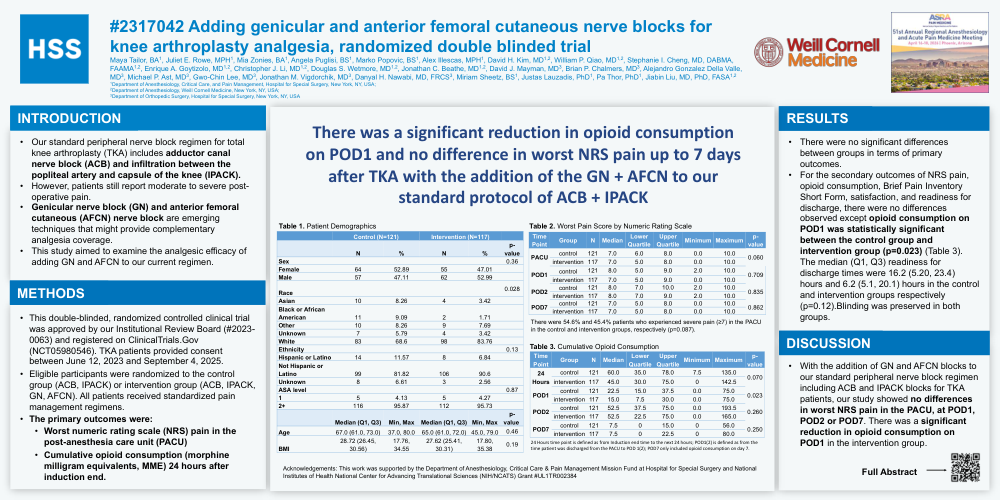
Our standard peripheral nerve block regimen for total knee arthroplasty (TKA) includes adductor canal nerve block (ACB) and infiltration between the popliteal artery and capsule of the knee (IPACK). However, patients still report moderate to severe post-operative pain. Genicular nerve block (GN) and anterior femoral cutaneous (AFCN) nerve block are emerging techniques that might provide complementary analgesia coverage. This study aimed to examine the analgesic efficacy of adding GN and AFCN to our current regimen.
Methods
This double-blinded, randomized controlled clinical trial was approved by our Institutional Review Board (#2023-0063) and registered on ClinicalTrials.Gov (NCT05980546). TKA patients provided consent between June 12, 2023 and September 4, 2025. Eligible participants were randomized to the control group (ACB, IPACK) or intervention group (ACB, IPACK, GN, AFCN) (Figure 1). All patients received standardized pain management regimens. The primary outcomes were the worst numeric rating scale (NRS) pain in the post-anesthesia care unit (PACU) and cumulative opioid consumption (morphine milligram equivalents, MME) 24 hours after induction end. Secondary outcomes included NRS pain, opioid consumption, Brief Pain Inventory Short Form, satisfaction, readiness for discharge, and blinding up to 7 days postoperatively (POD). Statistical analysis used a significance level of 0.05 and included chi-square tests (categorical variables), t-test or Mann-Whitney U tests (continuous variables), and regression using generalized estimating equation model (longitudinal analysis).
Results
A total of 244 participants were enrolled, with 238 analyzed. There were 121 patients in the control group, and 117 in the intervention group. The median (Q1, Q3) ages were 67.0 (61.0, 73.0) and 65.0 (61.0, 72.0), and the median body mass indexes were 28.7 (26.5, 30.6) and 27.6 (25.4, 30.3) (Table 1). The worst median (Q1, Q3) NRS pain scores in the PACU were 7.0 (6.0, 8.0) in the control group and 7.0 (5.0, 8.0) in the intervention group (p=0.06, Table 2), and cumulative opioid consumption in the first 24 hours were 60.0 (35.0, 78.0) MME and 45.0 (30.0, 75.0) MME in the control and intervention groups respectively (p=0.07, Table 3).
For the secondary outcomes of NRS pain, opioid consumption, Brief Pain Inventory Short Form, satisfaction, and readiness for discharge, there were no differences observed except median (Q1, Q3) opioid consumption on POD1 after induction end was statistically significant between the control group (22.5 (15.0, 37.5) MME) and intervention group (15.0 (7.5, 30.0) MME) (p=0.023) (Table 2 & Table 3). There were 54.6% and 45.4% patients who experienced severe pain (≥7) in the PACU in the control and intervention groups, respectively (p=0.087). The median (Q1, Q3) readiness for discharge times were 16.2 (5.20, 23.4) hours and 6.2 (5.1, 20.1) hours in the control and intervention groups respectively (p=0.12). Blinding was preserved in both groups.
Discussion
With the addition of GN and AFCN blocks to our standard peripheral nerve block regimen including ACB and IPACK blocks for TKA patients, our study showed no differences in worst NRS pain in the PACU, on POD1, POD2 or POD7. There was a significant reduction in opioid consumption on POD1 in the intervention group.
References
- Kim DH, Choi SS, Yoon SH, Lee SH, Seo DK, Lee IG, Choi WJ, Shin JW. Ultrasound-Guided Genicular Nerve Block for Knee Osteoarthritis: A Double-Blind, Randomized Controlled Trial of Local Anesthetic Alone or in Combination with Corticosteroid. Pain Physician. 2018 Jan;21(1):41-52. PMID: 29357330.
- Rambhia M, Chen A, Kumar AH, Bullock WM, Bolognesi M, Gadsden J. Ultrasound-guided genicular nerve blocks following total knee arthroplasty: a randomized, double-blind, placebo-controlled trial. Reg Anesth Pain Med. 2021 Oct;46(10):862-866. doi: 10.1136/rapm-2021-102667. Epub 2021 Jul 14. PMID: 34261807.
- Kampitak W, Tanavalee A, Tansatit T, Ngarmukos S, Songborassamee N, Vichainarong C. The analgesic efficacy of anterior femoral cutaneous nerve block in combination with femoral triangle block in total knee arthroplasty: a randomized controlled trial. Korean J Anesthesiol. 2021 Dec;74(6):496-505. doi: 10.4097/kja.21120. Epub 2021 Jun 29. PMID: 34182749; PMCID: PMC8648511.