Loading...

372 posters, 1 audios, 13 topics, 29 sessions, 1,035 authors, 449 institutions

ePostersLive by SciGen Technologies S.A. All rights reserved.

2316883

Ultrasound-guided Cryoneurolysis of the Lateral and Medial Pectoral Nerves for Symptomatic Thoracic Outlet Syndrome: A Case Report
Part of Topic

Scientific Abstracts > Chronic Pain

Ultrasound-guided Cryoneurolysis of the Lateral and Medial Pectoral Nerves for Symptomatic Thoracic Outlet Syndrome: A Case Report

Jonnie Jenkins BS, Galina Bubel, MD, Arun Kalava, MD

INTRODUCTION- 

•Thoracic outlet syndrome (TOS) results from compression of the brachial plexus or subclavian vessels within the thoracic outlet, an anatomical space bounded by the clavicle, first rib, and surrounding musculature.
•Management typically begins with conservative therapy including physical therapy, postural correction, anti-inflammatory medications, and targeted nerve blocks, while surgical decompression such as first rib resection is reserved for refractory cases.
•Cryoneurolysis is a minimally invasive technique that applies extreme cold to peripheral nerves while preserving surrounding connective structures and temporarily interrupting nociceptive transmission; used to treat intercostal neuralgia and controlling postoperative pain in procedures such as mastectomy, shoulder arthroplasty, total knee arthroplasty, and thoracotomy.
•This case highlights the use of ultrasound-guided cryoneurolysis of the medial and lateral pectoral nerves as a potential treatment option for refractory thoracic outlet syndrome due to pectoralis minor compression.
 

CASE PRESENTATION- 

•36-year-old woman presenting with chronic left anterior chest and sternal pain radiating toward the intercostal and pectoralis minor region following repeat left first rib resection for recurrent thoracic outlet syndrome.
•History significant for initial first rib resection in 2023 with symptom relief, followed by blunt trauma to the surgical site one year later resulting in recurrence of left upper extremity pain and paresthesias.
•Subsequent treatments included scar hydrodissection procedures and revision first rib resection in 2025 complicated by hematoma and lymphatic fluid accumulation requiring multiple reoperations.
•The patient subsequently developed severe neuropathic pain of the left chest wall refractory to NSAIDs, opioid therapy, and multiple PEC I and PEC II nerve blocks.

• Diagnostic medial and lateral pectoral nerve blocks produced near-complete symptom relief for 2–3 days, suggesting a pectoral nerve pain generator.

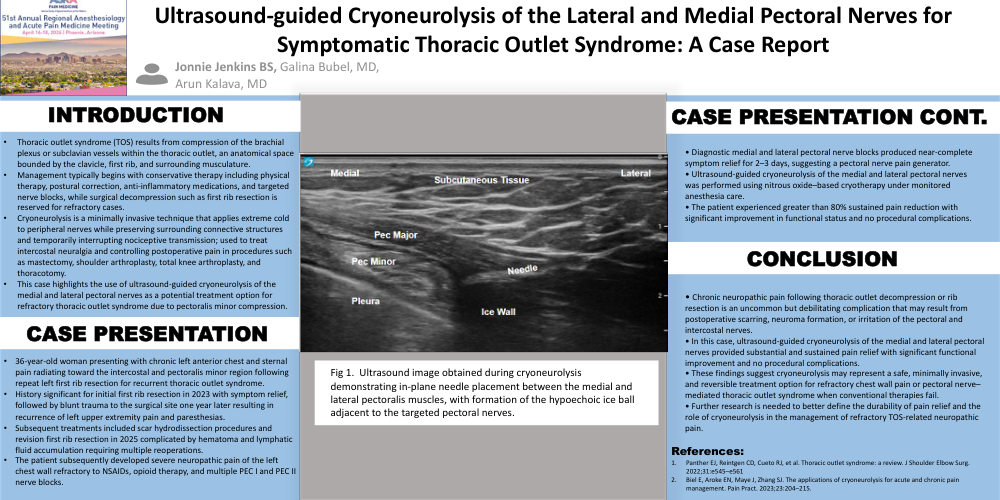
• Ultrasound-guided cryoneurolysis of the medial and lateral pectoral nerves was performed using nitrous oxide–based cryotherapy under monitored anesthesia care.

• The patient experienced greater than 80% sustained pain reduction with significant improvement in functional status and no procedural complications
 

CONCLUSION-

• Chronic neuropathic pain following thoracic outlet decompression or rib resection is an uncommon but debilitating complication that may result from postoperative scarring, neuroma formation, or irritation of the pectoral and intercostal nerves.

• In this case, ultrasound-guided cryoneurolysis of the medial and lateral pectoral nerves provided substantial and sustained pain relief with significant functional improvement and no procedural complications.

• These findings suggest cryoneurolysis may represent a safe, minimally invasive, and reversible treatment option for refractory chest wall pain or pectoral nerve–mediated thoracic outlet syndrome when conventional therapies fail.

• Further research is needed to better define the durability of pain relief and the role of cryoneurolysis in the management of refractory TOS-related neuropathic pain.


References:

1.Panther EJ, Reintgen CD, Cueto RJ, et al. Thoracic outlet syndrome: a review. J Shoulder Elbow Surg. 2022;31:e545–e561
2.Biel E, Aroke EN, Maye J, Zhang SJ. The applications of cryoneurolysis for acute and chronic pain management. Pain Pract. 2023;23:204–215. 
asraspring2026 banner
Copyright © 2015-2026, ePostersLive® SciGen is a registered trademark of SciGen Technologies S.A. Patent pending.

This website and third-party tools we use rely on cookies for the best user experience. By selecting "I agree", you agree to cookie usage as described in our Privacy Policy.
